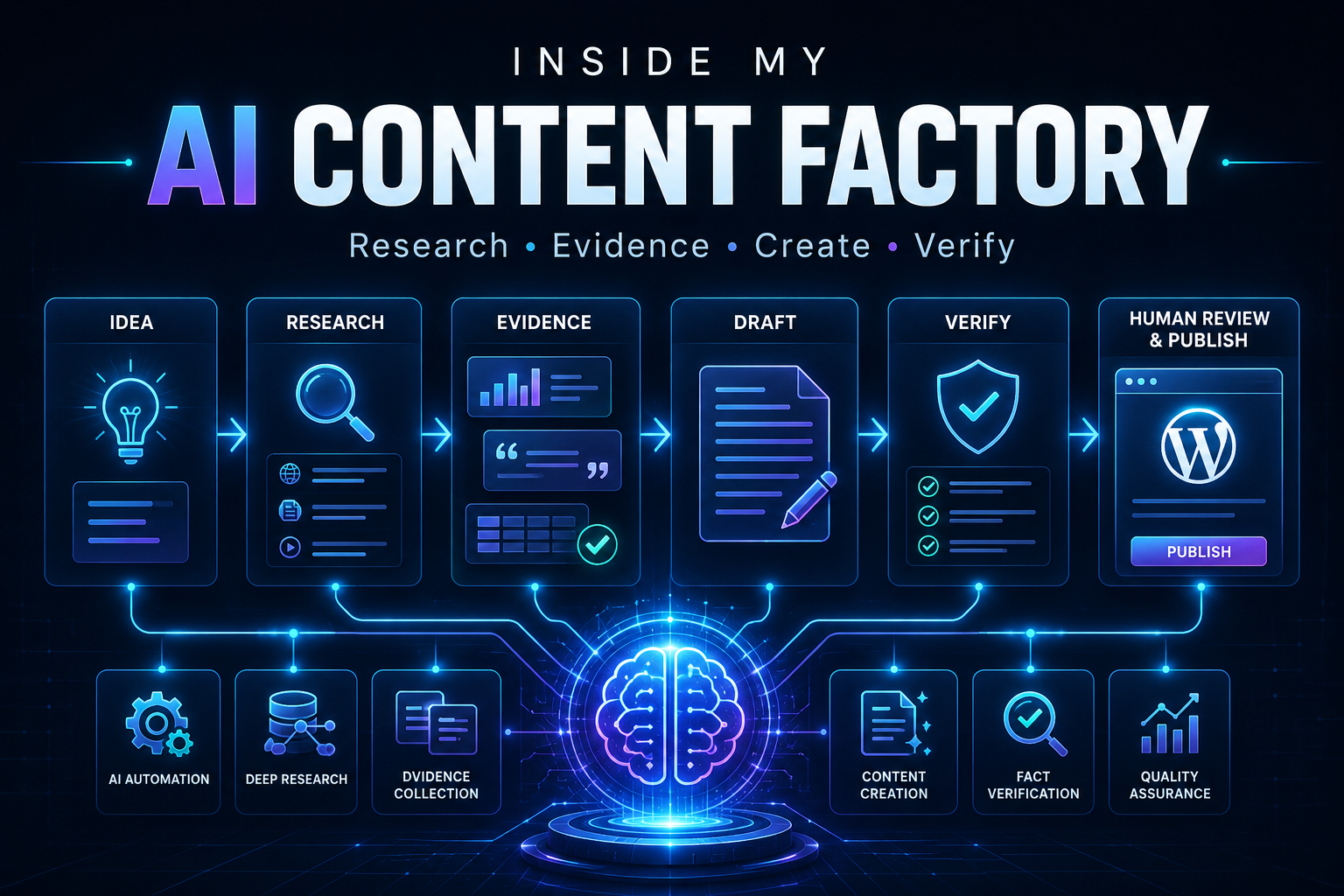
A practical blueprint for turning one content idea into researched, tested, fact-checked and publish-ready content without relying on generic one-click AI writing.
An AI content factory is more than a writing prompt. It is a repeatable production system that researches demand, gathers evidence, creates an outline, produces a draft, verifies factual claims, prepares visuals and pauses for human review before publishing. Claude Code can coordinate that workflow because it can work with files, scripts, browser automation and defined project instructions.
Why an AI Content Factory Needs More Than a Writing Prompt
AI can generate thousands of words in seconds. That is no longer the difficult part. The difficult part is producing something worth publishing: content that answers a real search question, contains useful first-hand material, does not invent facts and still sounds like a person with a point of view.
That is why the strongest AI publishing workflows are moving away from the “enter a keyword and press Generate” model. Instead, the better approach is to build a system around the model. In that system, the AI is one worker; research, evidence, rules and human judgment determine whether the final article is trustworthy.
One idea in, one publishable guide out
A well-designed content factory can begin with a very small instruction. Instead of asking an AI to write the article immediately, the instruction starts a workflow.
Build a complete guide about self-hosting an AI application.
Use the content-factory workflow.
Research first, create the evidence plan, then stop for approval.
The important phrase is not the topic. It is use the workflow. A good factory already knows which stages must happen next. It should know where files belong, what research must be performed, what evidence is required, what it is allowed to automate and when it must wait for a human.
From one idea, the system can produce a keyword brief, competitor-gap notes, an outline, an experiment plan, screenshots, a claims file, a draft, a verification report and a final WordPress-ready article. The goal is not maximum autonomy. The goal is predictable quality.
What is an AI content factory?
An AI content factory is a structured publishing workflow in which an AI model coordinates multiple content-production tasks according to predefined rules. Those tasks can include search research, source collection, browser testing, screenshots, data analysis, drafting, editing, SEO preparation and publishing checks.
A basic AI writer produces text. A content factory produces artifacts around the text. Those artifacts matter because they tell you why a statement is present, where a number came from, which screenshot supports a step and whether the draft passed your own quality requirements.
Prompt-only workflow
Keyword → prompt → AI draft → copy → publish. Fast, but easy to make generic and difficult to audit.
Factory workflow
Idea → demand research → evidence plan → testing → draft → claim verification → human review → publish.
This distinction becomes especially useful for technical tutorials, product reviews, software comparisons, affiliate content and any article where readers expect screenshots, measurements, real examples or exact instructions.
Why build a content factory instead of simply prompting ChatGPT or Claude?
Modern language models are excellent at generating fluent text, but fluency is not the same as proof. If the workflow does not force the model to gather current information or create original evidence, the safest thing it can do is synthesize patterns it already knows.
That is often enough for brainstorming. It is weaker for competitive search content. An article becomes more useful when it contains information another page cannot reproduce by simply asking the same model the same question.
For example, an AI-assisted software tutorial can become substantially more valuable when the workflow actually installs the software, records the steps, captures the error states, tests the recommended fix and saves the screenshots before the article is written.
The advantage of a factory is therefore not merely speed. It is that you can make research and first-hand evidence repeatable.
The five building blocks
You can think of the system as five roles. The exact tools can change, but the roles remain useful across niches.
The written rules, stages, limits and checkpoints that govern every run.
Search data, sources, comments, APIs and research that reveal what people need.
Browser automation and scripts that let the system interact with real tools.
A controlled place where claims can be tested before they appear in the article.
Your voice, standards, experience, positioning and reusable knowledge.
Block 1: The contract
The contract is the operating manual for the factory. In a Claude Code project, this can be a markdown instruction file that explains the stages in plain English.
A useful contract answers questions such as: What must happen before drafting? Which sources are acceptable? What counts as evidence? How are files named? Can the system create paid cloud resources? What is the maximum budget? When must it stop and ask for approval? What checks must pass before publishing?
# Content Factory Rules

1. Never draft before research is complete.
2. Identify the primary search intent and at least three content gaps.
3. Create an evidence plan before running experiments.
4. Never spend money without an approved cost cap.
5. Save screenshots and experiment output inside /evidence.
6. Every factual claim must have a source or experiment reference.
7. Stop for human approval after planning.
8. Stop again before publication.
Notice how little of that is traditional programming. It is process design. You are explaining how a reliable content team should work, and then giving the AI enough tools to execute the repetitive parts.
Block 2: The senses
The senses tell the system what is happening outside the model. For search-focused content, that can include Google results, keyword tools, Google Trends, Search Console data, YouTube comments, Reddit discussions, community questions, product reviews and customer emails.
This stage should answer four things before writing begins: what the reader actually wants, which phrasing people use, what the current top pages already cover and what useful information is still missing.
For your own WordPress site, you can also turn your existing articles into part of the senses layer. The system can identify relevant internal links, outdated posts that should be refreshed and supporting pages that can strengthen a new guide.
Block 3: The hands
The hands are the tools that allow the AI to act instead of only talk. A browser automation tool such as Playwright can open pages, click buttons, fill forms, test interfaces and capture screenshots. Shell scripts can install software, run commands or measure performance. Small Python scripts can clean datasets, generate charts or verify numbers.
This is the stage that turns “I think this works” into “the workflow tested it.”
Block 4: The lab
The lab is wherever your niche can produce first-hand evidence. For a self-hosting article, that may be a disposable cloud server. An SEO article, for example, may use a Search Console export. Meanwhile, an affiliate comparison may use product specifications verified from manufacturer pages plus your own comparison spreadsheet.
Similarly, an email-marketing guide might use a real campaign or sandbox account as its lab. By contrast, a personal-finance calculator might use a spreadsheet with formulas that are stress-tested across multiple scenarios.
Block 5: The brain
Your brain layer is the context the model should not invent. It can contain your preferred writing style, your audience, recurring opinions, examples you have personally approved, formatting rules, disclosure language, brand terminology and internal-link priorities.
A strong brain is also useful for avoiding the lifeless tone many AI articles have. Instead of asking the model to “sound human,” give it actual material that defines how your site communicates.
| Brain file | What it contains |
|---|---|
| voice.md | Sentence style, tone, phrases to avoid, preferred vocabulary. |
| audience.md | Who the site serves, their experience level and common problems. |
| beliefs.md | Your recurring positions and the principles behind recommendations. |
| stories.md | Approved personal examples and facts that may be reused. |
| links.md | Priority internal pages, affiliate disclosures and approved external resources. |
A complete 10-stage content-factory pipeline
Once the five building blocks exist, the factory needs an order of operations. One practical model is a ten-stage pipeline.
Recon should happen before the outline
A common mistake is generating an outline from the keyword before looking at the live search landscape. That can produce a perfectly structured article for the wrong intent.
Instead, let recon influence the outline. If the top results are beginner tutorials, a highly technical comparison may miss the query. If all competing pages explain setup but none explain failure modes, troubleshooting can become your differentiator.
| Recon question | Why it matters |
|---|---|
| What is the primary intent? | Prevents writing the wrong type of page. |
| What do the ranking pages repeat? | Shows the expected baseline readers already receive elsewhere. |
| What questions remain unanswered? | Reveals content gaps worth filling. |
| What can we test ourselves? | Creates a plan for unique evidence. |
| Which internal pages are relevant? | Builds internal linking into the draft from the beginning. |
The plan should include a stop
Automation becomes safer when the workflow is designed around explicit gates. Before the factory spends money, changes a live site or publishes anything, it should stop and show you the plan.
A strong plan can include the proposed title, search intent, thesis, major sections, evidence experiments, screenshots to capture, external sources, internal links, affiliate opportunities and estimated cost.
That single checkpoint prevents a large amount of wasted work. You can reject a weak angle before the system creates a 5,000-word draft around it.
The evidence-first layer: make the article earn its claims
Evidence-first publishing means the draft is downstream from evidence rather than the other way around. Instead of writing a sentence and then searching for something that appears to support it, the system first gathers the proof and then writes only what that proof allows.
One simple way to enforce that is to save all artifacts inside a predictable structure.
/content-factory/
  /articles/
    /ai-content-factory/
      brief.md
      plan.md
      sources.md
      claims.md
      draft.md
      /evidence/
        install-test.txt
        benchmark.csv
        browser-notes.md
      /assets/
        screenshot-01.png
        workflow-diagram.png
      verification.md
Use a claims map
A claims map is a small file or table that connects factual statements in the draft to their supporting evidence. This is one of the most practical ways to reduce hallucinated details.
| Claim | Evidence | Status |
|---|---|---|
| The test installation used 4 GB RAM. | evidence/server-config.txt | Verified |
| The workflow completed successfully after the configuration change. | evidence/run-02.txt | Verified |
| The current pricing starts at a specific amount. | Official vendor pricing page, checked on publish date | Recheck before publish |
| The tool is “the fastest” option. | No defensible source | Remove or qualify |
The last row is the point. The claims map does not only prove statements. It also gives the system a place to admit when a statement is too strong.
Capture failures, not only successful steps
Some of the most useful tutorial content appears when the lab fails. When a command produces an error, save it. If a setting is confusing, capture it. When a product requires an undocumented workaround, verify the workaround and explain it.
Readers often arrive at technical guides because the happy path already failed for them. A factory that records failure states can generate much more helpful troubleshooting sections than a model that only summarizes official documentation.
The anti-slop layer: verification and quality control
Research and experiments improve the draft, but they do not guarantee that the draft uses the evidence correctly. A separate verification stage is still necessary.
I recommend at least four passes.
1. Evidence pass
Check every measurable or factual statement against its receipt.
2. Adversarial pass
Ask a second pass to find overclaims, stale facts, weak logic and missing caveats.
3. Voice pass
Compare the article against your brand rules and remove generic AI phrasing.
4. Technical pass
Check links, headings, schema, HTML, code blocks, image alt text and mobile rendering.
The final human read should remain a hard requirement for content published under your name. AI can inspect more files and run more checks than a person wants to do manually, but the publisher still owns the final recommendation, claim and disclosure.
Build link quality into the workflow
Link building inside an article should not mean filling the page with random outbound URLs. A better system uses three link types deliberately:
| Link type | How to use it |
|---|---|
| Internal links | Connect the article to relevant guides, reviews and category pages already on your site. |
| Primary external sources | Link to official documentation, original studies, product specifications or first-party announcements when factual verification is needed. |
| Affiliate/referral links | Use only where the product or service is relevant; add a clear disclosure and appropriate sponsored/nofollow attributes where required. |
For example, if your article mentions Claude, link to the official Claude page. If it discusses browser automation, the official Playwright documentation is a useful primary resource. Commercial links should only be added when they are relevant, confirmed, and clearly disclosed.
What does an AI content factory cost to run?
The correct answer depends on how much real-world work you ask the factory to perform. A workflow that only researches public sources can be inexpensive. A workflow that launches servers, uses paid keyword APIs, generates images or runs long browser sessions has more variable costs.
| Cost area | Typical role | How to control it |
|---|---|---|
| AI model / coding agent | Planning, scripting, analysis, drafting and verification. | Use project rules and reusable scripts so the model does not rediscover the same process every run. |
| Search / keyword data | Demand research and SERP analysis. | Cache results and pull only the metrics needed for the brief. |
| Cloud lab | Disposable servers and test environments. | Set a hard budget cap and automatic teardown rule. |
| Browser automation | Testing flows and capturing screenshots. | Reuse login state where appropriate and keep scenarios focused. |
| Human review | Final judgment, editorial quality and publication approval. | Let automation organize evidence so review time is spent on decisions, not clerical work. |
The highest-value optimization is usually not reducing a few cents of API usage. It is reducing the amount of human time spent on repetitive research and formatting while preserving the human decisions that affect credibility.
The flywheel: every article can improve the next one
A mature content factory should not start from zero every time. The workflow can save verified lessons, reusable code, preferred formatting, useful sources and internal-link relationships after each run.
Suppose the system discovers a reliable fix while testing a tutorial. After publication, it can propose that fix as a new entry in your knowledge base. You approve it once. Future related articles can then use that verified information without rediscovering it.
The same idea works for WordPress. Every published guide gives the factory more internal-link targets. Over time, it can recommend tighter topic clusters, identify orphaned posts and suggest where older pages should link to the new article.
How to build your own AI content factory
You do not need to reproduce someone else’s exact tech stack. Start with the roles and build the smallest version that can complete one article from beginning to end.
| Block | Question to answer | Examples |
|---|---|---|
| Contract | What are the stages, rules and approval gates? | A markdown SOP, publishing checklist and budget limits. |
| Senses | Where do audience questions and current facts come from? | Search results, keyword data, comments, forums, analytics, official docs. |
| Hands | What can the system test or capture? | Browser automation, scripts, spreadsheets, APIs, screenshots. |
| Lab | Where can you create first-hand evidence? | Cloud server, sandbox account, test campaign, demo store, comparison sheet. |
| Brain | What should the AI know about your site and point of view? | Voice guide, audience profile, approved stories, disclosures, internal links. |
A minimal version you can build first
- Write one workflow file. Define research, planning, drafting, verification and two human checkpoints. Do not over-engineer it.
- Create a claims file for every article. Require a receipt for numbers, product claims, current pricing and technical assertions.
- Create a small brand brain. Start with five files: voice, audience, beliefs, stories and links.
- Add one evidence tool. Browser screenshots are enough for many niches. Technical sites may add disposable servers or scripts.
- Run one article all the way through. The first complete run will reveal which parts deserve automation next.
Example: affiliate product content factory
If your site publishes affiliate buying guides, the lab does not need to deploy software. Your workflow could instead verify each product against manufacturer specifications, collect price ranges, compare warranty information, inspect customer-review themes and generate a structured comparison table.
The factory could require that each “best for” recommendation has a reason tied to verified attributes. It could also generate an affiliate-link map so the final article never accidentally sends one CTA to the wrong product.
Example: SEO content factory
For SEO-focused publishing, the senses become especially important. The factory can combine live SERP research with your Search Console queries, identify pages already receiving impressions and decide whether the better move is a new article or an update to an existing page.
The lab could create small data analyses from your own exports. That produces original charts and examples rather than yet another article that repeats the same third-party statistics.
Example: tutorial content factory
For tutorials, the workflow should refuse to draft step-by-step instructions until the process has been completed in a test environment. Each major step can have a screenshot requirement. Errors are captured automatically and used to create a troubleshooting section.
Want to use this on your WordPress workflow?
Start with one article template, one claims map and one human approval gate. Once that works reliably, add browser automation, richer research and evidence collection.
Explore VanelSylvestre.comHow to Design the Architecture of an AI Content Factory
A reliable AI content factory needs an architecture before it needs more prompts. The architecture defines where information enters, how it is transformed, what evidence is required, which actions an agent may take, and where a human must approve the result. Without those boundaries, automation tends to become a collection of disconnected prompts that are difficult to audit and even harder to improve.
I would separate the system into an orchestration layer, a research layer, an evidence store, a knowledge layer, an asset pipeline, a drafting layer, a verification layer and a publishing layer. These components can live in simple folders at first. The important point is that each stage has a clear responsibility and leaves behind an artifact that the next stage can inspect.
Every important stage should produce something inspectable. Research produces source notes. Experiments produce results. Drafting produces a versioned document. Verification produces an issue report. Publishing produces the final HTML and a record of what went live.
Orchestration Layer
The orchestrator decides which stage runs next. It should know the project status, required inputs, completed checks and approval state. It should not silently skip research because a model believes it already knows the subject. In other words, a useful orchestrator behaves more like a production manager than a writer.
For a small workflow, the orchestrator can be a Markdown checklist and a set of commands. For a larger operation, it may use scripts, an agent framework or a database. Therefore, start with the smallest implementation that gives you reliable state. Complexity is only valuable when it solves a real coordination problem.
Research and Retrieval Layer
The research layer gathers current information that should not be guessed from model memory. This can include official documentation, search results, Search Console exports, customer questions, product specifications, pricing pages and community discussions. The layer should preserve the source URL, retrieval date and enough context to understand what the source actually supports.
However, research is not the same as copying competitors. For example, competitor pages can reveal the questions an audience expects to be answered, but your article should be built from verified sources, your own tests and your own editorial judgment. The research stage should identify gaps rather than manufacture a rewritten version of what already ranks.
Evidence Store
An evidence store gives the drafting and verification stages something concrete to reference. It might contain screenshots, CSV exports, test logs, quotations within permitted limits, source summaries, calculations and notes from hands-on use. Keep evidence close to the project so another reviewer can understand how a statement was produced.
In addition, evidence helps with future updates. Six months later, you can see whether a pricing statement came from an official page, whether a screenshot reflects an older interface, and whether a recommendation was based on a real test or only an editorial opinion.
Knowledge Layer
The knowledge layer contains reusable information that belongs to your business or editorial process: voice rules, approved author information, internal-link destinations, product relationships, disclosure requirements, recurring audience questions and lessons from previous projects. Retrieval should be selective. Loading every note into every article creates noise and can cause unrelated facts to leak into the draft.
For example, a simple tagging system can be enough. For example, a WordPress tutorial might retrieve WordPress publishing rules, your preferred HTML conventions and relevant internal links while ignoring knowledge about an unrelated product category.
How to Build an AI Content Factory for SEO Without Creating Search-Engine-First Content
Importantly, SEO can be part of the production system without becoming the reason the content exists. The useful distinction is between discovering what people need and manufacturing pages only because a keyword exists. Search data can reveal language, problems and unanswered questions. Editorial judgment decides whether your site can provide a genuinely useful answer.
Google’s current guidance on generative AI content emphasizes value for users and warns that generating many pages without adding value can violate its scaled content abuse policy. That makes quality control especially important for an automated publishing system. The goal should be to make research and verification more consistent, not to multiply low-value pages.
Use Keyword Research as Audience Research
As a result, keyword research becomes more useful when you stop treating every phrase as a separate article. Group terms by intent. If several queries ask essentially the same question, one comprehensive page may satisfy them more naturally than five overlapping posts. If the intent is meaningfully different, a supporting article can earn its own place in the cluster.
Record the primary problem, secondary questions, expected format and level of expertise. For example, a beginner tutorial needs definitions and setup steps. By contrast, a comparison needs decision criteria. Meanwhile, a troubleshooting article needs symptoms, causes and fixes. This intent map gives the writing agent a purpose beyond inserting keywords.
Build Search Console Feedback Into the Factory
After publication, Search Console can show which queries and pages are receiving impressions and clicks. However, those observations need context. Feed those observations into the learning stage carefully. A new query can reveal a missing explanation, but one impression should not automatically trigger a new article or a major rewrite.
Use longer-term patterns. If a page repeatedly receives impressions for a relevant question it barely answers, improving that section may help readers. If multiple pages receive impressions for the same intent, review whether they are complementary or unnecessarily competing with one another.
Internal Linking as a Production Step
In addition, internal linking should happen before publication rather than being an afterthought. The planning stage can identify existing pages that explain prerequisites, related tutorials that help the reader continue, and older articles that should link back to the new resource.
Do not allow the system to invent URLs. Maintain a verified internal-link inventory or query the live site. Broken or hypothetical internal links create a poor experience and are exactly the kind of production artifact a verification stage should catch.
Build a Research System the AI Can Audit
Above all, good research is traceable. A useful project does not simply contain a paragraph labeled “research.” It contains a record of what was searched, which sources were selected, why they were considered reliable and which claims they support.
Create a Source Hierarchy
For product capabilities, prefer official documentation. For policies, prefer the organization that publishes the policy. For statistics, look for the original dataset or report when possible. Community discussions are valuable for discovering pain points and real-world experiences, but they should not automatically be treated as authoritative evidence for factual claims.
Your contract can define this hierarchy. When a source is weak, the agent should either find stronger support, qualify the statement or remove it. This simple rule can prevent confident but fragile claims from reaching the draft.
Record Freshness Requirements
Meanwhile, different facts age at different speeds. A definition may remain accurate for years, while software pricing, an interface, an API endpoint or an SEO feature can change quickly. Label volatile claims so the system knows what must be rechecked during a refresh.
Therefore, a content factory should never assume that because a source was valid for the previous article it is still current. Retrieval dates and refresh rules turn maintenance into a predictable process.
Separate Discovery Sources From Evidence Sources
For example, a forum thread might reveal that users struggle with a particular setting. That makes it an excellent discovery source. The final explanation of how the setting works may still be better supported by official documentation and your own test. Separating these roles improves both usefulness and reliability.
Create a Content Brief That Is More Than an Outline
Therefore, the brief is the bridge between research and production. A weak brief lists headings. A strong brief explains the audience, problem, promise, thesis, evidence requirements, original elements, internal links, conversion goal, visual assets and claims that need special verification.
- Primary reader and experience level.
- Problem the article must solve.
- Primary and secondary search intent.
- Unique contribution or first-hand element.
- Required primary sources.
- Experiments or screenshots to create.
- Claims that require verification.
- Existing pages to link to.
- Desired reader action after the article.
- Sections that require human expertise or approval.
As a result, this brief gives the drafting agent constraints. It also gives the human reviewer something concrete to approve before expensive work begins. If the brief cannot explain why the article deserves to exist, adding more automation will not fix the underlying editorial problem.
Evidence-Driven Content: Moving Beyond Generic AI Writing
Consequently, one of the best ways to make an automated article less generic is to improve the inputs. If the model receives only a title and a keyword, it must fill the article from broad patterns. If it receives test results, screenshots, primary documentation, customer questions and your own observations, it can organize material that is specific to the project.
Design Experiments Before Drafting
First, when a claim can be tested, define the test before the article is written. State what you are trying to learn, the environment, steps, expected output and limitations. Save the result whether it confirms or contradicts your initial assumption.
This prevents the common failure mode where a draft makes a strong claim first and research is later used only to justify it. Ultimately, evidence should shape the conclusion, not merely decorate it.
Capture Failures as Useful Information
Sometimes, a failed setup can be more valuable than a perfect demo. Record error messages, unexpected prerequisites and recovery steps. In tutorials, these details often answer the exact questions readers have after generic documentation stops helping.
Likewise, the system should not automatically hide failures because they make the workflow look less polished. Real friction can become troubleshooting content and demonstrates that the process was actually tested.
Turn Raw Evidence Into Reader-Friendly Assets
However, raw logs are useful to the verifier but not always useful to the reader. Instead, convert relevant evidence into concise tables, annotated screenshots, diagrams or examples. Keep the underlying source available internally so the visual summary can be checked later.
A Multi-Layer Verification Framework for AI Content
For this reason, verification works best when different passes have different jobs. Asking one model to write a draft and then asking the same context whether the draft is good can miss systematic errors. Separate the checks and make each reviewer search for a particular failure.
Claim Verification
First, extract important factual claims and map each one to evidence. High-risk statements such as prices, dates, legal requirements, medical claims, financial claims, product capabilities and current software behavior deserve stronger scrutiny than ordinary explanatory prose.
However, if evidence is absent, the verifier should not fabricate a citation. It should return an unresolved issue. Consequently, the editor can research the point, qualify it, or remove it.
Link Verification
Next, check that internal links resolve to real pages and that external links point to the intended source. In addition, for affiliate links, verify the exact tracking destination and disclosure requirements. Do not let an automation “repair” an unknown affiliate URL by guessing.
HTML and Publishing Verification
Then, search the final HTML for placeholders, editor notes, dummy domains, duplicate H1 elements, broken anchors, unclosed tags and raw citation artifacts. Then inspect the rendered page because valid HTML can still produce a poor mobile layout.
Voice and Repetition Verification
Long AI-assisted drafts can repeat the same conclusion in different words. A voice pass should flag repeated openings, generic transition phrases, excessive summaries and sections that add no new information. Removing redundant paragraphs can improve a long article more than adding another thousand words.
Adversarial Fact Review
Give the reviewer permission to disagree. Ask it to identify the strongest unsupported claim, the weakest source, the most likely outdated statement and the section where the conclusion exceeds the evidence. The objective is not to make the draft sound confident; it is to make the published version defensible.
Where Human Review Should Remain Mandatory
In practice, automation is strongest when the decision boundaries are explicit. Human approval should remain mandatory when the system is about to publish under a person’s name, make a consequential claim, recommend a product based on subjective judgment, change an established editorial policy, or take an irreversible external action.
A human should also review anything that depends on personal experience. An AI can organize notes about an experience, but it should not invent first-person testing, emotions, purchases or outcomes.
Approval Gate Before Drafting
First, the initial gate answers: Is this article worth making? Review the thesis, intent, evidence plan and potential overlap with existing pages. Rejecting a weak idea here saves research, API cost and editing time.
Approval Gate Before Publishing
Finally, the last gate answers: Am I willing to put my name on this exact page? Review claims, disclosures, affiliate links, visuals, title, introduction, calls to action and the visitor-facing rendering. In other words, the human is not there merely to click Approve; the human owns the decision.
AI Content Factory Workflow for WordPress
For example, WordPress is a practical publishing target because the final output can be standardized. Decide whether your system produces Gutenberg blocks, one Custom HTML block, or content through an authorized publishing API. As a result, consistency reduces formatting errors.
Separate Content From Theme Responsibilities
Whenever possible, let the theme and SEO plugin handle sitewide elements such as the main page title, canonical tags and much of the structured data. The article body should focus on semantic content. Duplicating page-level elements inside custom HTML can create unnecessary conflicts.
Use a Pre-Publish HTML Checklist
Validate heading hierarchy, responsive tables, image dimensions, alt text, anchor links, external-link attributes, CTA destinations and mobile spacing. Search the raw HTML for known production artifacts before pasting it into WordPress.
Verify the Public Version
Finally, after updating the page, open the actual URL in a private browser window. Check the headline, table of contents, images, buttons and a few links. If you use caching or a CDN, remember that an editor preview and a crawler can temporarily see different versions. The visitor-facing page is the final product that matters.
Using an AI Content Factory for Affiliate Marketing
Additionally, affiliate content adds another layer of verification because the article can influence purchasing decisions and contains commercial tracking links. The factory should distinguish product facts, editorial opinions and commercial relationships.
Maintain an Approved Affiliate-Link Registry
Store confirmed affiliate URLs in a controlled file or database. The drafting system may select from approved links, but it should never create a tracking URL from memory. This protects revenue and reduces the risk of publishing a malformed or unauthorized link.
Separate Product Facts From Recommendations
Specifications can come from manufacturer documentation or verified listings. Recommendations should explain the criteria used and, when applicable, the nature of hands-on testing. Do not claim to have personally used a product when the evidence only contains public specifications.
Keep Disclosures Visible
Commercial relationships should be clear to readers. Build disclosure checks into the template rather than relying on the writer to remember them for every article. Finally, the human review should confirm that disclosure language matches the site’s policy and the programs involved.
Cost Control: Make the Factory Efficient Before Making It Bigger
However, automation can become expensive when every stage uses the largest model, repeated searches and unnecessary browser sessions. Track cost by project and by stage. You may discover that research or screenshot generation costs more than drafting, or that a verification pass is repeatedly processing unchanged content.
Route Tasks by Difficulty
For example, use capable reasoning models for ambiguous planning and difficult verification. Simpler deterministic scripts can handle file naming, HTML checks, duplicate detection and other mechanical tasks. Not every operation needs an AI call.
Cache Stable Knowledge
Likewise, your voice guide and approved internal-link inventory do not need to be rediscovered for every article. Store stable information and retrieve it selectively. Current facts such as pricing or product availability should still be refreshed when required.
Measure Cost Per Approved Article
However, generation cost alone is misleading. Track the total cost required to reach a publishable page, including failed runs and human editing time. A cheaper model that creates hours of cleanup may be more expensive than a stronger model used selectively.
Security and Permissions in Agent-Based Content Workflows
As a result, when the factory gains browser, file and publishing access, permissions become part of editorial quality. Give each component only the access required for its job. A research agent usually does not need permission to publish a WordPress post, and a formatting script does not need access to billing information.
Protect Credentials
First, keep API keys and passwords outside prompts and article files. Use environment variables, secret managers or the credential system provided by the platform. Logs should avoid printing secrets, and screenshots should be reviewed for tokens, email addresses or account information before publication.
Use Staging Environments
In addition, when an agent is testing WordPress plugins, ecommerce settings or code, use a staging environment whenever practical. This limits the consequences of a bad action and gives the system a safe place to capture evidence.
Require Confirmation for External Actions
Finally, publishing, deleting content, sending messages, changing DNS, making purchases or modifying production settings should have explicit controls. Therefore, a content factory should be autonomous where mistakes are reversible and supervised where they are consequential.
How to Measure Whether Your AI Content Factory Is Actually Better
Although speed is easy to measure, it should not be the only success metric. A factory that produces ten weak articles per day is not necessarily better than a workflow that produces two durable resources per week.
Production Metrics
First, track time from idea to approved brief, brief to draft, draft to verified version and verified version to publication. Count revision cycles and unresolved verification issues. These metrics reveal bottlenecks in the system.
Quality Metrics
Next, track factual corrections after publication, broken-link rate, editor-note incidents, percentage of important claims with evidence and the amount of human rewriting required. As a result, quality metrics help you improve the contract instead of blaming every failure on the model.
Audience and Business Metrics
Then, depending on the site, monitor organic clicks, engaged sessions, newsletter subscriptions, affiliate clicks, leads or sales. Compare pages by intent and age rather than assuming every article should produce the same outcome.
Learning Metrics
Finally, record how often a lesson from one project prevents a problem in a later project. Over time, the factory becomes more valuable when knowledge compounds. A recurring error that appears in ten articles is evidence that the workflow needs a rule, not ten separate manual fixes.
How to Scale an AI Content Factory Without Scaling Mistakes
Therefore, scale only after one production line is reliable. After all, increasing volume multiplies both strengths and defects. If the workflow invents links one percent of the time, hundreds of articles can turn a small failure rate into a serious cleanup project.
Standardize Before Parallelizing
First, document the stages, inputs, outputs and approval criteria. Run several projects through the same process and fix recurring failures. Only then allow multiple projects to move through the pipeline at once.
Use a Production Ledger
In addition, every project should have an owner, stage, status, last action, next action and approval state. In addition, a ledger prevents two agents from editing the same file and makes abandoned projects visible.
Set Stop Conditions
Most importantly, an agent should stop when evidence is insufficient, a source conflicts with another source, credentials are missing, a requested action exceeds permission or a human decision is required. Therefore, knowing when not to continue is a core automation capability.
Audit Samples After Scaling
Finally, do not assume that a workflow remains reliable because the first five articles looked good. Periodically sample published pages, inspect raw HTML, verify claims and test links. Use findings to update the contract and verification rules.
Reusable Templates for an AI Content Production System
As a result, templates make expectations explicit and reduce the amount of instruction that must be recreated for every project. Keep them short enough that people actually maintain them.
Research Record Template
QUESTION:
What must the article establish?

SOURCE:
Official URL or internal evidence file

RETRIEVED:
Date checked

SUPPORTS:
Exact claim or section supported

LIMITATIONS:
What this source does not prove
Experiment Record Template
GOAL:
What are we testing?

ENVIRONMENT:
Software, version, account type or setup

STEPS:
Repeatable procedure

RESULT:
What actually happened?

EVIDENCE:
Screenshot, log, export or calculation

LIMITATIONS:
Conditions that may change the result
Verification Report Template
CRITICAL:
Unsupported or dangerous claims

HIGH:
Broken links, incorrect facts, missing disclosure

MEDIUM:
Ambiguous wording, weak source, outdated screenshot

LOW:
Style, repetition, formatting

STATUS:
Pass / revise / human decision required
The templates are intentionally plain. Ultimately, the value comes from consistent use, not from turning every project into paperwork.
A Practical 90-Day AI Content Factory Implementation Plan
Days 1–15: Document the Current Workflow
Before automating anything, write down how an article is produced today. Identify research sources, repetitive tasks, approval decisions, publishing steps and common mistakes. For example, choose one article type for the pilot rather than trying to support every niche at once.
Days 16–30: Build the Minimum Factory
Create the contract, project folder structure, research template, evidence folder, author knowledge files and final verification checklist. At first, automate only a few mechanical steps. Run one real article through the entire process and record every failure.
Days 31–45: Add Evidence and Browser Work
Introduce controlled browser automation where it genuinely creates value, such as capturing software screenshots or verifying a public setting. Meanwhile, keep production credentials restricted and test on staging accounts.
Days 46–60: Improve Verification
Add claim extraction, link checks, placeholder searches and an adversarial review. Then, compare automated findings with human review. If the human repeatedly finds the same missed problem, turn it into a new explicit rule.
Days 61–75: Connect Publishing
Standardize WordPress-ready output and create a pre-publication package containing HTML, title, meta description, image requirements, disclosure information and verification status. Finally, keep publication approval human-controlled.
Days 76–90: Measure and Scale Carefully
Review cost, production time, revision count and early audience metrics. Decide which stages are stable enough to run in parallel. Therefore, scale the reliable components, not the entire workflow indiscriminately.
Advanced AI Content Factory Questions
Should an AI content factory publish automatically?
It can technically be designed to do so, but automatic publication increases the cost of mistakes. For most editorial sites, I prefer a final human approval gate. The system can prepare everything required for publication while leaving the consequential decision to a person.
How long should an AI-generated article be?
There is no useful universal target. The article should be long enough to solve the reader’s problem and no longer. A complex implementation guide may need thousands of words, while a narrow answer may need only a few paragraphs. Do not add filler to reach a number.
Can I use multiple AI models in one factory?
Yes. Different models can be assigned to planning, coding, research synthesis or review. Multiple models do not automatically create better verification, however. The workflow still needs evidence and explicit criteria.
What should never be stored in the AI knowledge base?
Avoid storing passwords, API secrets, private customer data or information the system does not need. Separate editorial knowledge from credentials and sensitive operational data.
How do I stop the system from inventing links?
Require URLs to come from a verified retrieval result, an approved affiliate registry or a current internal-link inventory. If no verified URL exists, the system should leave the link unresolved for human review rather than guessing.
How do I prevent duplicate articles?
Search the existing content inventory before approving a new brief. Compare intent, not only titles. If an existing page already solves the same problem, improve it or define a genuinely distinct angle.
Can the factory update old articles?
Yes, and refresh workflows can be extremely valuable. The system can identify volatile claims, check links, compare current documentation, flag outdated screenshots and propose changes. Preserve human review so a refresh does not accidentally remove important historical context or change the page’s intent.
Does AI-assisted content automatically hurt Google rankings?
No. Google’s published people-first content guidance focuses on whether content is useful and whether automation is being used to manipulate rankings at scale. AI assistance does not remove the need for originality, accuracy, value and compliance with spam policies.
What is the biggest mistake when building a content factory?
Automating volume before quality control. A system that can produce content quickly can also produce mistakes quickly. Build the contract, evidence process and verification gates before increasing throughput.
What makes the system improve over time?
A controlled learning loop. After each project, identify lessons worth preserving, review them, and add approved knowledge or rules to the system. Do not let every model observation become permanent truth automatically.
Frequently asked questions
Core AI Content Factory Questions
What is an AI content factory?
It is a repeatable system around an AI model that handles research, planning, evidence collection, drafting, verification and publishing preparation according to predefined rules. The model creates the text, but the surrounding workflow controls quality.
How is this different from asking ChatGPT or Claude to write an article?
A normal prompt usually asks the model to move directly from topic to prose. A factory inserts research, evidence, checkpoints and verification before publication, which makes the output easier to audit and more useful for high-stakes factual content.
Do I need Claude Code?
No. Claude Code is useful because coding agents can work with project files, commands and scripts, but the architecture can be implemented with other agent frameworks or automation tools. The important part is the workflow design.
Implementation and Publishing Questions
How do I reduce AI hallucinations?
Require factual claims to point to a source or evidence artifact, separate drafting from verification, use primary sources for current facts and keep a human final review before publication.
Can this be used for affiliate marketing?
Yes. An affiliate workflow can verify product details, maintain a product-link map, create comparison tables, enforce disclosure rules and flag pricing or availability claims for rechecking before publication.
Can an AI content factory work outside the technology niche?
Yes. Replace the technical lab with whatever creates evidence in your niche: a spreadsheet model, a demo account, a product comparison process, an email experiment, an analytics export or another controlled test.
Should the system publish automatically?
For most independent publishers, automatic drafting is much safer than automatic publishing. Keep a final review gate so you can verify recommendations, disclosures, factual claims and layout before the page goes live.
Editorial note: This guide is an independent educational article inspired by modern evidence-first AI publishing workflows. Product names and trademarks belong to their respective owners. Always verify current pricing, terms and technical documentation before publishing factual claims.




Pingback: AI Trading Engine Review 2026: Features, How It Works & Pricing
Pingback: How to Self Host n8n on a VPS: Complete Guide (2026)