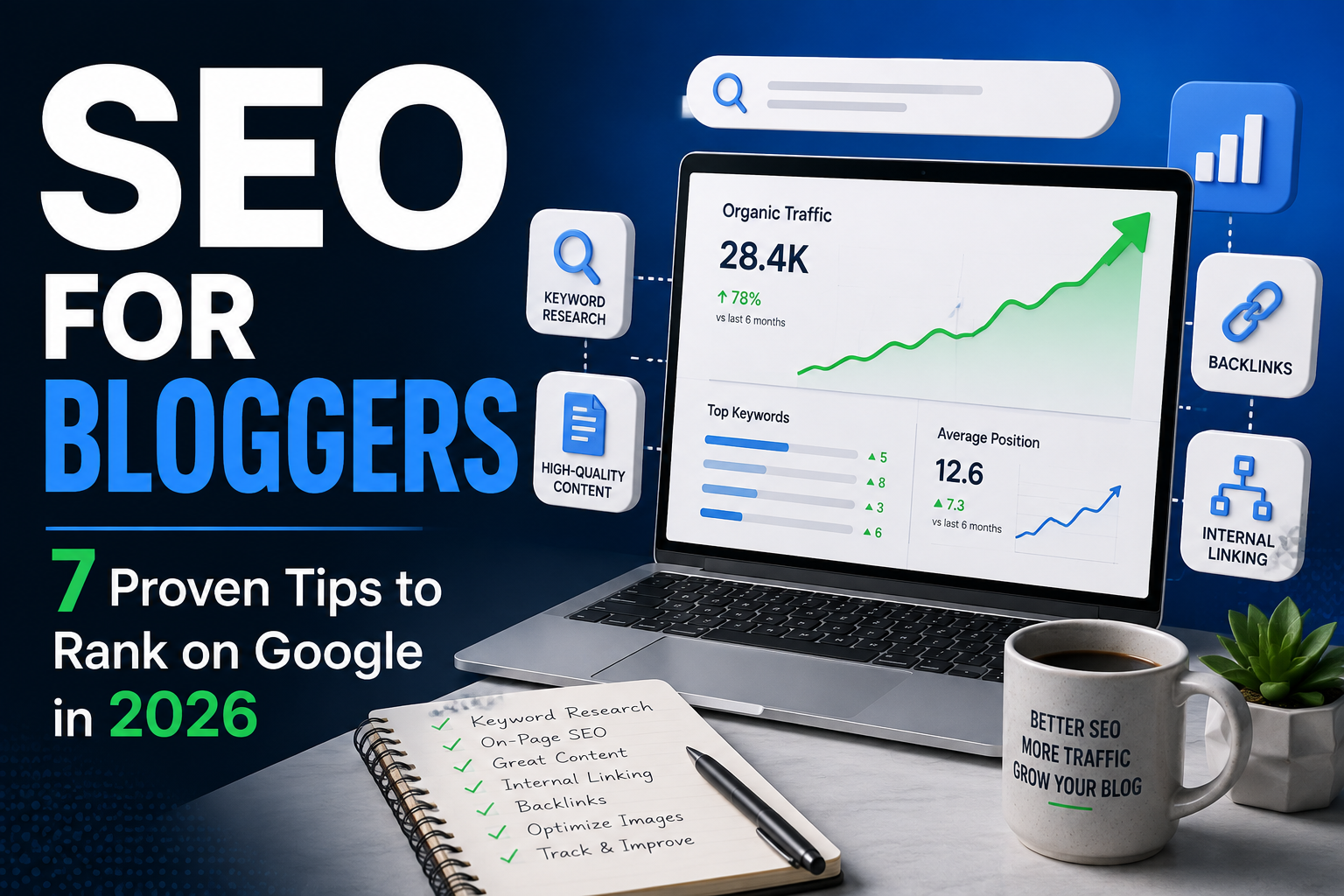
SEO for Bloggers: 7 Practical Ways to Optimize Your Content and Grow Organic Traffic
A practical, business-focused guide to keyword research, search intent, on-page SEO, content quality, internal links, backlinks, image optimization, and the technical details that help blog posts compete in modern search.
Getting traffic from Google used to feel simple: choose a keyword, publish a long article, build a few backlinks, and wait. That approach is no longer enough. Search engines now evaluate whether a page actually satisfies the person behind the query, whether the site demonstrates real topical depth, whether the content is easy to navigate, and whether other trusted pages consider it worth referencing.
Put This Step Into Practice
That sounds like more work, but it creates an opportunity for serious bloggers. You do not need to publish hundreds of posts. You need a repeatable system for publishing pages that answer the right searches, make the answer easy to understand, and connect naturally to the rest of your website.
However, If you treat your blog like a business, organic search can become a compounding acquisition channel. A well-built article can attract visitors for months or years, introduce those visitors to related pages, grow an email list, and eventually generate revenue through services, digital products, ads, sponsorships, or affiliate marketing.
1. Start With Keyword Research — Then Validate Search Intent
Keyword research is where blog SEO begins, but keyword volume alone should never decide what you publish. A phrase can receive thousands of searches and still be a poor target if the people searching it want a type of page you are not planning to create.
For example, a search like best email marketing software usually suggests commercial comparison intent. The reader likely wants a shortlist, pricing differences, pros and cons, screenshots, and a recommendation. A search like how does email automation work is more informational. The person probably wants an explanation, examples, and a simple process.
Choose one primary keyword and a small topic cluster
Instead of forcing the same keyword into every paragraph, choose one clear primary phrase and then identify several supporting concepts. Those related concepts help you cover the subject naturally while giving search engines additional context.
In addition, Newer websites usually benefit from specific long-tail phrases because they are easier to satisfy precisely. A phrase such as SEO checklist for a new food blog gives you a much clearer content target than a broad term like SEO.
How to check the real search intent
Before writing, search the keyword and inspect what currently ranks. Are the results tutorials, product roundups, category pages, tools, videos, local listings, or forum discussions? Google is giving you a strong clue about what users repeatedly choose for that query.
2. Put Your Main Topic in the Places That Matter Most
Once you know what the article is about, make that topic obvious. Search engines should not have to guess. Your title, URL, introduction, headings, image descriptions, and internal anchor text can all reinforce the page’s subject without turning the article into keyword soup.
Title tag
For example, Your SEO title is one of the strongest signals describing the page. Place the main topic near the beginning when it reads naturally, then use the remaining space to communicate a benefit, angle, date, audience, or reason to click.
A weak title says: Some Great SEO Advice You Need to Know. A stronger title says: SEO for Bloggers: 7 Ways to Grow Organic Traffic in 2026. The second version makes the topic, audience, and promise clear immediately.
URL slug
Keep the URL short, readable, and stable. Avoid unnecessary dates, stop words, or long strings of categories. A clean structure such as /seo-for-bloggers/ is easier to share and easier to keep if you update the article later.
Headings and body copy
As a result, Your H2 and H3 headings should work like signposts. A reader who scans only the headings should still understand the article. Use related phrases in headings when they fit, but focus on clarity first.
Meta description
A meta description is primarily a click-through tool. Explain what the page offers and why it is useful. Google may rewrite the snippet, but a strong description still gives search engines and social platforms useful context.
| Element | Recommended approach | Common mistake |
|---|---|---|
| SEO title | Lead with the topic and a clear benefit. | Writing a clever headline that hides the keyword. |
| URL | Short, descriptive, lowercase slug. | Using dates or long category paths unnecessarily. |
| H1 | One clear main headline for the page. | Multiple competing H1 headings. |
| H2/H3 | Organize the answer into logical sections. | Repeating the exact keyword in every heading. |
| Meta description | Describe the value and match the query intent. | Stuffing keywords with no reason to click. |
3. Create Content That Deserves to Be the Result
Word count is not a ranking strategy. A long article can still be weak if it repeats itself, avoids the main question, or adds paragraphs only to reach an arbitrary target. Strong content earns its length by solving more of the reader’s problem.
Therefore, For a competitive informational query, that often means including definitions, a clear process, examples, visuals, tradeoffs, FAQs, recommended next steps, and links to deeper resources. For a product comparison, it may mean first-hand testing details, pricing, use cases, alternatives, and who should avoid each option.
Build information gain into the article
If your page only paraphrases what the top ten results already say, it gives search engines little reason to replace them. Add something useful that comes from your own research or organization of the topic.
- Original screenshots showing a real process.
- A mini case study from your own website.
- A comparison table that saves the reader time.
- A checklist built from practical experience.
- Current examples rather than generic theory.
- A clear opinion explaining which approach you would choose and why.
Format for humans before search engines
Large blocks of text are difficult to read on mobile. Break complex ideas into short paragraphs, descriptive headings, tables, lists, callout boxes, and visuals. The goal is not to decorate the page; it is to make comprehension faster.
Need dependable WordPress hosting for a growing blog?
Meanwhile, Fast pages, reliable uptime, backups, and a good WordPress workflow make SEO execution easier. If you are still choosing hosting, you can review Hostinger through my affiliate link.
Check Hostinger4. Build an Internal Linking System, Not Random Links
Internal links are one of the most controllable parts of blog SEO. They help readers discover related information, help search engines crawl deeper into your site, and give context about which pages are most important.
The key is relevance. Do not insert ten unrelated links because a plugin suggests them. Link when the next page genuinely helps the person reading the current sentence.
Use a hub-and-spoke structure
More importantly, A strong content hub starts with a broad pillar page and connects it to narrower supporting articles. The supporting articles then link back to the pillar when relevant. This creates a logical topical neighborhood.
Anchor text should describe the destination
“Click here” gives little context. A phrase like learn how to start a blog tells both the reader and search engine what the linked page is likely about. Keep it natural; you do not need to force exact-match anchors every time.
You can also use internal links commercially. An informational guide may link to a comparison article, which may then link to a product or affiliate offer. That creates a reader journey instead of expecting a cold visitor to buy immediately.
5. Earn Backlinks Through Assets, Outreach, and Relationships
In practice, Backlinks remain valuable because a link from another relevant website can act as a vote of confidence and a discovery path. But the quality, context, and legitimacy of the link matter far more than raw link counts.
The safest long-term approach is to give people a real reason to reference your page. That could be a statistic, calculator, template, original image, study, glossary, expert quote, or unusually useful guide.
Four backlink methods that fit bloggers
- Guest contributions: write genuinely useful content for relevant publications and include a contextual link when editorially appropriate.
- Original data: survey an audience, analyze public data, or publish a small industry benchmark that others can cite.
- Resource outreach: find pages already linking to resources similar to yours and explain why your page may help their readers.
- Relationship building: participate in your niche before asking for anything. Share useful work, contribute insights, and collaborate.
Create pages people naturally cite
Writers need sources. If you publish concise data, definitions, examples, or charts that are easier to reference than what already exists, you increase your chances of earning links without asking for every one manually.
However, One good tactic is to turn a recurring question in your niche into a small evergreen resource. A finance blogger might publish a calculator. A marketing blogger might publish benchmark statistics. A travel blogger might create a detailed packing checklist by destination and season.
6. Convert Search Traffic Into an Audience You Own
Ranking is useful, but your relationship with a Google visitor can disappear after one session. Email gives you a way to continue that relationship without depending on the person finding you in search again.
Place subscription opportunities where they make sense rather than covering the page with popups. A targeted content upgrade usually performs better than a generic “join my newsletter” form because it continues the topic the reader already cares about.
Lead magnet ideas for bloggers
- A one-page SEO publishing checklist.
- A keyword research worksheet.
- A blog post outline template.
- A 30-day content calendar.
- A list of outreach email frameworks.
Turn each blog post into a traffic pathway
In addition, Use your content to move a reader from search → useful answer → related article → email list or offer. That is how SEO becomes part of a business rather than just a pageview strategy.
Jump to the SEO checklist7. Optimize Images, Performance, and Page Experience
Images can strengthen a blog post, but oversized images can also slow it down. Resize images to the dimensions you actually need, compress them before uploading, use modern formats such as WebP when practical, and lazy-load images that appear below the fold.
Use descriptive file names and alt text
A file name such as seo-keyword-research-process.webp is more useful than IMG_4837.webp. Alt text should describe what is visible or the function of the image. Do not stuff keywords into every alt attribute.
For example, an image showing a keyword research dashboard might use alt text such as: Keyword research dashboard comparing search volume and competition. That description is useful for accessibility and gives search engines meaningful context.
Do not ignore Core Web Vitals and mobile usability
For example, Your theme, page builder, fonts, scripts, ads, and images all affect performance. A beautiful blog that jumps around while loading or becomes difficult to use on a phone creates a poor visitor experience.
Bonus: Refresh Existing Posts Before Publishing Endless New Ones
One of the most overlooked SEO opportunities is updating content you already have. An older page may already possess backlinks, history, internal links, and some rankings. Improving it can sometimes create faster results than starting from zero.
Look for pages that rank on page two, posts losing traffic, articles with outdated screenshots, and pages targeting keywords whose search results have changed significantly. Then improve the parts that no longer satisfy the query.
A practical content refresh process
- Re-check the main keyword and search intent.
- Compare the article with the current top results.
- Remove outdated or redundant sections.
- Add missing questions, examples, tables, or visuals.
- Update internal links in both directions.
- Improve the title and description if click-through is weak.
- Republish only after the page is materially better.
SEO for Bloggers FAQ
What is the most important SEO rule for bloggers?
As a result, Match the searcher’s intent and make your page genuinely useful. Technical optimization can help search engines understand a page, but it cannot rescue content that fails to answer the question the user actually asked.
How many keywords should I target in one blog post?
Usually one primary topic plus a small group of closely related subtopics is enough. You can naturally rank for many keyword variations without creating a separate paragraph for each phrase.
How long should an SEO blog post be?
As long as necessary to satisfy the query without padding. Competitive topics may require a comprehensive guide, while a narrow question can often be answered well in a much shorter article.
Do bloggers need coding knowledge for SEO?
Therefore, No. Most day-to-day blog SEO can be handled inside WordPress and standard SEO tools. Basic HTML knowledge is useful for troubleshooting headings, links, structured data, and page performance, but it is not a requirement to begin.
Are backlinks still important?
Links from relevant, trustworthy pages can still help establish authority and discovery. Focus on legitimate editorial links and useful relationships rather than mass-produced link schemes.
How often should I update old articles?
There is no universal schedule. Update when information becomes outdated, rankings decline, the search intent changes, or you have meaningful new information that can improve the page.
Can a new blog rank in Google?
Meanwhile, Yes, but new sites usually need patience and a focused strategy. Start with specific topics you can answer exceptionally well, build topical depth, improve internal linking, and gradually earn references from other sites.
SEO for Bloggers: Final Takeaways
Successful blog SEO is a system. Research a topic people actually search for. Understand why they are searching. Build the strongest useful answer you can. Make the page easy to understand, connect it to related content, and give other sites a reason to reference it.
You do not need to master every technical detail before publishing. Start with the fundamentals: search intent, helpful content, clean on-page optimization, internal links, legitimate backlinks, strong page experience, and consistent updates.
More importantly, Most importantly, connect traffic to a business objective. Organic visitors become far more valuable when your site helps them take a sensible next step—reading another guide, joining your email list, requesting a service, or evaluating a product you genuinely recommend.
Last updated: August 2026.




Pingback: Affiliate Marketing for Beginners: Step-by-Step Guide (2026)
Pingback: How to Start a Successful Blog in 2026: Beginner Guide
Pingback: 7 Best Passive Income Ideas to Make Money in 2026 - Vanel Sylvestre
Pingback: 25 Best Work From Home Jobs in 2026 (Remote Careers)
Pingback: Passive Income Online: 17 Ways to Make Money From Home
Pingback: 25 Side Hustles for Passive Income to Start in 2026
Pingback: 21 Passive Income Ideas for Stay-at-Home Moms in 2026
Pingback: 17 Passive Income Ideas for Couples to Build Together - Vanel Sylvestre
Pingback: 25 Passive Income Ideas With No Money to Start in 2026 - Vanel Sylvestre
Pingback: 19 Passive Income Ideas for Students With Little Money - Vanel Sylvestre
Pingback: 15 Passive Income Business Ideas You Can Start From Home - Vanel Sylvestre
Pingback: 17 Digital Passive Income Ideas That Can Make Money While You Sleep - Vanel Sylvestre
Pingback: Website Passive Income: 15 Ways to Make Money in 2026
Pingback: Canva Passive Income: 21 Ideas to Make Money in 2026
Pingback: 15 Passive Income Ideas With $100 or Less in 2026
Pingback: Garmin Venu 4 45mm Review 2026: Features, Battery & Buying Guide - Vanel Sylvestre