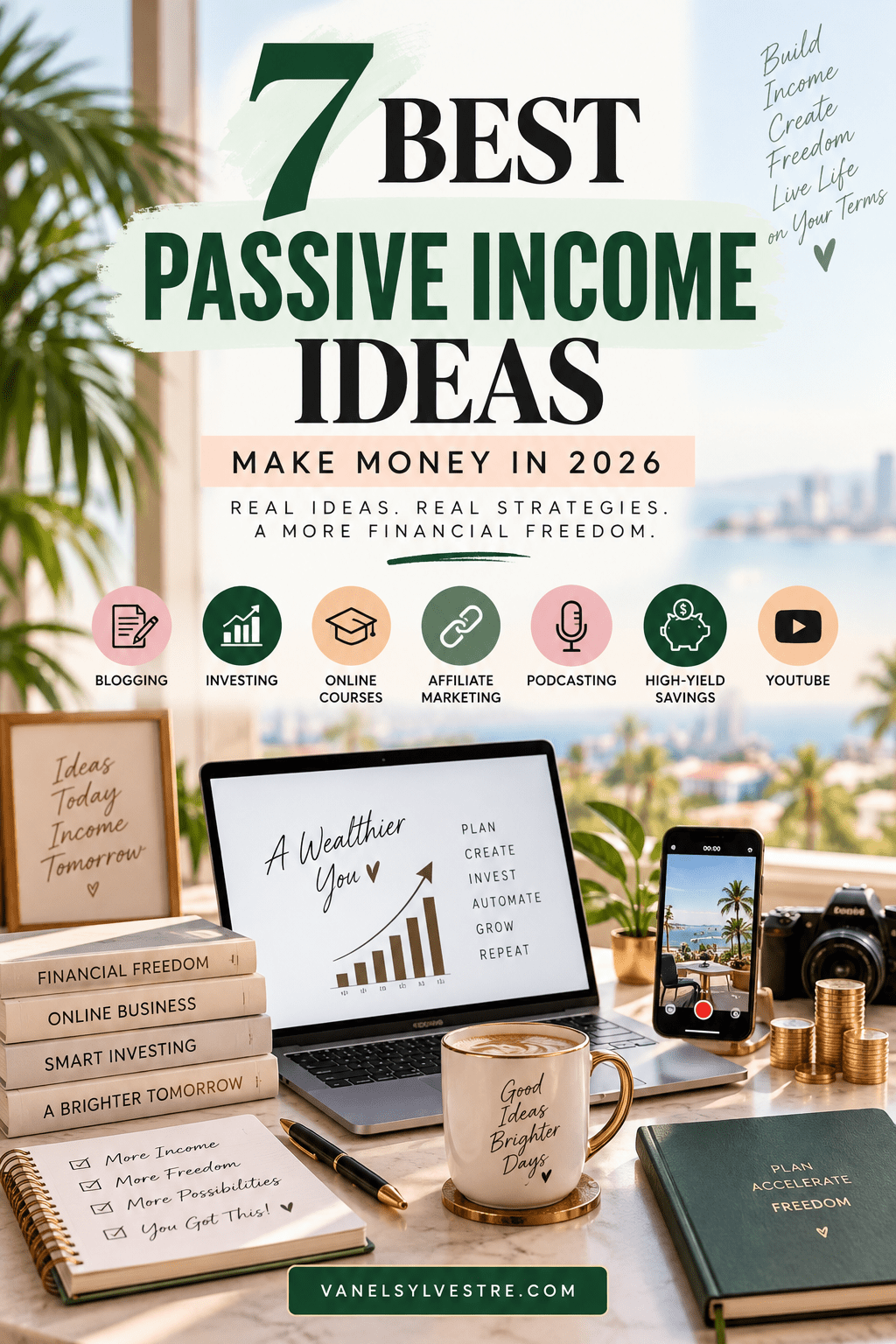
7 Best Passive Income Ideas to Make Real Money in 2026
The best passive income ideas can create recurring revenue without requiring you to trade every hour for money. This 2026 guide compares blogging, affiliate marketing, YouTube, online courses, investing, podcasting, and savings so you can choose a realistic path based on your time, skills, capital, and risk tolerance.

Why I Wrote This Passive Income Guide
I’m Vanel Sylvestre. I am a real estate investor, business owner, and affiliate marketer with more than 10 years of experience in online marketing. Over that time, I have used online marketing tools and affiliate strategies to generate thousands of dollars online. That experience is why this guide focuses on the difference between an idea that sounds passive and a system that can actually become easier to maintain over time.
Personal-results disclosure: The $300,000+ figure reflects my own 2025 affiliate-marketing results as reported from my business records. It is not a typical-results claim, a guarantee, or a promise that readers will earn the same amount.
I do not believe passive income means “money with no work.” In my experience, the strongest online income streams usually begin with active work: choosing a market, publishing useful content, building traffic, testing offers, improving conversion paths, and maintaining what works. The goal is to create assets and systems that can keep producing value without requiring you to restart from zero every day.
Editorial standard: income examples in this article are educational scenarios, not guarantees. Financial products and tax topics are linked to primary or authoritative sources where appropriate, and affiliate relationships are disclosed.
Passive Income Idea Finder
Use this quick tool to narrow the list based on your starting position. It is a decision aid, not an earnings prediction.
Passive income sounds simple: build or buy an asset once, then let it keep producing income with less day-to-day effort. In reality, the best passive income ideas are rarely completely passive. A blog needs content updates. Rental property needs management. A YouTube library needs new videos. An online course needs customer support and occasional refreshes. Even a savings account needs you to compare rates, understand protections, and decide where your cash belongs.
The goal is leverage: separating what you earn from the hours you personally work. If you create a useful article that brings visitors for three years, record a course that sells while you sleep, publish a YouTube video that keeps generating views, or own an investment that pays distributions, your previous work or capital is doing part of the work for you.
This guide focuses on seven realistic paths. Some require money. Others require time. Another path may require a skill you can package into content. None is guaranteed. The right choice depends on your starting capital, tolerance for risk, willingness to learn, and how quickly you need cash flow.
What Are Passive Income Ideas, Really?
The phrase “passive income” gets used for very different things. In everyday business language, it can mean revenue that continues after the main production work is finished. In U.S. tax law, however, “passive activity” has a more specific meaning tied to participation and rental activities. The IRS explains those rules in Publication 925. Those concepts overlap, but they are not interchangeable.
For an online entrepreneur, a better working definition is this: passive income is income produced by an asset, system, or body of work that does not require a new hour of labor for every new dollar earned. That asset might be a website, a catalog of videos, a course, a library of downloadable products, intellectual property, or invested capital.
The distinction matters because it protects you from get-rich-quick marketing. If somebody promises meaningful income with no work, no capital, no audience, no risk, and no learning curve, the economics usually do not make sense. Sustainable passive income normally asks you to invest at least one of four things first: time, money, expertise, or distribution.
Time
You create content, learn a platform, build systems, or develop a product before the income becomes predictable.
Money
You invest capital in savings, securities, real estate, equipment, software, or outsourcing.
Expertise
You package knowledge into tutorials, courses, consulting funnels, templates, or recommendations people trust.
Distribution
You build traffic, search visibility, an email list, subscribers, partnerships, or an audience that can repeatedly discover your offers.
Systems
You automate delivery, payments, email sequences, publishing, customer onboarding, and recurring maintenance.
Patience
Compounding usually matters more than one viral week. Many durable income streams become useful only after months or years.
The realistic goal is not “money for nothing.” The goal is to do work once, build an asset, and let that asset keep working longer than you do.
Active income vs. semi-passive income vs. passive income
Think of income on a spectrum. A freelance project is active because you usually get paid for a specific deliverable. By contrast, a blog is semi-passive because old posts can keep earning, but the site still needs strategy and maintenance. From an operating perspective, a diversified investment portfolio may be more passive, but it requires capital and exposes you to market risk.
This spectrum is useful because it changes how you design your strategy. A beginner who needs money next month should not depend on a brand-new blog or YouTube channel. Active work such as freelancing, consulting, or services may generate cash faster. You can then use that cash to fund assets that become more passive over time.
How to Choose the Right Passive Income Ideas
The best passive income idea is not automatically the one with the biggest upside. It is the one that matches your resources and gives you a realistic chance of staying with the process long enough to see results. Before choosing, score each idea on startup cost, time to first revenue, scalability, risk, maintenance, and whether you already have an unfair advantage such as professional experience or an existing audience.
Choose by What You Have More Of: Time or Capital
Decision framework| Income idea | Startup cash | Time to meaningful results | Ongoing work | Passive potential | Main risk | Best for |
|---|---|---|---|---|---|---|
| Blog / content business | Low to moderate | Months | Moderate | High after a content library matures | Traffic and ranking volatility | Writers, marketers, niche experts |
| Investing | Varies; capital required | Years for compounding | Low to moderate | High operationally | Market / property / liquidity risk | People with investable savings |
| Online course | Low to moderate | Weeks to months | Moderate | High after validation and automation | Weak demand or distribution | People with teachable expertise |
| Affiliate marketing | Low | Months | Moderate | High for evergreen content | Program changes and traffic dependency | Reviewers, publishers, creators |
| Podcast | Low to moderate | Months to years | Moderate to high | Medium | Slow audience growth | Strong communicators and interviewers |
| High-yield savings | Capital required | Immediate interest accrual | Very low | Very high operationally | Rates, inflation, institution limits | Emergency funds and short-term cash |
| YouTube | Low to moderate | Months | Moderate to high | High for evergreen libraries | Algorithm and monetization changes | Teachers, entertainers, visual creators |
Use the “cash flow first, assets second” model
If you are starting with little money, the fastest route is often to use a skill to create active income, then reinvest part of that income into assets. For example, you might offer a service, use the profit to launch a website, publish content that ranks for commercial searches, build an email list, and later create a course. Over time, your income mix can shift from mostly active to increasingly asset-driven.
That transition is more realistic than expecting a new passive-income project to replace a salary immediately. It also reduces pressure. When you do not need a new blog to pay your rent in month one, you can make better decisions about content quality, audience trust, and monetization.
1. Blogging: One of the Best Passive Income Ideas
A blog is one of the most flexible digital assets because a single site can support multiple income streams: affiliate commissions, display advertising, sponsored content, lead generation, digital products, courses, consulting, memberships, software, ecommerce, and email marketing. The site itself is not the business. The business is the combination of useful content, search visibility, audience trust, and offers that solve real problems.
The biggest mistake is starting with “What do I feel like writing about?” instead of “Who am I helping, what are they trying to accomplish, and what products or services do they already spend money on?” Passion helps you stay interested, but commercial viability matters if your goal is income.
If you are starting from zero, read my step-by-step guide to starting a blog. For the monetization workflow, see how to start a blog and make money. If you are still choosing your publishing stack, compare my best blogging platforms for 2026. For the broader business and growth framework, use my guide to building a successful blog.
Blogging Passive Income Ideas: Start With WordPress
For a content business that you want to control, self-hosted WordPress gives you flexibility for SEO, affiliate content, landing pages, email integrations, analytics, and monetization. I use and recommend comparing hosting based on speed, support, renewal pricing, backups, and your actual traffic needs.
Check Hostinger PlansI may earn a commission if you purchase through this link.
Step 1: Choose a niche with demand and monetization depth
A strong niche has three characteristics. First, people consistently search for information or actively consume content about it. Second, there are problems worth solving—ideally problems connected to products, software, services, education, or decisions. Third, you can realistically produce better content than what already exists.
Do not judge a niche only by one keyword. Build a topic map. If you are considering home offices, for example, you could cover desks, chairs, monitors, lighting, productivity, cable management, webcams, microphones, storage, ergonomic setup, and remote-work software. That creates dozens or hundreds of useful pages rather than one fragile keyword.
Step 2: Build around search intent, not keyword repetition
Modern SEO starts with understanding the task behind the search. A person searching “best podcast microphone” is probably comparing products. Someone searching “how to reduce echo in a room” wants a tutorial. A person searching “Rode PodMic vs Shure MV7” wants a direct comparison. Each page should match that intent quickly and completely.
Google’s own guidance emphasizes helpful, reliable, people-first content and specifically warns against creating pages primarily to manipulate search rankings. That is why you should use keywords naturally, provide original value, cite trustworthy sources where appropriate, and avoid expanding an article with filler simply to hit a number. See Google Search Central’s people-first content guidance.
Step 3: Publish a cluster, not isolated posts
A topical cluster is a group of related pages that answer the major questions around a subject and link to each other logically. For example, a hosting cluster could include “best WordPress hosting,” “managed WordPress hosting,” “Hostinger review,” “SiteGround review,” “Cloudways review,” “how to migrate WordPress,” and “how much website hosting costs.”
Internal links help readers move to the next useful page, distribute authority across your site, and make your information architecture easier to understand. Avoid adding random internal links simply because a keyword appears. Link when the destination genuinely helps the reader continue the task.
Step 4: Monetize according to reader intent
Informational articles are good for awareness, email signups, and internal linking. Commercial comparison pages can generate affiliate revenue. Product tutorials can naturally recommend software or equipment. High-intent “best,” “review,” “alternatives,” “pricing,” and “vs.” searches often sit closer to a buying decision, but they are also more competitive and require stronger evidence.
Do not turn every paragraph into a sales pitch. The highest-converting affiliate content usually earns trust first. Explain who a product is for, who should skip it, the tradeoffs, and alternatives. If a tool has limitations, say so. Long-term conversion depends on credibility.
Step 5: Build an email list from the beginning
Search traffic is rented attention because algorithms change. An email list gives you a direct line to people who asked to hear from you. Offer something connected to the article: a checklist, comparison chart, calculator, template, mini-course, or resource guide. Then send useful emails that deepen the relationship instead of immediately pushing offers.
Step 6: Treat backlinks as earned distribution
Strong links can help search engines and people discover your content, but link building works best when it is based on relationships, original resources, useful data, expert contributions, or genuinely valuable guest content. Avoid buying large volumes of low-quality links or creating obviously artificial networks. The goal is not to manufacture a signal; it is to create something other websites have a reason to reference.
How a blog becomes more passive over time
At the beginning, blogging is active. You research, write, edit, design, build links, test calls to action, and learn what your audience needs. Over time, the library becomes an asset. Older posts bring traffic. Affiliate links keep working. Email sequences continue nurturing subscribers. Standard operating procedures allow you to delegate editing, design, updating, outreach, and content production.
The “passive” part comes from systems and compounding, not from publishing five posts and disappearing.

2. Investing as a Long-Term Passive Income Idea
In contrast, Investing is different from building an online business because capital does more of the work. Instead of creating traffic or content, you allocate money to assets with the expectation of future income, appreciation, or both. That can include diversified funds, bonds, real estate, certificates of deposit, and other instruments depending on your country and eligibility.
Investing can look “more passive” operationally, but the risk is real. Markets fall. Properties need repairs. Borrowing magnifies both gains and losses. Fees reduce returns. Taxes matter. Liquidity matters. A product that is appropriate for one person may be wrong for another.
Real Estate Passive Income Ideas
Rental real estate can create income from rent while also giving you exposure to long-term property values. But it is not automatically passive. Finding a property, arranging financing, handling vacancies, screening tenants, paying taxes and insurance, maintaining the building, and managing repairs all require work unless you delegate them.
Therefore, A property manager can reduce day-to-day involvement, but management fees must be included in the numbers. The correct question is not “Will rent cover the mortgage?” It is “What is the expected return after vacancy, management, maintenance, insurance, taxes, financing costs, capital expenditures, and a margin for uncertainty?”
Tax treatment can also be complicated. In the United States, the IRS has specific passive-activity rules, and rental activities are generally treated as passive subject to exceptions and special rules. Review the current IRS Publication 925 and get qualified advice for your own situation.
Diversified index investing
For many investors, diversified funds are a simpler way to own a broad basket of companies instead of trying to identify individual winners. The core advantage is diversification: the result is not tied to a single company. But diversification does not eliminate market risk, and values can decline sharply during downturns.
Focus on asset allocation, costs, time horizon, and your ability to stay invested during volatility. Chasing last year’s hottest sector can turn a long-term plan into short-term speculation. A written investment policy—what you own, why you own it, how often you rebalance, and under what conditions you change course—can reduce emotional decisions.
Income-focused investments
Some investors seek dividends, bond interest, or real-estate distributions. Income can feel attractive because cash arrives without selling the asset, but a high yield is not automatically a good investment. Companies can cut dividends. Bond prices move when rates change. Real-estate vehicles have sector and financing risks. Evaluate total return and risk, not yield in isolation.
Automated investing and robo-advisors
In addition, Automated platforms can simplify allocation, rebalancing, and recurring contributions. The convenience may be valuable if it keeps you consistent. Compare fees, underlying funds, tax features, account protections, and whether the portfolio matches your actual risk tolerance.
Use a simple hierarchy
- Build an emergency cash reserve before taking risks you cannot afford.
- Pay attention to high-cost debt that may overwhelm likely investment returns.
- Use diversified exposure rather than betting everything on one asset.
- Automate contributions when possible so consistency does not depend on motivation.
- Review fees, taxes, liquidity, and downside—not just projected gains.
- Increase contributions as your active or business income grows.
Over time, The most powerful passive-income role of investing may be what happens after you build a profitable business. Instead of spending every additional dollar, you can redirect a portion into diversified assets. That allows one income engine to fund another.
3. Online Courses as Passive Income Ideas
An online course converts expertise into a repeatable product. You do the hard work of organizing your knowledge, recording or writing the material, building exercises, and setting up delivery. After that, the same course can be sold many times without recreating it for every student.
The trap is creating a course before validating demand. A beautiful 40-hour course that nobody wants is not an asset; it is an expensive archive. Start with the transformation, not the video count.
Course Passive Income Ideas Start With a Measurable Outcome
“Learn digital marketing” is broad. “Launch your first affiliate website,” “set up a profitable local lead-generation campaign,” or “build your first WordPress course site” gives the learner a clearer destination. The more specific the transformation, the easier it is to design the curriculum and market the offer.
Validate before you record everything
Talk to the audience. Review search queries and community discussions. Run a workshop. Sell a small cohort. Offer a paid consultation. Build a waitlist. The strongest validation is not “That sounds cool.” It is a real commitment of attention, email, time, or money.
Design the shortest path to the result
Students do not buy hours of video; they buy progress. Remove lessons that are interesting but not necessary. Organize modules around milestones. Add checklists, templates, examples, worksheets, and troubleshooting guidance. Build quick wins into the first part of the course so students feel momentum.
Choose the right delivery model
At first, A self-paced course is the most scalable, but a cohort model can produce better feedback and accountability during the early versions. Many successful creators teach live first, document the questions students ask, then turn the improved material into an evergreen course.
Build a simple course funnel
- Attract: publish useful content that reaches people with the underlying problem.
- Capture: offer a focused lead magnet and collect email addresses.
- Nurture: teach something useful through an email sequence, webinar, workshop, or case study.
- Offer: show the gap between the audience’s current state and desired result, then explain how the course helps bridge it.
- Deliver: make onboarding simple, provide support boundaries, and collect feedback.
- Improve: update lessons based on completion data, student questions, and changes in the topic.
What makes course income more passive?
Then, Automation handles checkout, access, welcome emails, reminders, upsells, and certificate delivery. A searchable knowledge base reduces support. Clear scope prevents unlimited coaching from being bundled into a one-time course payment. A recorded course can be paired with optional higher-ticket services for students who want personal help.
As a result, Course income works best when it is built on existing trust. A blog, YouTube channel, podcast, newsletter, community, or professional reputation lowers the cost of finding students. Without distribution, you may need partnerships or paid acquisition, which changes the economics.
4. Affiliate Marketing Passive Income Ideas
Affiliate marketing pays you for referring customers to another company. You publish a tracked link; if a qualifying action or purchase occurs under the program’s rules, you may earn a commission. It is attractive because you do not need to manufacture the product, handle shipping, process most refunds, or build the underlying software.
But affiliate marketing is not simply “post links and get paid.” Sustainable affiliate income comes from matching the right product to the right reader at the right moment. That requires traffic, trust, and intent.
In 2025 alone, I generated more than $300,000 in passive income through affiliate marketing. I include that figure because this section is based on a model I have used in my own business, not just a theoretical income idea. My result is personal and should not be treated as typical or guaranteed.

If you want the complete setup process, read my guide on how to build an affiliate marketing website in 2026.
The Affiliate Marketing Income Flywheel
How the system compoundsUnderstand the affiliate revenue equation
A useful model is: traffic × affiliate click-through rate × merchant conversion rate × average order value × commission rate. If any one factor is weak, revenue suffers.
Suppose 5,000 people visit a commercial article. Suppose 25% click an affiliate link; that is 1,250 referral visits. At a 3% purchase rate, that becomes about 38 purchases. With an average $20 commission, the article produces about $760. Improve the article’s rankings, increase qualified traffic, improve the click-through rate, promote a higher-value product, or find a better-fitting offer, and the economics change.
The point is not the hypothetical number. The point is that affiliate income can be analyzed. Treat it like a funnel instead of hoping links magically convert.
Best Affiliate Passive Income Ideas and Content Types
- Product reviews: best when they include real advantages, limitations, use cases, and alternatives.
- Comparisons: “A vs. B” pages work when readers are choosing between specific options.
- Best-of lists: useful when each recommendation serves a different type of buyer.
- Tutorials: products can be recommended naturally when they help complete the task.
- Case studies: show the process, not just the result, and explain what tools contributed.
- Resource pages: a curated stack can become a high-converting destination for returning readers.
Choose programs based on economics and trust
However, Commission rate is only one factor. A lower rate from a trusted product with strong conversion can outperform a high commission from an offer people do not want. Review cookie duration, attribution rules, refund policies, payout thresholds, geographic restrictions, promotional rules, and whether the company frequently changes terms.
Example: website hosting as an affiliate category
Hosting fits naturally inside tutorials about launching WordPress sites, blogs, affiliate websites, and online businesses. The recommendation is contextually relevant because the reader actually needs hosting to complete the setup.
View HostingerPaid affiliate relationship: I may earn a commission if you purchase through this link.
Disclose affiliate relationships clearly
Trust and compliance matter. The U.S. Federal Trade Commission says material affiliate relationships should be disclosed clearly and conspicuously; it also notes that disclosures work better when they are close to the recommendation. Review the FTC’s current affiliate endorsement guidance and the rules that apply where you operate and where your audience is located.
Do not let the commission choose the recommendation
A quick way to destroy an affiliate site is to recommend whichever product pays the most. Readers compare notes. Bad recommendations generate refunds, complaints, and mistrust. Publish the product you would recommend even if the commission were temporarily removed. That mindset produces content that survives program changes.
Build beyond one merchant
Therefore, Affiliate programs close. Commission rates change. Tracking windows change. Merchants leave networks. A resilient affiliate business avoids dependence on one offer. Build multiple relevant partnerships, an email list, your own products, and other monetization options so one policy update cannot erase the business.
5. Podcasting as a Passive Income Idea
Podcasting is not automatically passive because episodes require planning, recording, editing, publishing, and promotion. The leverage appears after you build a searchable library, a loyal audience, reusable content, and monetization systems around that audience.
In addition, A podcast episode can become a YouTube video, blog article, newsletter, short clips, quotes, social posts, and a lead magnet. That “content atomization” makes one recording session produce assets across multiple platforms.
Pick a format you can sustain
Interview shows are attractive because guests bring expertise and may share episodes, but scheduling can become a burden. Solo shows give you more control but require you to carry the content. Co-hosted shows create natural conversation but add coordination. Choose based on your strengths and production capacity, not just what looks popular.
Build a show around a clear promise
“Conversations with interesting people” is difficult to position unless you already have a recognizable brand. A stronger concept tells the listener what recurring value they will get: weekly ecommerce teardowns, practical personal-finance lessons for young professionals, interviews with local business owners, or tactical SEO experiments.
Prioritize audio quality, but do not overbuy equipment
A quiet room, consistent microphone technique, and basic editing often matter more than an expensive setup. Start with a reliable microphone and headphones. Upgrade when the show proves demand. Remote recording software can help with guest interviews, but always test the connection and record backups when the episode matters.
Use AI carefully for production
AI tools can help transcribe episodes, draft show notes, create title variations, summarize key points, and generate voice elements when that is appropriate and transparent. If you want to experiment with high-quality synthetic voice workflows for intros, multilingual versions, or production, you can explore ElevenLabs.
Explore ElevenLabsAffiliate disclosure: I may earn a commission from qualifying purchases through this link.
Podcast Passive Income Ideas and Monetization Options
- Sponsorships and host-read ads.
- Affiliate links in show notes and companion articles.
- Premium feeds or memberships.
- Courses, consulting, events, or communities.
- Lead generation for your core business.
- Licensing or repackaging specialized educational content.
Sponsorship revenue usually becomes easier when the show has a defined audience rather than a random audience. A smaller podcast listened to by software buyers, dentists, real estate investors, or ecommerce operators may be more valuable to the right advertiser than a larger general-interest show.
Turn the podcast into an owned audience
For that reason, Do not let the podcast app be the only place listeners know you. Create a website for episode pages, collect email subscribers, and publish searchable summaries. Episodes can continue sending traffic long after the release date if the titles answer evergreen questions.
6. High-Yield Savings as a Passive Income Idea
A high-yield savings account is one of the simplest income-producing tools because there is no content to create, customer to support, or property to manage. You deposit cash at a financial institution, and the account pays interest according to its current terms.
However, It is best viewed as a cash-management tool rather than a path to rapid wealth. Its strength is simplicity and liquidity. It can be appropriate for emergency funds, near-term goals, tax reserves, business operating cash, or money you do not want exposed to stock-market volatility.
Savings-Based Passive Income Ideas: Compare More Than the Rate
Rates move. The institution offering the highest annual percentage yield today may not lead six months from now. Compare fees, minimum balances, transfer rules, customer service, access speed, and deposit protection. In the United States, the FDIC says the standard insurance amount is $250,000 per depositor, per FDIC-insured bank, per ownership category. Verify the institution and your coverage structure using the FDIC’s deposit-insurance resources; other countries use different systems.
Understand the inflation tradeoff
Cash feels stable because the account balance does not fluctuate like stocks, but purchasing power can still erode if inflation exceeds the interest you earn after tax. That is why high-yield savings often fits short-term reserves better than money intended for decades of growth.
Create separate cash buckets
For example, One practical system is to separate emergency cash, taxes, business reserves, and short-term goals. That makes it harder to accidentally spend money that has a specific job. Some institutions allow subaccounts or labeled savings buckets, but you can also use separate accounts if fees and complexity remain reasonable.
Automate the habit
As a result, Schedule transfers immediately after income arrives. Automation turns saving from a monthly decision into a default. The same principle applies to investing and business reserves: systems outperform willpower.
7. YouTube Passive Income Ideas
YouTube combines search, recommendation algorithms, subscriptions, advertising, and evergreen discovery. A useful video can continue attracting viewers long after publication. That makes a channel behave more like a media library than a social feed where content disappears in a day.
In addition, The income can come from advertising, affiliate links, sponsorships, memberships, courses, products, consulting leads, licensing, or directing viewers to your website and email list. Strong channels often combine several.
YouTube Passive Income Ideas Start With the Right Niche
A niche should give you enough depth for dozens of videos. Look for recurring problems, product decisions, tutorials, experiments, case studies, reactions, and updates. Instead of “technology,” you might focus on “AI tools for small businesses.” Instead of “finance,” you could focus on “personal finance for freelancers.” The narrower positioning helps viewers understand why they should subscribe.
Plan videos around viewer intent
Every video should answer three questions before you record: Who is this for? What does the viewer want? Why should they watch your version instead of the alternatives? That third question forces differentiation. Maybe you test the product, show a real setup, compare costs, use a clearer example, or provide a faster step-by-step path.
Win the click honestly
The title and thumbnail are the packaging. They should create curiosity while accurately representing the video. A high click-through rate means little if viewers immediately leave because the promise was misleading. Good packaging and good retention work together.
Deliver value early
Long intros, repeated channel announcements, and unnecessary backstory can lose viewers. Establish the benefit quickly. Show the result, problem, or key insight, then explain how the video will get there. Keep changing the visual or informational state so the video feels like it is moving.
Create a production system
- Research the topic and competing videos.
- Write a hook and structured outline.
- Record in batches when possible.
- Edit for clarity and pacing, not effects for their own sake.
- Create several title and thumbnail concepts before publishing.
- Add a useful description, chapters, resources, and disclosures.
- Review audience retention and traffic sources after publication.
- Turn winners into related videos and internal channel series.
Use affiliate links naturally
Video descriptions can support affiliate marketing when the products are genuinely part of the tutorial or recommendation. For example, a WordPress setup video can link to hosting; a creator workflow can link to software used in the process. Disclose the relationship clearly in the description and, when appropriate, in the video itself.
A simple YouTube-to-website funnel
Publish a tutorial → link to a deeper article or resource → capture an email subscriber → send useful follow-up content → recommend relevant tools or your own product. This converts a one-time view into an owned relationship.
How YouTube becomes more passive
Over time, Early on, production is active. As your library grows, older videos can keep generating views and leads. Templates make scripting faster. Batch recording reduces setup time. Editors can handle post-production. Standard operating procedures can delegate thumbnails, descriptions, uploads, clipping, and repurposing.
Again, the system—not the platform by itself—is what creates leverage.
A Practical 12-Month Roadmap for Passive Income Ideas
However, You do not need to pursue all seven ideas. In fact, doing so would probably slow you down. A better approach is to choose one primary cash-flow or content engine and one capital-based engine. For example: build a blog while automatically investing part of the income; grow YouTube while keeping short-term cash in a competitive savings account; sell a course while reinvesting profit into diversified assets.
12-Month Passive Income Roadmap at a Glance
Execution timelineChoose a niche, platform, publishing system, and email list.
Measure traction, improve winners, and validate monetization.
Systemize production, strengthen internal links, and diversify traffic.
Refresh proven assets, automate repeatable work, and reinvest profits.
Months 1–3: Build the foundation
- Choose one audience and one main problem area.
- Pick one primary platform: blog, YouTube, course, or podcast.
- Set up the minimum viable brand and publishing system.
- Create 10–20 high-value content ideas tied to real intent.
- Publish consistently enough to collect data.
- Start an email list immediately.
- Set a cash-reserve target and automate savings if appropriate.
Months 4–6: Find what works
Next, Review which topics attract impressions, views, clicks, replies, watch time, or email signups. Double down on patterns rather than blindly following the original plan. Build internal links between related pages. Update titles and intros where content gets visibility but weak clicks or retention. Reach out to potential partners, interview guests, and earn relevant mentions.
This is also the stage to introduce monetization where it naturally fits. Add relevant affiliate links. Offer a small paid service to learn what customers value. Run a workshop before building a full course. The goal is validation.
Months 7–9: Productize and automate
Then, Turn repeated tasks into checklists. Build email sequences. Create templates for briefs, scripts, thumbnails, outreach, and updates. Delegate the tasks that do not require your judgment. If your audience repeatedly asks for the same transformation, develop a course, toolkit, or productized service around it.
Months 10–12: Diversify carefully
Once one engine works, add a second monetization layer—not an entirely unrelated business. A blog with affiliate revenue might add a course. Meanwhile, a YouTube channel might add a newsletter and resource page. Podcast creators can add sponsorships and premium episodes. Finally, a profitable digital business might automatically move a fixed percentage of profit into savings or long-term investments.
The 80/20 reinvestment rule of thumb
You can create your own version, but a useful concept is to decide in advance what portion of additional income gets reinvested into growth and what portion goes toward financial resilience. For example, early-stage creators may put a larger share into content, software, contractors, and education. As the business becomes stable, they may direct more cash toward diversified investments and reserves.
The percentages are personal. The principle is universal: do not let revenue growth automatically become lifestyle inflation.
Passive Income Ideas: Mistakes to Avoid
1. Believing “passive” means no work
Even so, Every income stream has maintenance. The more honestly you model the ongoing work, the less likely you are to quit when reality shows up. Plan for updates, support, taxes, compliance, repairs, platform changes, and occasional setbacks.
2. Starting seven projects at once
Therefore, Passive-income lists are dangerous because every idea sounds possible. But attention is finite. Choose the business model that best matches your strengths, reach a measurable milestone, then diversify. One functioning asset is worth more than seven half-built ones.
3. Optimizing for revenue before usefulness
A page created only to place affiliate links will struggle to earn trust. Viewers also notice when a video exists only to push a sponsor. Students feel the gap when a course is built only because courses can be lucrative. Build the useful asset first; monetization should align with it.
4. Depending on one platform
Search rankings change. Social reach changes. Affiliate programs change. Ad platforms change. Diversify distribution by combining at least two channels over time and build assets you control: your domain, email list, products, customer relationships, and content archive.
5. Ignoring taxes and recordkeeping
In addition, Income streams create reporting responsibilities. Track revenue, expenses, affiliate payouts, platform fees, contractor costs, software subscriptions, and investment documents. Rules vary by country and business structure. Use qualified help where needed instead of treating tax questions as an afterthought.
6. Confusing gross revenue with profit
A course that sells $50,000 can still be unattractive if ads, refunds, contractors, software, and support consume most of it. A rental producing $3,000 in monthly rent is not “making $3,000” if expenses absorb $2,400. Track contribution margin and net profit, not screenshots of gross sales.
7. Chasing trends without an audience fit
Trends can help distribution, but your business should have a coherent reason for covering a topic. Google’s people-first guidance asks whether your site has an intended audience and a primary purpose. Publishing random trending topics solely to capture search traffic can weaken both user experience and brand clarity.
8. Buying tools instead of building the asset
However, Software can speed up a process, but tools do not substitute for strategy. A better microphone does not fix an unfocused podcast. A premium SEO suite does not make weak content useful. An AI writing tool does not create firsthand expertise. Buy tools when they remove a proven bottleneck.
9. Forgetting downside scenarios
Before committing money, ask what happens if revenue is half your forecast, a platform removes monetization, the property sits vacant, rates fall, or the market drops. The best plan is not the one with the highest spreadsheet return. It is the one you can survive when assumptions are wrong.
Which Passive Income Ideas Are Best for Beginners?
With very little capital but time and a marketable skill, start with a digital asset such as a blog, YouTube channel, affiliate site, or small course. People who already have substantial savings and a long time horizon may prioritize a diversified investment plan. When income is needed quickly, begin with active services and use the profit to fund passive-income assets.
For many online entrepreneurs, a useful sequence is:
- Use a skill to generate active income.
- Build a website or YouTube channel around the same audience.
- Capture email subscribers.
- Add affiliate partnerships that genuinely fit the content.
- Turn repeated expertise into a course or digital product.
- Document and delegate recurring tasks.
- Invest a portion of profits into long-term financial assets.
As a result, This sequence creates multiple layers of leverage while keeping the early stages grounded in real customer problems.
How to Make Passive Income Ideas More Durable
Once an income stream starts working, the next job is not to add random complexity. It is to reduce fragility. A durable system keeps operating even when a traffic source changes, a contractor leaves, one merchant lowers commissions, or your personal schedule becomes busy. That requires documentation, diversification, measurement, and a deliberate maintenance schedule.
Document the recurring work
If you perform the same task twice, write down the process. A content business might document keyword research, article briefing, editing, image compression, internal linking, publishing, updating, and outreach. Course businesses can document student onboarding, refund handling, support escalation, webinar setup, and testimonial requests. On YouTube, a workflow can cover research, scripting, file naming, editing, thumbnail design, upload settings, descriptions, chapters, and repurposing.
Documentation has two benefits. First, it makes your own work faster because you stop rebuilding the process from memory. Second, it creates the option to delegate. Delegation is one of the main transitions between self-employment and a more leveraged business.
Track leading indicators, not only revenue
For example, Revenue is a lagging indicator. By the time it falls, the underlying problem may have existed for weeks. Track the activities and signals that precede revenue. For a blog, those might be impressions, ranking distribution, email signups, affiliate clicks, and the number of pages receiving organic traffic. YouTube creators can watch impressions, click-through rate, average view duration, returning viewers, and traffic sources. Course owners should track lead volume, webinar attendance, sales-page conversion, completion rate, support volume, and refunds.
The goal is not to drown in dashboards. Pick a small set of metrics that explain the business. Review them on a predictable schedule and attach an action to meaningful changes.
Build an update calendar
However, Evergreen does not mean permanent. Software interfaces change. Product pricing changes. Financial rules change. Links break. Screenshots age. Competitors improve. Schedule reviews based on volatility. A tutorial about a fast-changing AI tool might need quarterly attention, while a broad financial principle may need only an annual factual review.
When you update a page, make the update substantive. Improve the answer, verify links, replace outdated claims, add new examples, and remove sections that no longer help. Merely changing the date does not make an old article more valuable.
Create redundancy in traffic
For example, A site that receives 95% of its traffic from one source is exposed to one source. The solution is not to abandon the source that works. It is to use that success to build other channels. Search traffic can feed an email list. YouTube can send viewers to evergreen articles. A podcast can create relationships with guests who later link to or share your work. A newsletter can bring repeat visitors back to updated content.
Create redundancy in monetization
Similarly, avoid building a business where one merchant or advertiser represents nearly all revenue unless you fully understand that concentration risk. Add relevant alternatives, direct products, services, sponsorships, or lead generation when they improve the customer journey. Diversification should make the business more useful—not clutter it with unrelated offers.
Protect your reputation as an asset
In addition, In affiliate marketing, content, and education, reputation compounds like capital. A reader who trusts one recommendation is more likely to return. Students who get a real result may refer other students. Brands that repeatedly see professional sponsorship performance may renew. Short-term tactics that damage trust can therefore be expensive even when they create a quick spike in revenue.
SEO and Link Building for Passive Income Ideas
If you are using a blog as the center of your passive-income strategy, SEO should be treated as a product-development process. Search data tells you what people are trying to accomplish. Your job is to create the most useful page you can reasonably produce for that task, then connect it to the rest of your site in a way that makes sense.
Build a topical map before publishing at scale
For example, Start with a core topic and expand it into categories. For “passive income,” a useful map might include blogging, affiliate marketing, digital products, courses, creator monetization, investing basics, savings, real estate, YouTube, podcasting, print-on-demand, licensing, and automation. Each category contains informational, commercial, and transactional searches.
Then decide which topics your site is genuinely qualified to cover. A focused site that demonstrates depth in online business and affiliate marketing may have a stronger reason to cover digital passive-income models than highly specialized tax or securities strategies. For those financial areas, cite authoritative sources and avoid pretending to provide individualized advice.
Use internal links as a guided path
For example, Internal links should answer “what does the reader need next?” In the blogging section, the natural next page is a launch guide. In the affiliate section, it is a tutorial on building an affiliate site. For deeper optimization, my SEO for bloggers guide covers search intent, internal links, backlinks, images, and content updates.
Use descriptive anchor text, but vary it naturally. You do not need to force the exact same keyword in every link. The surrounding context already helps explain the relationship.
Earn external links with reference-worthy assets
However, Generic articles are difficult to promote because there is no reason another publisher must cite them. Add assets that deserve references: original data, calculators, templates, checklists, diagrams, benchmarks, experiments, case studies, or expert surveys. A well-researched resource with a unique angle gives outreach a real purpose.
For example, a passive-income site could publish an annual creator income survey, a calculator that compares active hours to recurring revenue, a database of affiliate program terms, or a transparent case study documenting the first 12 months of a new content site. Those assets are more linkable than another generic “50 passive income ideas” list.
Use external links to strengthen the reader’s understanding
In addition, Outbound links are not magic ranking boosts. Their value is editorial: they let you support claims, send readers to primary sources, and distinguish fact from opinion. For regulation, tax, search policy, or financial definitions, link to the responsible authority when available. That is why this article points to the FTC, Google Search Central, and IRS guidance rather than using another blog as the final authority.
Keep commercial content evidence-driven
Affiliate pages should include enough evidence to help someone make a decision. Show pricing context, important features, limitations, best-fit users, alternatives, and what you would choose in specific scenarios. When possible, include original screenshots, testing notes, setup examples, or first-hand experience. Avoid copying manufacturer language and calling it a review.
Do not confuse backlinks with a shortcut
Therefore, Links matter because the web is built on references, but low-quality links can waste money and introduce risk. Instead of asking “How can I get 500 links?” ask “Which 25 sites, creators, newsletters, communities, or partners are genuinely relevant to this resource, and what can I offer that makes a relationship worthwhile?” Quality link acquisition is slower, but it produces referral traffic, brand recognition, and relationships in addition to SEO value.
Understand the Economics Behind Passive Income Ideas
An income stream can look impressive while producing weak economics. The best way to avoid this is to calculate a few simple numbers before scaling.
Customer acquisition cost
For example, If you spend money on ads, contractors, sponsorships, or outreach to acquire a customer, calculate the real cost per customer. Include creative production, software, and fees where relevant. A $100 course with a $70 acquisition cost may be less attractive than it first appears once refunds, taxes, platform fees, and support are included.
Lifetime value
A customer who buys one $20 product is different from a subscriber who stays for two years or a student who later buys an advanced program. Estimate lifetime value conservatively. Do not assume every customer will buy every future offer.
Payback period
How long does it take to recover what you spent acquiring the customer or asset? Shorter payback gives you more flexibility to reinvest. Long payback can still make sense for durable assets, but it increases cash-flow risk.
Margin
Digital products often have strong gross margins because delivery costs are low, but support, refunds, affiliates, advertising, software, payment processing, and contractors can materially reduce net margin. A media business may have low physical costs but high content-production costs. Track reality rather than assuming “digital” means nearly free.
Concentration
In addition, Measure what percentage of revenue comes from your top traffic source, top page, top video, top customer, and top affiliate program. High concentration is not always bad during early growth, but you should know it exists. A business dependent on one ranking or one merchant has a single point of failure.
Owner hours
One of the most revealing passive-income metrics is income per owner hour after the system matures. If a project earns $4,000 per month but requires 160 hours of your time, it is essentially a job at $25 per hour before expenses. If the same revenue eventually requires 20 hours of oversight because systems and delegation handle the rest, the business has become much more leveraged.
This is why “passive” is not a yes/no label. It is a direction. You are trying to increase the amount of value your assets produce relative to the amount of your direct labor required to maintain them.
Three Example Portfolios Built From Passive Income Ideas
For example, different starting situations call for different combinations. These examples are not recommendations; they show how the same principles can be arranged around constraints.
Example A: Low capital, strong digital skills
A marketer with little savings might start by offering a service such as SEO audits, WordPress setup, video editing, or paid-media management. The active income funds a niche website and basic production tools. The marketer publishes two high-quality articles per week, builds an email list, and adds relevant affiliate programs. After six months, the most common client problem becomes a small course or template product. A fixed percentage of business profit is then moved into emergency savings and long-term investments.
This portfolio is labor-heavy at the beginning but can become more passive because the content, email list, affiliate pages, and products continue producing value after the original work.
Example B: Existing professional expertise, limited time
A professional with a full-time job may not want to publish three times a week. Instead, they choose a narrow specialty and create one high-value YouTube video and one companion article every two weeks. Each topic answers a question clients repeatedly ask in their industry. Over time, the content attracts leads and email subscribers. The professional creates a focused course based on the same questions and uses a monthly workshop to convert interested viewers.
The content library becomes a lead-generation asset, while the course provides a scalable product that does not require one-on-one delivery for every sale.
Example C: High capital, low desire to create content
Someone with meaningful savings but little interest in building a public brand may focus on cash management, diversified investments, and potentially professionally managed real estate exposure if appropriate for their circumstances. Their “work” is mostly allocation, due diligence, periodic review, and tax planning. This can be operationally passive, but the capital risk is much higher than starting a blog for a few hundred dollars.
The lesson is simple: do not copy another person’s passive-income mix. Build around your own scarce resource.
Quarterly Maintenance Checklist for Passive Income Ideas
Passive-income assets improve when maintenance is scheduled instead of triggered by emergencies. Once per quarter, review the following areas.
- Traffic: which pages, videos, episodes, or channels gained or lost visibility?
- Conversion: which offers convert, and where are users dropping out?
- Links: are affiliate links, internal links, and cited sources still working?
- Offers: did a merchant change pricing, commissions, terms, or product quality?
- Content: which top-performing assets are outdated or missing key questions?
- Email: are welcome sequences, lead magnets, and automations still accurate?
- Costs: which software subscriptions or contractors no longer create enough value?
- Risk: are you overly dependent on one platform, client, product, or traffic source?
- Compliance: are disclosures, privacy language, terms, and claims still appropriate?
- Security: are websites backed up, plugins updated, accounts protected with strong authentication, and recovery methods current?
As a result, A quarterly review can prevent a small issue from becoming a large revenue loss. It also forces you to improve existing assets before constantly creating new ones.
Build the Skills Behind the Income Stream
Passive income becomes more realistic when you build the underlying skill first. If blogging is your starting point, use my how to start a blog guide and then study SEO for bloggers. If affiliate marketing is the model you want, see my affiliate marketing website guide. For products you can sell repeatedly, explore these digital product ideas. This creates a connected learning path instead of forcing one article to explain every technical step.
My 2026 Comparison of 25 Passive Income Ideas
To make this guide more useful than a simple list, I compared 25 income models using five practical criteria: startup capital, upfront work, scalability, ongoing risk, and how realistic the model is for a beginner to operate. The score is an editorial comparison based on those factors; it is not a promise of returns.
| Income model | Capital | Upfront work | Scalability | Risk | Overall |
|---|---|---|---|---|---|
| Affiliate niche site | Low | High | High | Medium | 9.2/10 |
| Blog + email newsletter | Low | High | High | Medium | 9.0/10 |
| Digital templates | Low | Medium | High | Low | 8.8/10 |
| Online course | Low–Mid | High | High | Medium | 8.7/10 |
| YouTube evergreen library | Low–Mid | High | High | Medium | 8.6/10 |
| SEO lead-generation site | Low | High | High | Medium | 8.5/10 |
| Paid newsletter archive | Low | High | High | Medium | 8.3/10 |
| Print-on-demand designs | Low | Medium | Medium | Low | 7.9/10 |
| Stock photography/video | Low–Mid | Medium | Medium | Low | 7.7/10 |
| Podcast back catalog | Low–Mid | High | Medium | Medium | 7.6/10 |
| Software/micro-SaaS | Mid | High | Very high | High | 8.4/10 |
| Mobile app | Mid | High | High | High | 8.0/10 |
| Website flipping | Mid | High | High | High | 7.8/10 |
| Domain/content asset licensing | Low–Mid | Medium | Medium | Medium | 7.4/10 |
| Book/ebook royalties | Low | High | Medium | Low | 7.8/10 |
| Music/audio licensing | Low–Mid | High | Medium | Low | 7.3/10 |
| REIT investing | Mid–High | Low | Medium | Medium | 7.9/10 |
| Dividend investing | Mid–High | Low | Medium | Medium | 7.8/10 |
| Treasury securities | Mid–High | Low | Low–Medium | Low | 7.5/10 |
| High-yield savings | Mid–High | Low | Low | Low | 7.2/10 |
| Rental real estate | High | High | High | High | 7.9/10 |
| Parking/storage rental | High | Medium | Medium | Medium | 7.4/10 |
| Equipment rental | Mid–High | Medium | Medium | Medium | 7.2/10 |
| Peer-to-peer lending | Mid | Low | Medium | High | 6.4/10 |
| Cash-back/rewards optimization | Low | Low | Low | Low | 6.0/10 |
Top 5 Passive Income Ideas in My 2026 Comparison
Original editorial scoringScores are my editorial comparison of startup capital, upfront work, scalability, ongoing risk, and beginner practicality—not projected investment returns.
What the comparison shows
For example, people with more time than capital, content assets such as an affiliate niche site, blog, digital products, courses, and an evergreen YouTube library score well because they can be started relatively cheaply and improved over time. They are not easy: the tradeoff for low startup capital is usually a large amount of upfront work and a delayed payoff.
On the other hand, people with more capital than time, savings products, Treasuries, diversified investments, REITs, and other asset-based approaches require less publishing and promotion, but the return profile depends on rates, markets, taxes, fees, and risk. That is why I separate “passive” from “risk-free.” They are not the same thing.
My own background in affiliate and online marketing is why I place particular emphasis on building owned digital assets. A useful article, email list, comparison page, course, or video library can become a reusable business asset. However, it still needs maintenance, accurate information, and a real audience.
Methodology
Therefore, I gave more weight to models that can be started without large debt, can scale beyond one-to-one labor, and can be maintained with systems once the initial asset exists. I reduced scores for models with high capital requirements, high platform dependence, substantial operational complexity, or unusually high risk. Readers should use the table to shortlist ideas and then perform their own financial, legal, tax, and market research.
Frequently Asked Questions About Passive Income Ideas
Passive Income Basics for Beginners
Can you really make passive income with no money?
You can start some digital models with very little cash, but “no money” usually means you pay with time and skill instead. A blog still needs a domain and hosting if you want full control. YouTube can be started with a phone, but producing strong content requires time. Affiliate marketing does not require inventory, but it does require an audience or traffic source. If you literally have no available capital, focus first on skill-based income and build assets from the profit.
How much passive income can a beginner make?
There is no reliable average that predicts what you will earn. Some projects make nothing. Others grow into meaningful businesses. Results depend on the model, niche, capital, traffic, conversion rate, execution, competition, and time. Build forecasts from inputs you can measure rather than income screenshots from other creators.
What is the easiest passive income stream?
From an operating perspective, interest on cash is simpler than running a media business, but it requires capital and may not outpace inflation over long periods. Digital businesses require more work but can have larger upside with less initial money. “Easiest” depends on whether your constraint is time, money, knowledge, or risk tolerance.
Building and Scaling Digital Passive Income
Is blogging still a good passive income idea in 2026?
Blogging can still work when the site has a clear audience, useful original content, strong distribution, and a realistic monetization strategy. It is harder to succeed with generic content that simply summarizes what already exists. Treat the blog as a brand and business asset rather than a volume-writing exercise.
Is affiliate marketing passive income?
Affiliate marketing can become semi-passive because existing content can continue generating tracked referrals. However, sites and videos need updates, programs change terms, and traffic sources evolve. The commission may be passive at the moment of purchase, but the asset behind it usually requires maintenance.
Can YouTube create passive income?
Yes, older videos can continue earning ad revenue, affiliate commissions, leads, and product sales. But channels need ongoing production and optimization if you want durable growth. Evergreen videos with strong search and recommendation potential are especially useful for building a long-tail library.
How long does it take to build passive income?
Cash interest begins accruing according to account terms, while digital businesses often take months before they produce consistent results. Investments may require years for meaningful compounding. The better question is how quickly you can reach the first validated milestone: first subscriber, first sale, first 1,000 visitors, first 10 videos, or first automatic monthly contribution.
Automation, AI, and Diversification
Should I use AI to build passive income?
AI can reduce production time for research organization, transcription, ideation, editing, customer support, and workflow automation. It should support expertise rather than replace it. Fact-check outputs, protect private data, respect platform rules and intellectual property, and add human judgment and original experience.
How many passive income streams should I have?
There is no magic number. Start with one engine you can operate well. Diversify after it works. Two strong income streams with different risk profiles are more useful than ten weak streams that all depend on the same platform.
Final Thoughts on Passive Income Ideas: Build Assets, Not Hype
Ultimately, Passive income is most useful as a design principle for your financial life. You are trying to build assets that continue creating value after the initial work: content that keeps attracting visitors, videos that keep being watched, courses that can be delivered repeatedly, recommendations that remain useful, investments that can compound, and cash reserves that earn interest while remaining available.
For example, The seven ideas in this guide—blogging, investing, online courses, affiliate marketing, podcasting, high-yield savings, and YouTube—can all play a role. You do not need all seven. Choose the one that matches what you have today, build it until you can measure traction, create systems around it, then use the resulting cash flow to add the next layer.
If you want to start with an owned online asset, begin with my How to Start a Blog in 2026 guide. If affiliate marketing is your preferred model, follow my Affiliate Marketing Website tutorial.
Ready to build your website?
Start with a focused niche, WordPress, and hosting you can grow with.
Check HostingerAffiliate link: I may earn a commission at no additional cost to you.




Pingback: 15 Passive Income Ideas With $100 or Less in 2026
Pingback: Passive Income Online: 17 Ways to Make Money From Home
Pingback: Affiliate Marketing Passive Income: Complete 2026 Guide
Pingback: Blog Passive Income: How to Start a Money-Making Blog - Vanel Sylvestre
Pingback: Pinterest Passive Income: How to Make Money in 2026
Pingback: 21 Passive Income Ideas for Stay-at-Home Moms in 2026
Pingback: 17 Passive Income Ideas for Couples to Build Together
Pingback: 25 Passive Income Ideas With No Money to Start in 2026
Pingback: 19 Passive Income Ideas for Students With Little Money
Pingback: 15 Passive Income Business Ideas You Can Start From Home
Pingback: Digital Passive Income Ideas
Pingback: Website Passive Income: 15 Ways to Make Money in 2026
Pingback: Canva Passive Income: 21 Ideas to Make Money in 2026
Pingback: YouTube Passive Income: 17 Faceless Ideas for 2026
Pingback: 25 Passive Income Assets That Can Generate Money in 2026