Writing Craft Guide · 2026
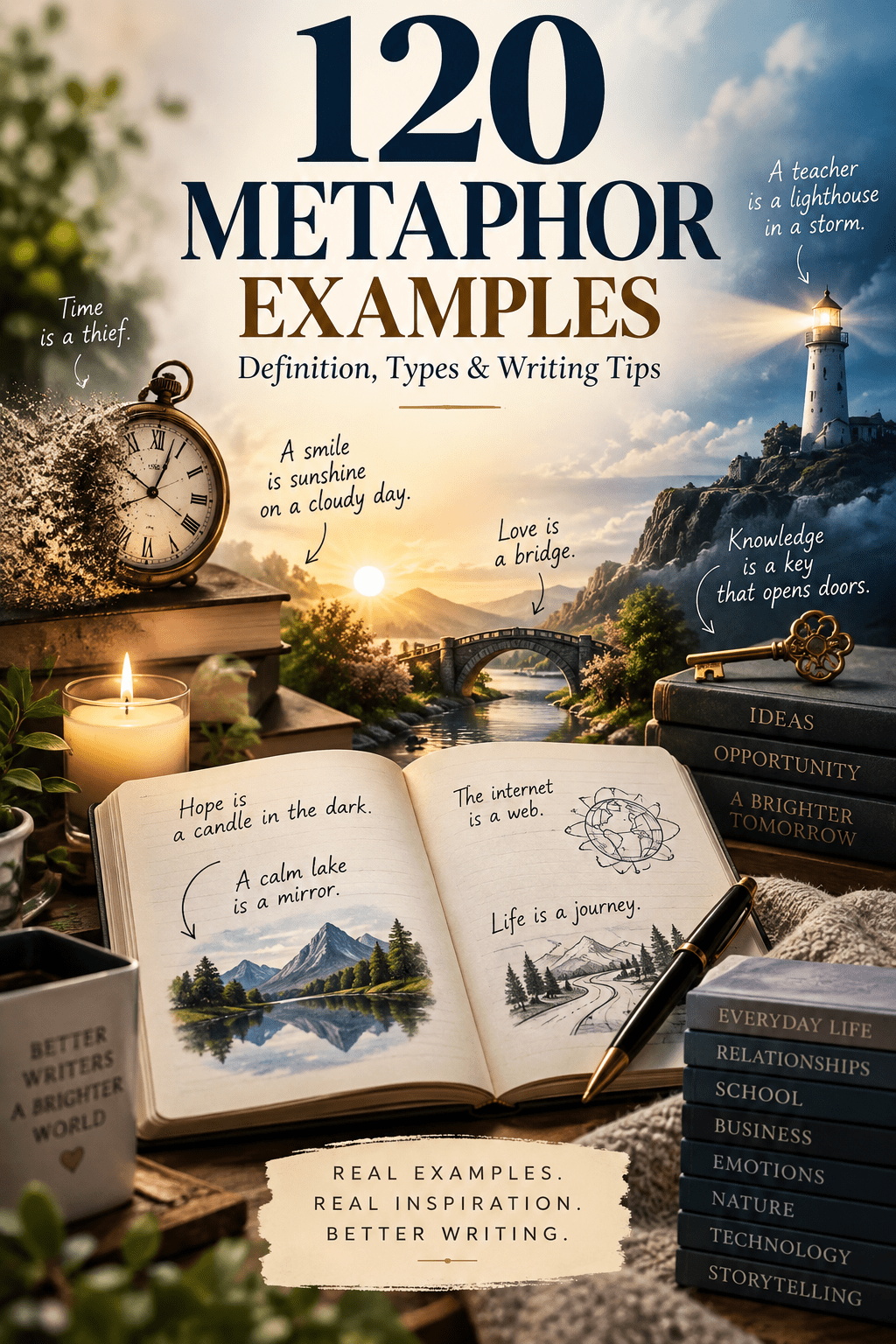
120 Metaphor Examples: Definition, Types & Writing Tips
For example, Metaphors make abstract ideas visible. This guide gives you 120 original metaphor examples, explains what each comparison communicates, and shows you how to create metaphors that feel natural instead of forced.
What is a metaphor?
In addition, A metaphor is a figure of speech that describes one thing as another in order to transfer qualities or meaning between them. “Time is a thief” does not literally claim that time is a person who steals. Instead, it suggests that time takes moments away from us. Unlike a simile, a basic metaphor usually makes the comparison directly rather than using like or as.
Metaphor is one of the most useful literary devices because it can make an unfamiliar idea easier to understand in only a few words. It also appears throughout practical writing techniques, from storytelling and speeches to blog posts and advertising.
Metaphor vs. simile
| Metaphor | Simile |
|---|---|
| Directly identifies one thing as another: “The lake is a mirror.” | Usually compares using like or as: “The lake is like a mirror.” |
| Often feels more immediate and compressed. | Signals the comparison more explicitly. |
However, Both devices can create imagery. However, neither is automatically stronger. The better choice is the one that communicates your exact idea with the least confusion.
Types of metaphors
Standard metaphor
As a result, A standard metaphor makes a direct comparison, such as “Her voice is velvet.” It is usually short and easy to recognize.
Implied metaphor
An implied metaphor suggests the comparison without naming both sides directly. If a manager “barked orders,” for example, the verb quietly compares the manager to a dog.
Extended metaphor
Moreover, An extended metaphor develops the same comparison across several sentences, a paragraph, a poem, or even a larger work. Because the comparison continues, the writer can explore several related qualities.
Mixed metaphor
For this reason, A mixed metaphor combines comparisons that do not fit together logically. Writers often avoid accidental mixed metaphors because they can distract the reader.
How to Read These Metaphor Examples
Each example identifies the literal subject, the metaphorical image used to describe it, and the quality transferred by the comparison. A useful metaphor is not simply an unusual equation between two things. It gives the reader a clearer way to see, feel, or understand the subject.
Everyday Life Metaphor Examples
These everyday life examples show how a direct comparison can turn an ordinary statement into a clearer mental picture. Notice that the sentences do not depend on like or as; instead, each one identifies one thing as another to transfer meaning.
For example, Subject: messy kitchen Metaphorical image: battlefield Why it works: The metaphor turns ordinary clutter into the aftermath of conflict, emphasizing disorder.
In addition, Subject: alarm clock Metaphorical image: dictator Why it works: It presents the alarm as an authority that controls when the speaker must act.
As a result, Subject: traffic Metaphorical image: river Why it works: The flowing image captures a long, continuous stream of red lights.
However, Subject: overfilled purse Metaphorical image: attic Why it works: Both contain a surprising collection of stored and forgotten objects.
Therefore, Subject: empty refrigerator Metaphorical image: desert Why it works: The comparison emphasizes scarcity and emptiness.
More everyday life metaphor examples
Moreover, Subject: garage Metaphorical image: museum Why it works: The stored projects become exhibits representing past intentions.
Similarly, Subject: laundry pile Metaphorical image: mountain Why it works: The metaphor exaggerates height and difficulty to show how overwhelming the chore feels.
In other words, Subject: crowded store Metaphorical image: maze Why it works: It suggests confusing movement and difficulty reaching the destination.
For example, Subject: favorite chair Metaphorical image: throne Why it works: The chair becomes a place of importance and habitual authority.
In addition, Subject: busy schedule Metaphorical image: jigsaw puzzle Why it works: Each commitment must fit carefully among the others.
More everyday life metaphor examples
As a result, Subject: hallway Metaphorical image: runway Why it works: People moving through it are framed as if they are displaying their appearance.
However, Subject: phone Metaphorical image: leash Why it works: The device is presented as something that restricts freedom and keeps the speaker attached.
Therefore, Subject: coffee shop Metaphorical image: office Why it works: The metaphor communicates how regularly and purposefully the speaker works there.
Moreover, Subject: weekend Metaphorical image: charging station Why it works: Rest is framed as replenishing depleted energy.
Similarly, Subject: junk drawer Metaphorical image: time capsule Why it works: Its forgotten objects preserve small pieces of earlier moments.
Love and Relationships Metaphor Examples
For example, These love and relationships examples show how a direct comparison can turn an ordinary statement into a clearer mental picture. Notice that the sentences do not depend on like or as; instead, each one identifies one thing as another to transfer meaning.
In other words, Subject: friendship Metaphorical image: anchor Why it works: The relationship provides stability during emotional difficulty.
For example, Subject: apology Metaphorical image: bridge Why it works: It creates a path across the distance caused by conflict.
In addition, Subject: marriage Metaphorical image: garden Why it works: The metaphor emphasizes ongoing care, growth, and maintenance.
As a result, Subject: jealousy Metaphorical image: wall Why it works: The emotion is presented as a barrier blocking closeness.
However, Subject: voice Metaphorical image: home Why it works: The metaphor transfers feelings of safety and belonging to a familiar voice.
More love and relationships metaphor examples
Therefore, Subject: conversation Metaphorical image: spark Why it works: A small beginning is shown as capable of starting something larger.
Moreover, Subject: silence Metaphorical image: locked door Why it works: It represents emotional inaccessibility and blocked communication.
Similarly, Subject: trust Metaphorical image: foundation Why it works: The relationship depends on trust in the same way a structure depends on its base.
In other words, Subject: kindness Metaphorical image: shelter Why it works: Emotional support is framed as protection from hardship.
For example, Subject: breakup Metaphorical image: crater Why it works: The event creates a large, disruptive absence in daily life.
More love and relationships metaphor examples
In addition, Subject: shared humor Metaphorical image: glue Why it works: It represents a force that helps keep the relationship connected.
As a result, Subject: promise Metaphorical image: thread Why it works: The promise offers a small but meaningful connection during uncertainty.
However, Subject: distance Metaphorical image: ocean Why it works: Physical separation becomes vast and difficult to cross.
Therefore, Subject: forgiveness Metaphorical image: open gate Why it works: It signals renewed access and the possibility of moving forward.
Moreover, Subject: memories Metaphorical image: rooms Why it works: The metaphor makes past experiences feel like mental places that can be reentered.
School and Learning Metaphor Examples
As a result, These school and learning examples show how a direct comparison can turn an ordinary statement into a clearer mental picture. Notice that the sentences do not depend on like or as; instead, each one identifies one thing as another to transfer meaning.
Similarly, Subject: difficult textbook Metaphorical image: brick wall Why it works: The material seems to block progress rather than invite understanding.
In other words, Subject: curiosity Metaphorical image: engine Why it works: It is presented as the force that drives learning forward.
For example, Subject: teacher’s explanation Metaphorical image: map Why it works: Guidance helps students navigate a difficult process.
In addition, Subject: memory Metaphorical image: filing cabinet Why it works: Stored information is pictured as organized material that can be retrieved.
As a result, Subject: long project Metaphorical image: marathon Why it works: The task requires sustained effort rather than one quick burst.
More school and learning metaphor examples
However, Subject: question Metaphorical image: doorway Why it works: One question creates access to broader understanding.
Therefore, Subject: first draft Metaphorical image: raw clay Why it works: The writing is unfinished material ready to be shaped.
Moreover, Subject: library Metaphorical image: engine room Why it works: It is framed as a less visible place that powers intellectual work.
Similarly, Subject: confusing concept Metaphorical image: knot Why it works: Understanding requires untangling interconnected difficulties.
In other words, Subject: practice Metaphorical image: ladder Why it works: Repeated effort creates upward progress toward confidence.
More school and learning metaphor examples
For example, Subject: exam Metaphorical image: mirror Why it works: The result reflects the quality of the work done beforehand.
In addition, Subject: discussion Metaphorical image: workshop Why it works: Ideas are treated as things participants can build, test, and improve.
As a result, Subject: notebook Metaphorical image: toolbox Why it works: Notes provide practical resources for improving later work.
However, Subject: deadline Metaphorical image: drumbeat Why it works: Awareness of time repeats steadily and shapes attention.
Therefore, Subject: graduation Metaphorical image: doorway Why it works: The event is framed as an entrance to a new stage rather than an ending.
Work and Business Metaphor Examples
These work and business examples show how a direct comparison can turn an ordinary statement into a clearer mental picture. Notice that the sentences do not depend on like or as; instead, each one identifies one thing as another to transfer meaning.
Moreover, Subject: inbox Metaphorical image: conveyor belt Why it works: New tasks keep arriving in a continuous stream.
Similarly, Subject: startup Metaphorical image: speedboat Why it works: The metaphor emphasizes agility compared with larger, slower organizations.
In other words, Subject: cash flow Metaphorical image: bloodstream Why it works: Money circulation is presented as essential to keeping the organization alive.
For example, Subject: manager Metaphorical image: compass Why it works: Leadership provides direction when the path is uncertain.
In addition, Subject: contract Metaphorical image: backbone Why it works: The agreement provides essential structure and support.
More work and business metaphor examples
As a result, Subject: meeting Metaphorical image: treadmill Why it works: Everyone expended effort without making meaningful forward progress.
However, Subject: brand Metaphorical image: promise Why it works: The metaphor frames reputation as an expectation the company must fulfill.
Therefore, Subject: new employee Metaphorical image: fresh eyes Why it works: The person brings a new perspective to familiar problems.
Moreover, Subject: sales target Metaphorical image: mountain Why it works: The goal appears large, demanding, and increasingly unavoidable.
Similarly, Subject: presentation Metaphorical image: blueprint Why it works: It lays out a structured plan for future action.
More work and business metaphor examples
In other words, Subject: gossip Metaphorical image: wildfire Why it works: The comparison emphasizes rapid spread and potential damage.
For example, Subject: reputation Metaphorical image: glass Why it works: It can be damaged quickly and may be difficult to restore.
In addition, Subject: customer database Metaphorical image: gold mine Why it works: The stored information contains valuable opportunities that require careful extraction.
As a result, Subject: approval process Metaphorical image: bottleneck Why it works: One narrow point restricts the progress of everything behind it.
However, Subject: launch Metaphorical image: springboard Why it works: One achievement creates momentum for a larger next move.
Emotions Metaphor Examples
For example, These emotions examples show how a direct comparison can turn an ordinary statement into a clearer mental picture. Notice that the sentences do not depend on like or as; instead, each one identifies one thing as another to transfer meaning.
Therefore, Subject: anxiety Metaphorical image: static Why it works: The emotion interferes with clear thinking like noise disrupting a signal.
Moreover, Subject: anger Metaphorical image: furnace Why it works: Heat and containment communicate intense internal pressure.
Similarly, Subject: grief Metaphorical image: heavy coat Why it works: The emotion surrounds him and adds weight to ordinary movement.
In other words, Subject: hope Metaphorical image: candle Why it works: A small source of light represents possibility during darkness.
For example, Subject: embarrassment Metaphorical image: spotlight Why it works: The emotion creates an exaggerated sense of being watched.
More emotions metaphor examples
In addition, Subject: relief Metaphorical image: open window Why it works: It introduces space and ease after emotional pressure.
As a result, Subject: patience Metaphorical image: fraying rope Why it works: The remaining strength appears close to breaking.
However, Subject: joy Metaphorical image: electricity Why it works: The emotion seems energetic, contagious, and physically charged.
Therefore, Subject: regret Metaphorical image: echo Why it works: Past choices repeatedly return to awareness.
Moreover, Subject: fear Metaphorical image: locked room Why it works: The emotion creates mental confinement and limits possible action.
More emotions metaphor examples
Similarly, Subject: confidence Metaphorical image: armor Why it works: It protects the speaker from vulnerability and self-doubt.
In other words, Subject: loneliness Metaphorical image: empty station Why it works: The deserted place embodies absence and isolation.
For example, Subject: suspicion Metaphorical image: seed Why it works: A small doubt can grow after it is planted.
In addition, Subject: calm Metaphorical image: clear lake Why it works: Still, transparent water represents emotional quiet.
As a result, Subject: guilt Metaphorical image: stone Why it works: The feeling is small enough to carry but heavy enough to remain noticeable.
Nature and Description Metaphor Examples
As a result, These nature and description examples show how a direct comparison can turn an ordinary statement into a clearer mental picture. Notice that the sentences do not depend on like or as; instead, each one identifies one thing as another to transfer meaning.
However, Subject: moon Metaphorical image: silver coin Why it works: Shape, color, and brightness are compressed into one familiar image.
Therefore, Subject: river Metaphorical image: ribbon Why it works: Its narrow path visually connects different parts of the landscape.
Moreover, Subject: storm Metaphorical image: army Why it works: The approaching weather gains scale, movement, and menace.
Similarly, Subject: forest Metaphorical image: cathedral Why it works: Height, quiet, and awe make the natural setting feel sacred.
In other words, Subject: fog Metaphorical image: curtain Why it works: The fog blocks the view as fabric blocks a stage.
More nature and description metaphor examples
For example, Subject: desert Metaphorical image: ocean Why it works: The metaphor emphasizes enormous scale and wave-like dunes.
In addition, Subject: lightning Metaphorical image: scar Why it works: Its sudden jagged line resembles a mark cut across a surface.
As a result, Subject: waterfall Metaphorical image: voice Why it works: The natural sound becomes a form of expression for the landscape.
However, Subject: autumn foliage Metaphorical image: fire Why it works: Bright warm colors suggest a last blaze before winter.
Therefore, Subject: pond Metaphorical image: mirror Why it works: Still water reflects its surroundings with unusual clarity.
More nature and description metaphor examples
Moreover, Subject: wind Metaphorical image: sculptor Why it works: Invisible force is framed as shaping physical forms.
Similarly, Subject: snow Metaphorical image: quilt Why it works: The covering appears soft, continuous, and insulating.
In other words, Subject: volcano Metaphorical image: furnace Why it works: Contained heat and the possibility of renewed activity create tension.
For example, Subject: coastline Metaphorical image: torn edge Why it works: Its irregular boundary resembles ripped material.
In addition, Subject: dawn Metaphorical image: opening door Why it works: The transition into light becomes an entrance to new time.
Technology and the Internet Metaphor Examples
These technology and the internet examples show how a direct comparison can turn an ordinary statement into a clearer mental picture. Notice that the sentences do not depend on like or as; instead, each one identifies one thing as another to transfer meaning.
As a result, Subject: internet Metaphorical image: highway Why it works: Data moves rapidly between destinations along connected routes.
However, Subject: phone Metaphorical image: command center Why it works: Many daily decisions and communications are controlled from one device.
Therefore, Subject: password Metaphorical image: front door Why it works: It controls access to a protected private space.
Moreover, Subject: algorithm Metaphorical image: editor Why it works: It selects and arranges what the user is likely to see.
Similarly, Subject: cloud storage Metaphorical image: attic Why it works: Files are kept away from immediate living space but remain available.
More technology and the internet metaphor examples
In other words, Subject: old laptop Metaphorical image: anchor Why it works: Its slowness holds back progress.
For example, Subject: notifications Metaphorical image: thrown pebbles Why it works: Each alert interrupts concentration with a small impact.
In addition, Subject: search bar Metaphorical image: doorway Why it works: A simple entry point provides access to a much larger space.
As a result, Subject: firewall Metaphorical image: security guard Why it works: It screens incoming activity and blocks unwanted access.
However, Subject: spreadsheet Metaphorical image: control panel Why it works: Important information and decisions are managed from one central view.
More technology and the internet metaphor examples
Therefore, Subject: social media space Metaphorical image: echo chamber Why it works: Repeated similar opinions seem louder because they circulate within a limited environment.
Moreover, Subject: backup Metaphorical image: lifeboat Why it works: It preserves essential material after a larger failure.
Similarly, Subject: broken link Metaphorical image: dead end Why it works: The expected route stops without reaching its destination.
In other words, Subject: software Metaphorical image: multi-tool Why it works: One product contains many practical functions.
For example, Subject: screen Metaphorical image: window Why it works: Remote video provides visual access to a place she is not physically occupying.
Writing and Storytelling Metaphor Examples
For example, These writing and storytelling examples show how a direct comparison can turn an ordinary statement into a clearer mental picture. Notice that the sentences do not depend on like or as; instead, each one identifies one thing as another to transfer meaning.
In addition, Subject: city Metaphorical image: sleeping beast Why it works: The metaphor makes the setting feel alive, powerful, and temporarily quiet.
As a result, Subject: secret Metaphorical image: burning fuse Why it works: The hidden information carries an approaching moment of exposure.
However, Subject: castle Metaphorical image: crown Why it works: Its elevated position and shape communicate dominance and importance.
Therefore, Subject: memory Metaphorical image: house Why it works: Some experiences are accessible while others remain closed off.
Moreover, Subject: question Metaphorical image: hook Why it works: It catches on a weak point that may pull the story apart.
More writing and storytelling metaphor examples
Similarly, Subject: night Metaphorical image: ocean Why it works: Darkness becomes vast, surrounding, and difficult to cross.
In other words, Subject: promise Metaphorical image: silk-wrapped poison Why it works: An attractive surface hides danger.
For example, Subject: map Metaphorical image: whisper Why it works: The object carries faint information from a distant past.
In addition, Subject: battlefield Metaphorical image: graveyard Why it works: Ruined objects stand as reminders of defeat and loss.
As a result, Subject: courage Metaphorical image: match Why it works: The strength is real but vulnerable under pressure.
More writing and storytelling metaphor examples
However, Subject: clue Metaphorical image: key Why it works: One piece of information unlocks the meaning of everything else.
Therefore, Subject: hallway Metaphorical image: throat Why it works: The enclosed passage feels organic, narrow, and threatening.
Moreover, Subject: crowd Metaphorical image: wave Why it works: Many individuals merge into one forceful movement.
Similarly, Subject: house Metaphorical image: unfinished book Why it works: Its unexplained history suggests a story interrupted before resolution.
In other words, Subject: sunrise Metaphorical image: promise Why it works: New light represents hope and continuation after hardship.
How to write a strong metaphor
As a result, First, decide what you actually want the reader to understand or feel. Next, identify a second thing that shares the quality you want to emphasize. Then choose only the details that support that connection. A useful metaphor creates a bridge between ideas; it should not force readers to solve a puzzle before they can understand your sentence.
Common metaphor mistakes
Using clichés: familiar metaphors can be useful, but overused comparisons may lose impact. Mixing images: if you begin with a journey metaphor, suddenly switching to cooking or warfare can make the sentence incoherent. Overexplaining: once the comparison is clear, trust the reader. Decorating instead of communicating: a metaphor should clarify, intensify, characterize, or create an intentional mood.
How metaphors work with other literary devices
Moreover, Metaphor frequently works alongside imagery, symbolism, personification, foreshadowing, irony, allusion, and repetition. That is why learning metaphor is a useful entry point into the broader study of figurative language. For a larger reference, see 57+ Literary Devices Every Writer Should Know. You can also explore power words when you want stronger emotional word choices.
Metaphor vs. Simile vs. Personification vs. Analogy
| Device | Main feature | Quick example |
|---|---|---|
| Metaphor | Describes one thing in terms of another to transfer meaning or qualities. | “The deadline is a storm cloud.” |
| Simile | Makes an explicit comparison, commonly with like or as. | “The deadline hangs over us like a storm cloud.” |
| Personification | Gives a nonhuman thing a human action, quality, or role. | “The deadline stared at us from the calendar.” |
| Analogy | Develops a comparison to explain how an idea or relationship works. | “A deadline is like a checkpoint: it turns an open process into a point where progress must be measured.” |
For more direct comparison practice, see our 120 simile examples. You can also compare these with our 120 personification examples.
How to Write a Strong Metaphor
Start with the exact quality you want to communicate
Decide whether the subject feels heavy, unstable, fast, protective, confusing, fragile, repetitive, or something else. Then choose an image that naturally carries that quality.
Make the image specific enough to add information
For example, calling a difficult task “a mountain” communicates size and effort. Calling it “a mountain with no marked trail” adds uncertainty and lack of guidance. Specificity can increase information without making the sentence longer than necessary.
Avoid accidental mixed metaphors
A metaphor becomes distracting when unrelated images collide without purpose. If a project is a “ship,” for instance, suddenly describing it as “climbing a ladder” may break the image unless the shift is intentional.
Extend a metaphor only when the extra details earn their space
An extended metaphor can organize a paragraph, poem, speech, or story. However, each additional detail should deepen the same comparison instead of repeating it.
Recommended writing references
For this reason, Affiliate disclosure: The Amazon links below use affiliate tag vanelsylves09-20. A qualifying purchase may earn this site a commission at no additional cost to the buyer.
The Emotion Thesaurus
In particular, A practical reference for describing emotion, reactions, and character behavior.
View on AmazonMetaphor examples FAQ
What are five simple metaphor examples?
Consequently, Five simple examples are “Time is a thief,” “The classroom was a zoo,” “Her smile was sunshine,” “Fear is a cage,” and “The lake was a mirror.” Each directly describes one thing as another.
What is the difference between metaphor and personification?
A metaphor compares one thing with another. Personification specifically gives human characteristics or actions to something nonhuman. Personification can therefore overlap with metaphor, but the terms describe different features.
Can a metaphor use the word “like”?
For example, A basic comparison using “like” or “as” is usually classified as a simile. Metaphor typically makes the identification more directly.
Why do writers use metaphors?
In addition, Writers use metaphors to explain abstract ideas, create imagery, compress meaning, establish mood, strengthen characterization, and help readers see familiar subjects from a new angle.
Final takeaway
You do not need an elaborate comparison to write an effective metaphor. Start with the meaning. Choose an image that genuinely shares the quality you want to communicate. Then make the comparison as clear and fresh as the context requires. Use the 120 examples above as models for structure, but create comparisons that fit your own subject, audience, and voice.




Pingback: 120 Personification Examples: Definition & Easy Examples
Pingback: 57+ Literary Devices Every Writer Should Know With Examples
Pingback: 120 Simile Examples: Definition, Types & Writing Tips - Vanel Sylvestre
Pingback: 120 Imagery Examples: Vivid Descriptive Writing Explained - Vanel Sylvestre
Pingback: 120 Alliteration Examples for Writing, Poetry & Headlines
Pingback: 120 Irony Examples: Verbal, Situational & Dramatic Irony - Vanel Sylvestre
Pingback: 120 Symbolism Examples: Meaning in Literature & Everyday Life - Vanel Sylvestre
Pingback: 120 Foreshadowing Examples: How to Hint at What Comes Next