For example, Writing Craft Guide · Updated 2026
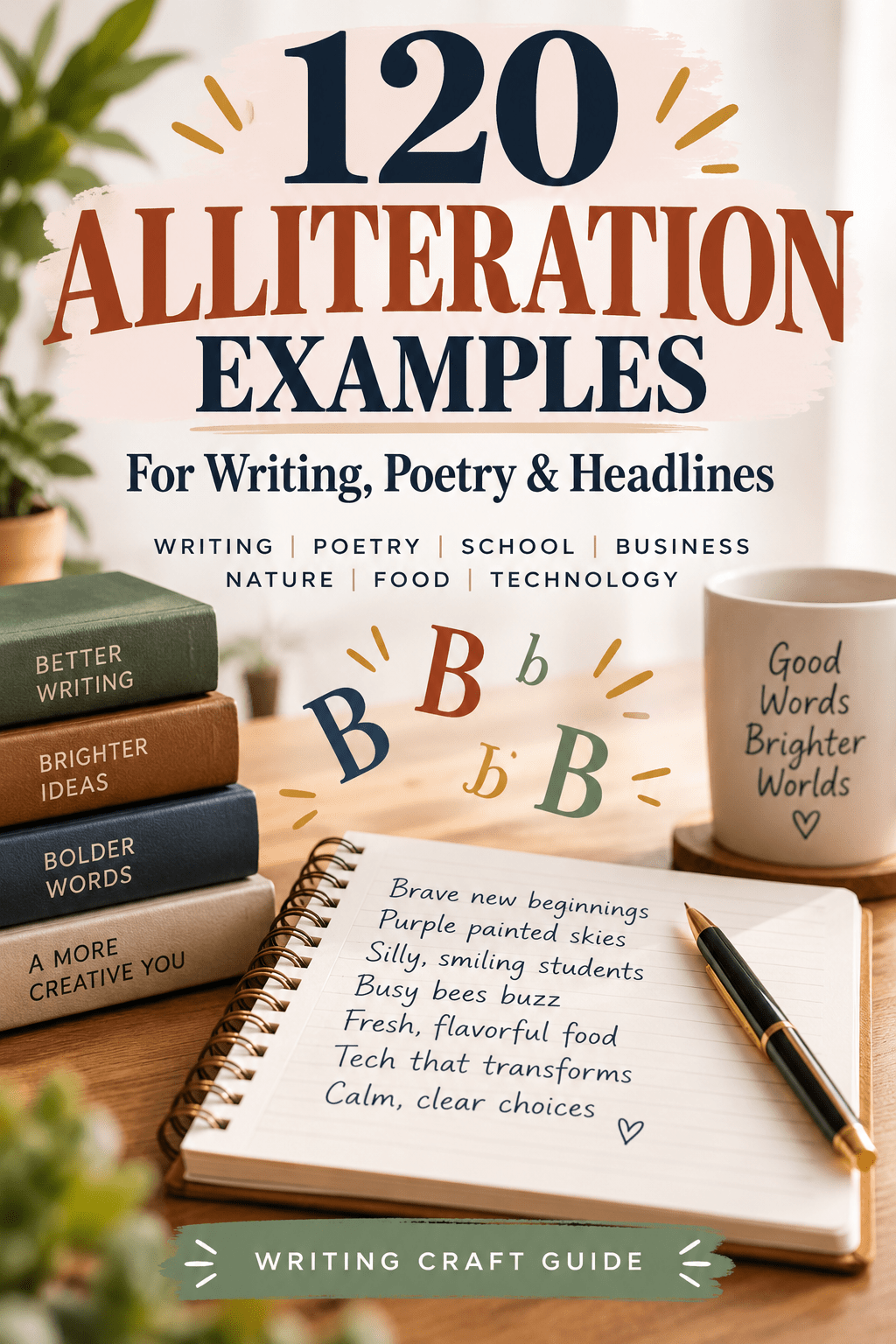
120 Alliteration Examples for Writing, Poetry & Headlines
Explore 120 original alliteration examples for writing, poetry, headlines, brands and everyday sentences, with simple explanations and usage tips.
What is alliteration?
In addition, Alliteration is the repetition of the same or similar beginning sound in nearby words. Writers use it to create rhythm, emphasis, mood, and memorability.
Alliteration depends on sound rather than spelling alone. Words can begin with the same letter without producing useful alliteration, while different spellings can sometimes create similar sounds.
As a result, This topic is part of a larger writing cluster. For the complete reference, visit 57+ Literary Devices Every Writer Should Know. You can also review 17 Writing Techniques Every Writer Should Know and our 120 Metaphor Examples.
Simple Examples
Use these examples to see how the technique changes tone, clarity, rhythm, or reader expectation.
Busy bakers boxed buttery biscuits before breakfast.
For example, Repeated sound: /b/. Why it works: The repeated /b/ sound gives the sentence a buoyant beat and makes the ordinary action memorable.
Calm Carla carried clean cups carefully.
In addition, Repeated sound: /k/. Why it works: The crisp /k/ sound creates a controlled, orderly rhythm that matches Carla’s careful movement.
Drowsy dogs dozed during dinner.
As a result, Repeated sound: /d/. Why it works: The soft, repeated /d/ sound slows the sentence and reinforces the sleepy mood.
Friendly farmers filled fresh fruit baskets.
However, Repeated sound: /f/. Why it works: The flowing /f/ sound links the words smoothly and adds a light, pleasant rhythm.
Everyday Alliteration: Examples 1–6
Gentle giants greeted grateful guests.
Therefore, Repeated sound: /g/. Why it works: The repeated hard /g/ sound emphasizes the group of related actions and gives the phrase a steady pulse.
Happy hikers hurried home before hail.
Moreover, Repeated sound: /h/. Why it works: The breathy /h/ sound adds speed and energy to the hikers’ movement.
Kind kids kept kittens cozy.
Similarly, Repeated sound: /k/. Why it works: The /k/ sound ties the caring actions together and makes the sentence catchy.
Lazy lions lounged beside the lake.
In other words, Repeated sound: /l/. Why it works: The liquid /l/ sound creates a relaxed musical quality that suits the scene.
Everyday Alliteration: Examples 7–12
Merry musicians made morning melodies.
For example, Repeated sound: /m/. Why it works: The humming /m/ sound reinforces the musical subject and creates a warm rhythm.
Nervous neighbors noticed noisy knocking.
In addition, Repeated sound: /n/. Why it works: The repeated /n/ sound builds a noticeable pattern while drawing attention to the disturbance.
Patient painters prepared purple panels.
As a result, Repeated sound: /p/. Why it works: The repeated /p/ sound produces a neat, percussive beat that emphasizes the sequence of work.
Quick cooks quietly chopped crisp carrots.
However, Repeated sound: /k/. Why it works: Although the spellings differ, quick, cooks, and crisp repeat the /k/ sound, showing that alliteration depends on sound rather than letter.
Alliteration for Descriptive Writing: Examples 13–18
Silver sunlight spilled across silent streets.
Therefore, Repeated sound: /s/. Why it works: The soft /s/ sound creates a hushed, shimmering atmosphere.
Brisk breezes bent the brittle branches.
Moreover, Repeated sound: /b/. Why it works: The repeated /b/ sound gives the description a firm beat and emphasizes the wind’s physical force.
Golden grass glowed beneath a gray sky.
Similarly, Repeated sound: /g/. Why it works: The hard /g/ sound binds the visual details together and makes the contrast more memorable.
Writing Examples
Similarly, Use these examples to see how the technique changes tone, clarity, rhythm, or reader expectation.
Velvet violets veiled the valley floor.
In other words, Repeated sound: /v/. Why it works: The vibrating /v/ sound gives the line a smooth, lush texture.
Pale petals pressed against the porch.
For example, Repeated sound: /p/. Why it works: The light /p/ repetitions create a delicate pulse that suits the fragile petals.
Rusty rails ran beside the river.
In addition, Repeated sound: /r/. Why it works: The rolling /r/ sound carries the sentence forward and connects the landscape details.
Tiny torches twinkled through the trees.
As a result, Repeated sound: /t/. Why it works: The repeated /t/ sound adds a quick sparkle to the image.
Alliteration for Descriptive Writing: Examples 19–24
Frosty fields faded into fog.
However, Repeated sound: /f/. Why it works: The airy /f/ sound reinforces the softness and distance of the foggy scene.
Crimson clouds crowded the coast.
Therefore, Repeated sound: /k/. Why it works: Crimson, clouds, crowded, and coast repeat the hard /k/ sound, creating a dense, dramatic rhythm.
Moonlit mist moved over the marsh.
Moreover, Repeated sound: /m/. Why it works: The gentle /m/ sound gives the scene a quiet, dreamlike flow.
Dark dunes disappeared at dawn.
Similarly, Repeated sound: /d/. Why it works: The repeated /d/ sound emphasizes the visual transition from darkness to daylight.
Alliteration for Mood and Emotion: Examples 25–30
Whispering willows waved above the water.
In other words, Repeated sound: /w/. Why it works: The repeated /w/ sound mimics a soft, flowing movement and supports the peaceful image.
Fearful footsteps followed Fiona home.
For example, Repeated sound: /f/. Why it works: The repeated /f/ sound keeps attention on the threatening movement and strengthens suspense.
Grim gray gates guarded the graveyard.
In addition, Repeated sound: /g/. Why it works: The hard /g/ sound makes the phrase heavier and supports an ominous mood.
Hopeful hearts held on through hardship.
As a result, Repeated sound: /h/. Why it works: The breathy /h/ sound unifies the emotional idea and gives the line an encouraging cadence.
Alliteration for Mood and Emotion: Examples 31–36
Lonely lanterns lit the long lane.
However, Repeated sound: /l/. Why it works: The lingering /l/ sound stretches the line and supports a quiet, isolated mood.
Restless rain rattled against the roof.
Therefore, Repeated sound: /r/. Why it works: The repeated /r/ sound adds agitation and helps the reader hear the unsettled weather.
Soft songs soothed Sarah’s sorrow.
Moreover, Repeated sound: /s/. Why it works: The gentle /s/ sound creates a calming musical effect that mirrors the meaning.
School Examples
Use these examples to see how the technique changes tone, clarity, rhythm, or reader expectation.
Tense travelers traded troubled looks.
Similarly, Repeated sound: /t/. Why it works: The repeated /t/ sound gives the sentence a clipped rhythm that reinforces tension.
Wild worries whirled within William.
In other words, Repeated sound: /w/. Why it works: The repeated /w/ sound makes the worries feel circular and persistent.
Bitter blame burned between brothers.
For example, Repeated sound: /b/. Why it works: The forceful /b/ sound adds emotional weight to the conflict.
Cheerful children chased colorful kites.
In addition, Repeated sound: /ch/. Why it works: Cheerful and children repeat the /ch/ sound, giving the sentence a playful opening pattern.
Alliteration in Action and Movement: Examples 37–42
Peaceful people paused beside the pond.
As a result, Repeated sound: /p/. Why it works: The repeated /p/ sound creates a measured pace that supports the calm mood.
Sudden silence settled over the stadium.
However, Repeated sound: /s/. Why it works: The /s/ repetition makes the abrupt quiet feel especially noticeable and dramatic.
Racing runners rounded the rocky ridge.
Therefore, Repeated sound: /r/. Why it works: The rolling /r/ sound gives the sentence momentum and mirrors continuous movement.
Daring divers dropped into deep water.
Moreover, Repeated sound: /d/. Why it works: The repeated /d/ sound creates a strong downward beat that suits the plunge.
Alliteration in Action and Movement: Examples 43–48
Fierce flames flickered across the forest floor.
Similarly, Repeated sound: /f/. Why it works: The repeated /f/ sound makes the fire feel active and spreading.
Galloping goats gathered near the gate.
In other words, Repeated sound: /g/. Why it works: The hard /g/ sound adds a lively, bouncing rhythm to the movement.
Jumping Jack juggled jars joyfully.
For example, Repeated sound: /j/. Why it works: The repeated /j/ sound creates an energetic, playful cadence.
Kicking kayakers kept their course.
In addition, Repeated sound: /k/. Why it works: The repeated /k/ sound produces a sharp beat that emphasizes effort and control.
Alliteration for Nature: Examples 49–54
Leaping lizards left the ledge.
As a result, Repeated sound: /l/. Why it works: The repeated /l/ sound links a quick chain of movement in a memorable phrase.
Marching musicians moved through Main Street.
However, Repeated sound: /m/. Why it works: The /m/ repetition creates a regular pulse reminiscent of a parade.
Pounding ponies passed the pasture.
Therefore, Repeated sound: /p/. Why it works: The percussive /p/ sound helps suggest the beat of hooves.
Business Examples
Use these examples to see how the technique changes tone, clarity, rhythm, or reader expectation.
Swift skaters swept across smooth ice.
Moreover, Repeated sound: /s/. Why it works: The /s/ sound gives the line a sliding quality that fits the motion.
Turning tires tore through the track.
Similarly, Repeated sound: /t/. Why it works: The repeated /t/ sound creates a rapid, mechanical rhythm.
Wandering wolves wound through the woods.
In other words, Repeated sound: /w/. Why it works: The repeated /w/ sound creates a flowing path through the sentence, matching the wolves’ movement.
Bubbling brooks bordered bright blossoms.
For example, Repeated sound: /b/. Why it works: The /b/ sound connects several lively natural details and gives the line a cheerful bounce.
Alliteration for Nature: Examples 55–60
Crashing currents carved coastal cliffs.
In addition, Repeated sound: /k/. Why it works: The hard /k/ sound adds force and helps convey the water striking rock.
Dewy daisies dotted the damp meadow.
As a result, Repeated sound: /d/. Why it works: The repeated /d/ sound gives the description a gentle, patterned rhythm.
Emerald evergreens edged the eastern ridge.
However, Repeated sound: /e/. Why it works: The repeated initial vowel sound creates a smooth opening echo across the phrase.
Fluttering feathers floated from the firs.
Therefore, Repeated sound: /f/. Why it works: The airy /f/ sound complements the light downward movement.
Alliteration for Poetry and Lyrical Writing: Examples 61–66
Green geckos gathered beneath garden gates.
Moreover, Repeated sound: /g/. Why it works: The repeated hard /g/ sound makes the scene playful and memorable.
Hazy hills hid behind heavy clouds.
Similarly, Repeated sound: /h/. Why it works: The breathy /h/ sound reinforces the muted, obscured landscape.
Icy islands appeared in the inlet.
In other words, Repeated sound: /i/. Why it works: The repeated initial vowel sound links the cold landscape details.
Jagged junipers jutted from the hillside.
For example, Repeated sound: /j/. Why it works: The repeated /j/ sound feels abrupt and angular, fitting the sharp shapes.
Alliteration for Poetry and Lyrical Writing: Examples 67–72
Misty mountains melted into morning light.
In addition, Repeated sound: /m/. Why it works: The soft /m/ sound creates a gradual, peaceful transition.
Rolling rivers rushed around rocks.
As a result, Repeated sound: /r/. Why it works: The repeated /r/ sound produces movement and energy appropriate to running water.
Wild winds whipped westward.
However, Repeated sound: /w/. Why it works: The /w/ repetition makes the wind feel continuous and forceful.
Nature Examples
Use these examples to see how the technique changes tone, clarity, rhythm, or reader expectation.
Blue bells bloom beneath the bridge.
Therefore, Repeated sound: /b/. Why it works: The repeated /b/ sound creates a compact musical beat suited to a poetic line.
Candlelight curls across the quiet cabin.
Moreover, Repeated sound: /k/. Why it works: Candlelight, curls, and cabin share the /k/ sound, framing the line with a subtle sonic pattern.
Dreaming dawn drifts over distant doors.
Similarly, Repeated sound: /d/. Why it works: The /d/ sound gives the line a measured, dreamlike cadence.
Falling feathers find forgotten fields.
In other words, Repeated sound: /f/. Why it works: The flowing /f/ sound reinforces softness and gentle movement.
Alliteration for Headlines, Names and Slogans: Examples 73–78
Glimmering glass gathers golden light.
For example, Repeated sound: /g/. Why it works: The repeated hard /g/ sound binds the shining visual details together.
Hushed hills hold the final light.
In addition, Repeated sound: /h/. Why it works: The breathy /h/ sound makes the line feel quiet and contemplative.
Little lights linger along the lane.
As a result, Repeated sound: /l/. Why it works: The liquid /l/ sound creates a smooth, lingering musical effect.
Midnight murmurs move beneath the moon.
However, Repeated sound: /m/. Why it works: The humming /m/ sound deepens the nocturnal, meditative mood.
Alliteration for Headlines, Names and Slogans: Examples 79–84
Quiet queens question curious courtiers.
Therefore, Repeated sound: /k/. Why it works: Quiet, queens, question, and curious repeat the /k/ sound despite different spellings, demonstrating sound-based alliteration.
Scarlet sails slide toward the sunset.
Moreover, Repeated sound: /s/. Why it works: The soft /s/ sound gives the line a gliding rhythm.
Tender twilight touches the treetops.
Similarly, Repeated sound: /t/. Why it works: The repeated /t/ sound adds a delicate pulse while linking related images.
Winter whispers through the waiting woods.
In other words, Repeated sound: /w/. Why it works: The /w/ repetition produces a breathy, atmospheric music appropriate to winter.
Alliteration for Kids and Classroom Practice: Examples 85–90
Better Baking Begins Here.
For example, Repeated sound: /b/. Why it works: The /b/ repetition makes the short headline punchy and easy to remember.
Creative Careers for Curious Minds.
In addition, Repeated sound: /k/. Why it works: Creative, careers, and curious share the /k/ sound, creating a cohesive headline.
Fresh Food, Fast.
As a result, Repeated sound: /f/. Why it works: The repeated /f/ sound compresses the message into a catchy rhythm.
Food Examples
Use these examples to see how the technique changes tone, clarity, rhythm, or reader expectation.
Money Moves Made Simple.
However, Repeated sound: /m/. Why it works: The /m/ sound turns several related ideas into a memorable phrase.
Perfect Photos in a Pinch.
Therefore, Repeated sound: /p/. Why it works: The repeated /p/ sound gives the headline an upbeat, promotional cadence.
Smart Study Strategies for Students.
Moreover, Repeated sound: /s/. Why it works: The /s/ repetition connects the topic words and improves memorability.
Travel Tips for Tired Tourists.
Similarly, Repeated sound: /t/. Why it works: The repeated /t/ sound creates a clear rhythm that works well in a title.
Alliteration for Kids and Classroom Practice: Examples 91–96
Winning Words for Writers.
In other words, Repeated sound: /w/. Why it works: The /w/ sound makes the phrase compact and brandable.
Bold Brands Build Belief.
For example, Repeated sound: /b/. Why it works: The repeated /b/ sound emphasizes the relationship between branding and trust.
Daily Deals Delivered Directly.
In addition, Repeated sound: /d/. Why it works: The /d/ repetition gives the slogan a quick, commercial rhythm.
Powerful Plans Produce Progress.
As a result, Repeated sound: /p/. Why it works: The /p/ sound creates a confident, forward-driving cadence.
Alliteration with Different Letters but the Same Sound: Examples 97–102
Simple Solutions, Serious Savings.
However, Repeated sound: /s/. Why it works: The repeated /s/ sound makes the benefit statement smoother and easier to recall.
Benny’s blue balloon bounced by the bench.
Therefore, Repeated sound: /b/. Why it works: The repeated /b/ sound is easy to hear, making this useful for identifying alliteration.
Clever cats can climb curtains.
Moreover, Repeated sound: /k/. Why it works: Clever, cats, can, and climb share the /k/ sound and demonstrate that sound matters more than spelling.
Danny drew dancing dragons.
Similarly, Repeated sound: /d/. Why it works: The repeated /d/ sound creates a simple, playful pattern for young readers.
Alliteration with Different Letters but the Same Sound: Examples 103–108
Five funny frogs found flowers.
In other words, Repeated sound: /f/. Why it works: The /f/ repetition makes the sentence rhythmic and easy to recognize.
Gina’s green grapes grew greatly.
For example, Repeated sound: /g/. Why it works: The hard /g/ sound repeats clearly across nearby words.
Hungry hamsters hid hazelnuts.
In addition, Repeated sound: /h/. Why it works: The /h/ sound creates an obvious opening pattern without making the sentence too complex.
Technology Examples
Use these examples to see how the technique changes tone, clarity, rhythm, or reader expectation.
Jolly jellyfish jumped joyfully.
As a result, Repeated sound: /j/. Why it works: The repeated /j/ sound gives the line a silly, energetic rhythm.
Little Lucy loves lemon lollipops.
However, Repeated sound: /l/. Why it works: The repeated /l/ sound makes the phrase musical and memorable.
Milo’s messy monkey mixed muffins.
Therefore, Repeated sound: /m/. Why it works: The /m/ repetition creates a clear classroom example of initial-sound repetition.
Nine noisy newts nibbled noodles.
Moreover, Repeated sound: /n/. Why it works: The /n/ sound repeats consistently and gives the sentence a tongue-twister quality.
Subtle Alliteration in Prose: Examples 109–114
Polly’s playful puppy pulled pillows.
Similarly, Repeated sound: /p/. Why it works: The repeated /p/ sound creates a strong, easy-to-hear pattern.
Tiny turtles tiptoed toward town.
In other words, Repeated sound: /t/. Why it works: The /t/ sound repeats across the main content words, producing a crisp rhythm.
Kind cats crossed the kitchen.
For example, Repeated sound: /k/. Why it works: Kind, cats, crossed, and kitchen use different letters or spellings but share the hard /k/ sound.
City sidewalks seemed silent.
In addition, Repeated sound: /s/. Why it works: City, sidewalks, seemed, and silent repeat the /s/ sound even though city begins with the letter c.
Subtle Alliteration in Prose: Examples 115–120
Phone photographers framed fresh flowers.
As a result, Repeated sound: /f/. Why it works: Phone, photographers, framed, fresh, and flowers repeat the /f/ sound across ph and f spellings.
Quick climbers crossed crumbling cliffs.
However, Repeated sound: /k/. Why it works: Quick, climbers, crossed, crumbling, and cliffs share the /k/ sound despite q and c spellings.
Giant jars jingled gently.
Therefore, Repeated sound: /j/. Why it works: Giant, jars, jingled, and gently repeat the /j/ sound even though g and j represent it.
Chemists carefully counted crystals.
Moreover, Repeated sound: /k/. Why it works: Chemists, carefully, counted, and crystals repeat the hard /k/ sound, showing why pronunciation matters.
More Technology Examples: Examples 13–15
School kids kept skipping.
Similarly, Repeated sound: /k/. Why it works: School, kids, kept, and skipping share the /k/ sound despite sc and k spellings.
Cycle sellers sent samples.
In other words, Repeated sound: /s/. Why it works: Cycle, sellers, sent, and samples repeat the /s/ sound across c and s.
Ghostly guests gathered by the gate.
For example, Repeated sound: /g/. Why it works: Ghostly, guests, gathered, and gate repeat the hard /g/ sound even though the spelling patterns vary.
Headlines Examples
Use these examples to see how the technique changes tone, clarity, rhythm, or reader expectation.
Choir conductors kept calm.
In addition, Repeated sound: /k/. Why it works: Choir, conductors, kept, and calm share the /k/ sound, so the phrase alliterates by sound.
Photo fans found fantastic frames.
As a result, Repeated sound: /f/. Why it works: Photo, fans, found, fantastic, and frames repeat the /f/ sound using ph and f.
Quartz crystals cracked quietly.
However, Repeated sound: /k/. Why it works: Quartz, crystals, cracked, and quietly share the /k/ sound even though the opening letters differ.
Mara closed the cabinet and carried the coffee upstairs.
Therefore, Repeated sound: /k/. Why it works: Closed, cabinet, carried, and coffee quietly repeat /k/, adding cohesion without sounding like a tongue twister.
More Headlines Examples: Examples 5–8
The storm left silver streaks across the sleeping city.
Moreover, Repeated sound: /s/. Why it works: Storm, silver, streaks, sleeping, and city create a soft /s/ pattern that supports the calm aftermath.
Ben watched the broken boat bob beyond the pier.
Similarly, Repeated sound: /b/. Why it works: Broken, boat, bob, and beyond repeat /b/, subtly focusing attention on the drifting boat.
She folded the faded photograph into the final page.
In other words, Repeated sound: /f/. Why it works: Folded, faded, photograph, and final repeat /f/, gently linking the character’s actions and the meaningful object.
Cold rain clicked against the kitchen window.
For example, Repeated sound: /k/. Why it works: Cold, clicked, and kitchen share /k/, giving the quiet scene an audible edge.
More Headlines Examples: Examples 9–12
The lantern left a little light along the landing.
In addition, Repeated sound: /l/. Why it works: Lantern, left, little, light, and landing repeat /l/, creating a smooth line through the description.
Miles moved more slowly as the mountain path narrowed.
As a result, Repeated sound: /m/. Why it works: Miles, moved, more, and mountain repeat /m/, subtly slowing and unifying the sentence.
A pale path passed between the pines.
However, Repeated sound: /p/. Why it works: Pale, path, passed, and pines repeat /p/, guiding attention through the landscape.
Rosa read the report while rain ran down the glass.
Therefore, Repeated sound: /r/. Why it works: Rosa, read, report, rain, and ran repeat /r/, linking the indoor action with the weather outside.
More Headlines Examples: Examples 13–15
She saw the small sign beside the station.
Moreover, Repeated sound: /s/. Why it works: She, saw, small, sign, and station repeat /s/, creating unobtrusive sound patterning in ordinary prose.
Tom took the torn ticket from his coat.
Similarly, Repeated sound: /t/. Why it works: Tom, took, torn, and ticket repeat /t/, giving a simple action a compact rhythmic structure.
Waves washed the weathered wall below the walkway.
In other words, Repeated sound: /w/. Why it works: Waves, washed, weathered, wall, and walkway repeat /w/, creating a flowing sound that fits the water.
How to use alliteration effectively
Start with meaning rather than decoration. Ask what you want the reader to notice, understand, anticipate, hear, or picture. Then use the technique only where it strengthens that purpose. During editing, remove examples that sound forced, repetitive, confusing, or more noticeable than the idea they are supposed to support.
Recommended writing references
Therefore, Affiliate disclosure: Amazon links use affiliate tag vanelsylves09-20. Qualifying purchases may earn this site a commission at no additional cost to the buyer.
The Emotion Thesaurus
In other words, A useful reference for character emotion and description.
View on Amazon15 Famous Alliteration Examples in Literature
These well-known examples show that literary alliteration is not decoration alone. Writers use repeated opening sounds to control rhythm, emphasize images, and make important phrases linger in the reader’s ear.
For example, 1. William Shakespeare, Romeo and Juliet. “From forth the fatal loins of these two foes” repeatedly uses /f/. The forceful pattern makes the prologue sound formal and fateful.
2. Edgar Allan Poe, The Raven. Poe repeatedly clusters consonant sounds throughout the poem to intensify its hypnotic musicality and uneasy atmosphere.
Moreover, 3. Samuel Taylor Coleridge, The Rime of the Ancient Mariner. “The fair breeze blew, the white foam flew” uses /b/ and /f/ patterns that give the ship’s movement a quick, musical pulse.
4. Alfred, Lord Tennyson, The Eagle. “He clasps the crag with crooked hands” repeats the hard /k/ sound. The compact consonants reinforce the eagle’s grip and the rugged rock.
Similarly, 5. William Shakespeare, Macbeth. Shakespeare’s sound patterns frequently make supernatural and violent passages more memorable, showing how alliteration can strengthen mood as well as rhythm.
Alliteration Across Poetry and Classic Literature
6. John Milton, Paradise Lost. Milton uses recurring initial sounds to give blank verse additional sonic structure even when end rhyme is absent.
In addition, 7. Geoffrey Chaucer, The Canterbury Tales. Alliterative clusters contribute to the musical movement of descriptive passages and connect Chaucer’s Middle English verse to older sound traditions.
8. William Langland, Piers Plowman. The poem is built heavily around alliterative verse, demonstrating that repeated stressed sounds once served as a major structural principle in English poetry.
For example, 9. Anonymous, Sir Gawain and the Green Knight. Dense alliteration organizes many lines around repeated stressed consonants, giving the poem a powerful oral rhythm.
10. Anonymous, Beowulf. Old English verse uses alliteration as a core organizing device, linking stressed words across the line and helping create its distinctive oral cadence.
More Famous Alliteration Examples
Moreover, 11. Percy Bysshe Shelley, Ode to the West Wind. Shelley’s repeated consonant sounds reinforce motion and musicality as the poem addresses the restless wind.
12. John Keats, To Autumn. Keats layers soft consonant patterns into rich sensory descriptions, allowing sound to support the poem’s slow, abundant atmosphere.
Similarly, 13. Christina Rossetti, Goblin Market. Repeated initial sounds help make lists and descriptions feel chant-like, energetic, and memorable.
14. Charles Dickens, A Tale of Two Cities. Dickens frequently uses patterned sounds alongside parallel structure, helping key descriptive phrases acquire extra rhythm and emphasis.
In addition, 15. Walt Whitman, Leaves of Grass. Whitman’s long free-verse lines often use recurring consonants to create internal music when conventional rhyme is absent.
Alliteration Is About Sound, Not Just Spelling
A reliable way to identify alliteration is to read the words aloud. The device repeats an opening consonant sound in nearby words, so different letters can still alliterate when they produce the same sound. For example, kind cats repeats the /k/ sound. By contrast, words that begin with the same letter do not automatically alliterate if their opening sounds differ. This sound-first rule is one of the most important details to understand when studying alliteration.
Alliteration vs. Assonance vs. Consonance
| Sound device | What repeats? | Simple example |
|---|---|---|
| Alliteration | Opening consonant sounds in nearby words | Silver sails slide. |
| Assonance | Vowel sounds, often inside words | Slow road home. |
| Consonance | Consonant sounds in any prominent position | Blank and think. |
Writers often combine these sound devices. The useful question is not simply which letters repeat, but which sounds repeat and where they occur. For more literary techniques, see our complete guide to literary devices.
How to Use Alliteration Without Overdoing It
Use alliteration when the sound supports the purpose of the sentence. Soft sounds such as /s/, /f/, and /w/ can create flow or quietness, while harder sounds such as /k/, /t/, and /b/ can add punch or urgency. In prose, two or three strategically repeated sounds are often more natural than forcing every word to begin alike. In poetry, headlines, names, and slogans, a stronger pattern can be useful because rhythm and memorability matter more.
Choosing Sounds for the Effect You Want
FAQ
Is alliteration a literary device?
Yes. It is commonly taught as a literary or writing technique because it changes how readers interpret, imagine, or experience language.
Can bloggers use alliteration?
For this reason, Yes. Literary techniques are not limited to fiction and poetry. Used carefully, they can improve explanations, introductions, headlines, examples, storytelling, and persuasive writing.
Continue learning literary devices
Return to the literary devices hub to compare this technique with metaphor, simile, imagery, personification, alliteration, irony, symbolism, foreshadowing, and many others.
Recommended writing resource
Moreover, For a practical reference on clearer, stronger writing, this classic guide is a useful companion.
View on Amazon



Pingback: 57+ Literary Devices Every Writer Should Know With Examples