For example, Writing Craft Guide · Updated 2026
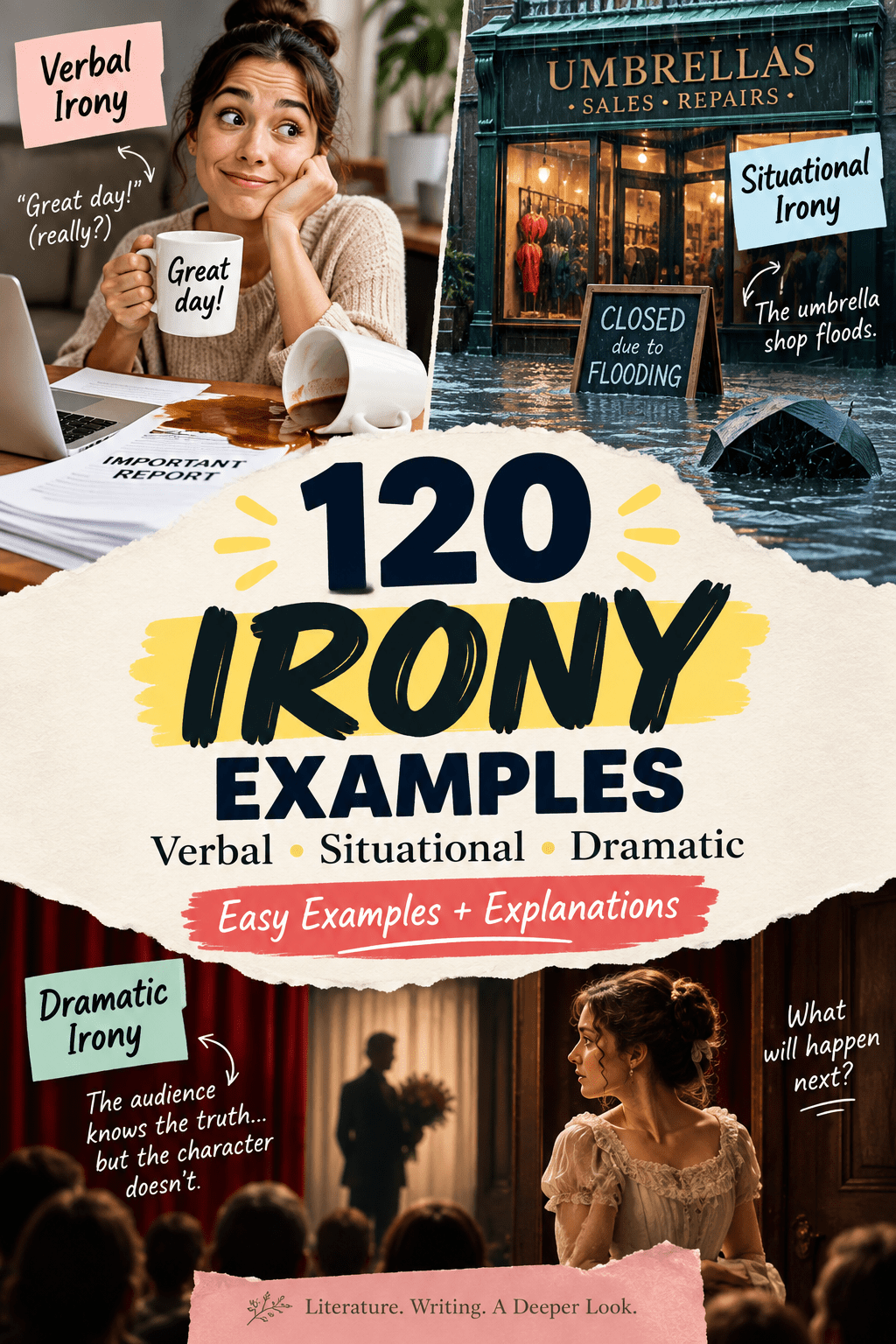
120 Irony Examples: Verbal, Situational & Dramatic Irony
Learn verbal, situational and dramatic irony through 120 original examples, clear explanations and practical writing tips.
What is irony?
In addition, Irony creates meaning through a gap between appearance and reality, expectation and outcome, or what is said and what is actually meant.
Irony and foreshadowing often work together: a writer can plant a clue that readers recognize before a character understands its importance. Compare these examples with our 120 foreshadowing examples.
The three major forms are verbal irony, situational irony, and dramatic irony. They work differently, so context matters more than simply finding an unexpected event.
As a result, This topic is part of a larger writing cluster. For the complete reference, visit 57+ Literary Devices Every Writer Should Know. You can also review 17 Writing Techniques Every Writer Should Know and our 120 Metaphor Examples.
How to Identify the Three Types of Irony
Verbal irony happens when a speaker intentionally says something that conflicts with the intended meaning. Situational irony occurs when the actual outcome meaningfully reverses what the situation leads us to expect. Dramatic irony occurs when the audience knows important information that one or more characters do not.
Verbal Irony Examples
Use these examples to see how the technique changes tone, clarity, rhythm, or reader expectation.
After the printer jams five minutes before the deadline, Maya says, “Excellent timing.”
For example, Type: Verbal irony Irony/contrast: Her positive words conflict with her obvious frustration. Why it works: The mismatch communicates annoyance without stating it directly.
Standing in pouring rain without an umbrella, Luis says, “Beautiful weather for a picnic.”
In addition, Type: Verbal irony Irony/contrast: The praise means the opposite of the miserable conditions. Why it works: The exaggerated approval makes the complaint humorous.
After deleting the finished presentation by mistake, Nina says, “I’m really on top of things today.”
As a result, Type: Verbal irony Irony/contrast: She describes herself as competent immediately after a careless error. Why it works: The contrast turns self-criticism into dry humor.
When the bus pulls away just as he reaches the stop, Omar says, “Perfect.”
However, Type: Verbal irony Irony/contrast: The word expresses displeasure rather than satisfaction. Why it works: A single positive word gains an opposite meaning from context.
Verbal Irony Examples 1–5
Looking at a mountain of dirty dishes, Tia says, “Well, this should take two seconds.”
Therefore, Type: Verbal irony Irony/contrast: She deliberately understates an obviously large task. Why it works: The understatement highlights how overwhelming the chore is.
After a toddler covers the wall in marker, his father says, “What a masterpiece.”
Moreover, Type: Verbal irony Irony/contrast: The compliment is not literal praise for the damage. Why it works: The playful wording softens frustration while acknowledging the mess.
When the Wi-Fi dies during an online exam, the student mutters, “Technology is amazing.”
Similarly, Type: Verbal irony Irony/contrast: The statement praises technology at the moment it fails. Why it works: The context reverses the surface meaning.
After getting a parking ticket, Ben says, “Exactly what my budget needed.”
In other words, Type: Verbal irony Irony/contrast: He presents an unwanted expense as if it were helpful. Why it works: The opposite meaning emphasizes financial irritation.
Verbal Irony Examples 6–10
When the supposedly quick meeting enters its third hour, Ava whispers, “I love efficient meetings.”
For example, Type: Verbal irony Irony/contrast: Her praise conflicts with the meeting’s obvious inefficiency. Why it works: The remark criticizes the situation indirectly.
Seeing the empty refrigerator, Marcus says, “We’re clearly prepared for the week.”
In addition, Type: Verbal irony Irony/contrast: His words claim preparation while the evidence shows the opposite. Why it works: The contrast points out poor planning.
After tripping over a perfectly visible box, Jen says, “Graceful as always.”
As a result, Type: Verbal irony Irony/contrast: She compliments her grace immediately after clumsiness. Why it works: Self-directed verbal irony creates comic embarrassment.
When the air conditioner breaks on the hottest day, Devon says, “Couldn’t have picked a better day.”
However, Type: Verbal irony Irony/contrast: The literal sentence sounds positive, but he means the timing is terrible. Why it works: Context supplies the opposite intention.
Verbal Irony Examples 11–15
After receiving twelve new tasks at 4:55 p.m., Priya says, “Nice quiet end to the day.”
Therefore, Type: Verbal irony Irony/contrast: Her description conflicts with the sudden workload. Why it works: The understated complaint emphasizes bad timing.
Watching smoke rise from his burnt toast, Eli says, “Breakfast of champions.”
Moreover, Type: Verbal irony Irony/contrast: The grand praise clashes with the ruined food. Why it works: The contrast makes a small failure funny.
When her phone battery reaches one percent before a long trip, Zoe says, “Fantastic planning.”
Similarly, Type: Verbal irony Irony/contrast: She praises planning while criticizing her own lack of preparation. Why it works: The irony communicates regret concisely.
Situational Irony Examples
Similarly, Use these examples to see how the technique changes tone, clarity, rhythm, or reader expectation.
After the dog tracks mud across a freshly cleaned floor, Carla says, “Thank you for helping.”
In other words, Type: Verbal irony Irony/contrast: The polite gratitude is intentionally opposite to her reaction. Why it works: The false thanks humorously signals annoyance.
When a loud neighbor starts drilling at 6 a.m., Andre says, “So considerate.”
For example, Type: Verbal irony Irony/contrast: The adjective praises consideration while the behavior is inconsiderate. Why it works: The contrast delivers criticism without a direct insult.
After missing an easy shot, the player says, “Future MVP right here.”
In addition, Type: Verbal irony Irony/contrast: He gives himself an elite compliment after a poor performance. Why it works: The exaggeration makes the self-criticism playful.
Seeing a two-hour line, Kim says, “Good thing this will be quick.”
As a result, Type: Verbal irony Irony/contrast: The claim of speed conflicts with visible evidence. Why it works: Readers immediately infer her actual impatience.
Verbal Irony Examples 16–20
After forgetting his own password for the fifth time, Ray says, “Security expert.”
However, Type: Verbal irony Irony/contrast: The title suggests competence while his behavior shows the opposite. Why it works: The short label works as self-mocking verbal irony.
When the recipe collapses in the oven, Lena says, “Just like the picture.”
Therefore, Type: Verbal irony Irony/contrast: Her claim of similarity is contradicted by the failed result. Why it works: The comparison highlights the cooking disaster.
After a storm cancels the beach wedding, the best man says, “At least the forecast was accurate.”
Moreover, Type: Verbal irony Irony/contrast: He says this after everyone ignored a forecast that predicted the storm. Why it works: The remark indirectly criticizes their earlier optimism.
When the elevator stops on every floor, Sam says, “Express service.”
Similarly, Type: Verbal irony Irony/contrast: He labels slow service as fast. Why it works: The opposite description makes the inconvenience comic.
Verbal Irony Examples 21–25
After opening an email titled ‘Quick Question’ that contains twenty requests, Mia says, “Very quick.”
In other words, Type: Verbal irony Irony/contrast: She repeats the sender’s description while meaning the reverse. Why it works: The irony exposes the misleading label.
When his alarm fails, Noah says, “Reliable little machine.”
For example, Type: Verbal irony Irony/contrast: He calls the alarm reliable immediately after it proves unreliable. Why it works: The context flips the compliment.
After the team loses 8–0, the coach says privately, “That went according to plan.”
In addition, Type: Verbal irony Irony/contrast: The outcome clearly contradicts any successful plan. Why it works: The deadpan statement conveys disappointment.
Looking at a desk buried in papers, Grace says, “Minimalism is really working for me.”
As a result, Type: Verbal irony Irony/contrast: Her claim conflicts with the visible clutter. Why it works: The mismatch makes the joke depend on shared observation.
Verbal Irony Examples 26–30
When the automatic door refuses to open, Ian says, “Very automatic.”
However, Type: Verbal irony Irony/contrast: The description contradicts the object’s failed function. Why it works: The irony focuses attention on the malfunction.
After spilling paint on his new shoes, Cole says, “Great first day wearing these.”
Therefore, Type: Verbal irony Irony/contrast: He calls a damaging event great. Why it works: The positive adjective expresses frustration.
When a ‘silent’ appliance rattles loudly, Bea says, “Whisper quiet.”
Moreover, Type: Verbal irony Irony/contrast: She repeats the advertised promise despite opposite evidence. Why it works: The remark criticizes the product claim.
Dramatic Irony Examples
Use these examples to see how the technique changes tone, clarity, rhythm, or reader expectation.
After forgetting the umbrella despite three reminders, June says, “My memory never lets me down.”
Similarly, Type: Verbal irony Irony/contrast: The literal claim is disproved by her behavior. Why it works: Self-irony turns a mistake into humor.
When the restaurant loses the reservation, Theo says, “Wonderful organization.”
In other words, Type: Verbal irony Irony/contrast: He praises organization while experiencing disorganization. Why it works: The opposite meaning communicates criticism politely.
After a computer update creates new errors, Ana says, “Love these improvements.”
For example, Type: Verbal irony Irony/contrast: She calls harmful changes improvements. Why it works: The wording questions whether the update improved anything.
When the supposedly unbreakable toy snaps immediately, Dad says, “Built to last.”
In addition, Type: Verbal irony Irony/contrast: He echoes a durability claim after instant failure. Why it works: The contradiction exposes the claim as unreliable.
Verbal Irony Examples 31–35
After walking into the wrong classroom, Leo says, “Clearly I know where I’m going.”
As a result, Type: Verbal irony Irony/contrast: His statement conflicts with his mistake. Why it works: The irony acknowledges embarrassment without explanation.
When the coffee shop misspells her simple name for the tenth time, Sara says, “Nailed it again.”
However, Type: Verbal irony Irony/contrast: She congratulates an error. Why it works: The repeated ironic praise turns a recurring annoyance into a joke.
After an app designed to save time requires a forty-minute setup, Vic says, “So convenient.”
Therefore, Type: Verbal irony Irony/contrast: The convenience claim conflicts with the effort required. Why it works: The irony criticizes poor design.
When the ‘easy-open’ package requires scissors, Pat says, “Easy indeed.”
Moreover, Type: Verbal irony Irony/contrast: The label and experience contradict each other. Why it works: Repeating the product language makes the criticism clear.
Verbal Irony Examples 36–40
After a tiny typo changes the entire spreadsheet, Dee says, “Details clearly don’t matter.”
Similarly, Type: Verbal irony Irony/contrast: She says the opposite of the lesson the error demonstrates. Why it works: The irony emphasizes that details matter enormously.
When the power returns one minute after he buys candles, Joel says, “Excellent investment.”
In other words, Type: Verbal irony Irony/contrast: The purchase immediately becomes unnecessary. Why it works: Calling it excellent expresses amused frustration.
A fire station catches fire because its alarm system was never tested.
For example, Type: Situational irony Irony/contrast: A place devoted to preventing fires is damaged by the very danger it is meant to fight. Why it works: The outcome reverses the institution’s expected role.
A locksmith locks his keys inside his van.
In addition, Type: Situational irony Irony/contrast: A professional who helps others gain access cannot access his own vehicle. Why it works: The reversal grows directly from his expertise.
Situational Irony Examples 41–45
A marriage counselor files for divorce after publishing a book called The Perfect Marriage.
As a result, Type: Situational irony Irony/contrast: Her public expertise contrasts with the collapse of her own marriage. Why it works: The outcome challenges expectations created by her profession and title.
A traffic officer receives repeated speeding tickets.
However, Type: Situational irony Irony/contrast: Someone responsible for enforcing speed laws repeatedly breaks them. Why it works: The contradiction between role and behavior creates situational irony.
A fitness influencer drives three blocks to avoid walking.
Therefore, Type: Situational irony Irony/contrast: A person who publicly promotes exercise avoids a simple chance to exercise. Why it works: The behavior undermines the expectation created by the persona.
School Examples
In contrast, Use these examples to see how the technique changes tone, clarity, rhythm, or reader expectation.
A waterproof-phone demonstration ends when the phone stops working in water.
Moreover, Type: Situational irony Irony/contrast: A feature meant to prove resistance is disproved by the test itself. Why it works: The demonstration produces the opposite of its intended result.
A town builds a giant clock to celebrate punctuality, but the ceremony starts an hour late.
Similarly, Type: Situational irony Irony/contrast: An event honoring timeliness is itself late. Why it works: The event contradicts its own stated value.
A professional organizer loses an award because she cannot find the entry form.
In other words, Type: Situational irony Irony/contrast: A person known for organization suffers because of disorganization. Why it works: The cause of failure reverses expectations created by her skill.
A bakery famous for birthday cakes forgets its own tenth anniversary.
For example, Type: Situational irony Irony/contrast: A business centered on celebrations overlooks its own milestone. Why it works: The outcome conflicts with what the bakery helps customers remember.
Situational Irony Examples 46–50
A weatherproof shelter closes because rain damaged the roof.
In addition, Type: Situational irony Irony/contrast: A structure designed to protect against weather is defeated by ordinary weather. Why it works: Its purpose and failure point directly oppose each other.
A detective searching for a stolen bicycle unknowingly rides it to interviews.
As a result, Type: Situational irony Irony/contrast: The investigator possesses the evidence he is trying to find. Why it works: The audience can appreciate the reversal once the truth is revealed.
A sleep researcher oversleeps and misses a conference on healthy sleep habits.
However, Type: Situational irony Irony/contrast: Expertise in sleep contributes to missing an event about managing sleep. Why it works: The outcome contradicts professional expectations.
A cybersecurity company exposes customer data through a weak password.
Therefore, Type: Situational irony Irony/contrast: A company selling protection fails at the exact security practice it promotes. Why it works: The failure reverses the promise at the center of its business.
Situational Irony Examples 51–55
A minimalist buys dozens of storage boxes to hold books about owning less.
Moreover, Type: Situational irony Irony/contrast: The effort to practice minimalism creates more possessions. Why it works: The solution produces the opposite of the goal.
A chef wins an award for perfect eggs but burns breakfast at home.
Similarly, Type: Situational irony Irony/contrast: Public mastery contrasts with an ordinary private failure. Why it works: The unexpected reversal humanizes expertise.
A sign reading ‘Do Not Litter’ falls off and becomes street litter.
In other words, Type: Situational irony Irony/contrast: The object promoting cleanliness becomes the problem it condemns. Why it works: Its physical fate reverses its message.
A company’s ‘paperless initiative’ requires employees to print a forty-page manual.
For example, Type: Situational irony Irony/contrast: A program intended to reduce paper consumption creates a large paper requirement. Why it works: The method contradicts the goal.
Situational Irony Examples 56–60
A museum’s theft-prevention exhibit is stolen overnight.
In addition, Type: Situational irony Irony/contrast: An exhibit about preventing theft becomes the target of theft. Why it works: The subject of the display becomes its real-world outcome.
A professional proofreader’s business card contains a spelling error.
As a result, Type: Situational irony Irony/contrast: Someone paid to catch textual mistakes overlooks one in a key professional document. Why it works: The error contradicts the expertise being advertised.
A ‘quiet retreat’ is located beside an airport runway.
However, Type: Situational irony Irony/contrast: A place marketed for silence sits beside a major source of noise. Why it works: Reality conflicts sharply with the advertised expectation.
Work Examples
Use these examples to see how the technique changes tone, clarity, rhythm, or reader expectation.
A lifeguard forgets how to swim after years working only behind a desk.
Therefore, Type: Situational irony Irony/contrast: A person associated with water safety lacks the fundamental skill expected of the role. Why it works: The situation overturns a basic assumption.
A recycling campaign mails every resident three layers of plastic packaging.
Moreover, Type: Situational irony Irony/contrast: An environmental effort generates the waste it asks people to reduce. Why it works: The means undermine the message.
A productivity seminar runs overtime because the speaker cannot manage the schedule.
Similarly, Type: Situational irony Irony/contrast: A lesson about efficiency is delivered inefficiently. Why it works: The event demonstrates the opposite of what it teaches.
A map company’s delivery driver gets lost bringing maps to a store.
In other words, Type: Situational irony Irony/contrast: A worker transporting navigation tools cannot navigate successfully. Why it works: The product and failure form a direct reversal.
Situational Irony Examples 61–65
A dentist who lectures patients about sugar owns the town’s largest candy collection.
For example, Type: Situational irony Irony/contrast: Professional advice conflicts with a private habit. Why it works: The contradiction creates irony without requiring a spoken opposite.
A ‘guaranteed indestructible’ suitcase breaks before the first flight.
In addition, Type: Situational irony Irony/contrast: A product fails precisely where its promise says it cannot. Why it works: Expectation and outcome are opposites.
A school cancels its attendance-award ceremony because too few students show up.
As a result, Type: Situational irony Irony/contrast: An event celebrating attendance fails due to poor attendance. Why it works: The reason for cancellation reverses the ceremony’s purpose.
A memory-training instructor forgets the date of her own workshop.
However, Type: Situational irony Irony/contrast: Someone teaching memory techniques forgets an essential detail. Why it works: The failure conflicts with the skill being sold.
Situational Irony Examples 66–70
A noise-control committee meeting is interrupted by members shouting over one another.
Therefore, Type: Situational irony Irony/contrast: A group formed to reduce noise creates excessive noise itself. Why it works: Their conduct contradicts their mission.
A plumber’s home floods because of a leaking pipe he postponed fixing.
Moreover, Type: Situational irony Irony/contrast: A professional who repairs leaks for others suffers from his own neglected leak. Why it works: The expertise makes the outcome unexpectedly fitting.
A motivational speaker quits halfway through a talk about perseverance.
Similarly, Type: Situational irony Irony/contrast: The speaker abandons the very behavior being promoted. Why it works: The action reverses the message.
A bookstore’s sign saying ‘Knowledge Is Power’ loses power during a blackout.
In other words, Type: Situational irony Irony/contrast: The word ‘power’ is figurative on the sign but literal power disappears. Why it works: The double meaning creates a playful situational reversal.
Situational Irony Examples 71–75
A ‘fast-track’ application takes twice as long as the standard process.
For example, Type: Situational irony Irony/contrast: The option promising speed becomes slower. Why it works: The result directly contradicts the label.
A privacy conference accidentally publishes every attendee’s email address.
In addition, Type: Situational irony Irony/contrast: An event centered on privacy causes a privacy breach. Why it works: The outcome opposes its central concern.
A meditation app sends so many notifications that users cannot relax.
As a result, Type: Situational irony Irony/contrast: A tool meant to reduce stress becomes a source of interruption. Why it works: Its method defeats its purpose.
Technology Examples
For example, Use these examples to see how the technique changes tone, clarity, rhythm, or reader expectation.
A famous time-management author misses the deadline for a book about deadlines.
However, Type: Situational irony Irony/contrast: The expert fails at the exact practice taught in the book. Why it works: The reversal connects profession, subject, and outcome.
A company installs anti-slip flooring, and workers trip over the installation materials.
Therefore, Type: Situational irony Irony/contrast: A safety improvement temporarily creates the hazard it is meant to prevent. Why it works: The process produces the opposite of the intended effect.
A food-waste campaign orders too much food for its launch event and throws half away.
Moreover, Type: Situational irony Irony/contrast: An initiative against waste creates obvious waste. Why it works: The event contradicts its own cause.
A ‘backup’ generator fails during the only blackout of the year.
Similarly, Type: Situational irony Irony/contrast: Equipment kept specifically for power failure fails at the moment it is needed. Why it works: Expectation and outcome reverse.
Situational Irony Examples 76–80
A historian loses the only copy of a lecture titled ‘Learning From Past Mistakes.’
In other words, Type: Situational irony Irony/contrast: The speaker repeats a preventable mistake while preparing to discuss lessons from mistakes. Why it works: The situation reinforces the theme in an unintended way.
The audience sees a burglar hide behind the curtain before the homeowner enters the room.
For example, Type: Dramatic irony Irony/contrast: Viewers know the danger is present; the homeowner believes the room is empty. Why it works: The knowledge gap creates suspense because the audience anticipates discovery.
Readers learn that the friendly guide is the villain before the hero accepts his help.
In addition, Type: Dramatic irony Irony/contrast: Readers know the guide’s true identity; the hero trusts him. Why it works: Every reassuring action becomes tense because the audience understands the threat.
A film shows that the bridge is damaged before the family decides to drive across it.
As a result, Type: Dramatic irony Irony/contrast: The audience knows the route is dangerous; the family does not. Why it works: The ordinary decision to cross becomes suspenseful.
Dramatic Irony Examples 81–85
The audience sees poison added to a cup before the king chooses that cup.
However, Type: Dramatic irony Irony/contrast: Viewers know the drink is dangerous; the king believes it is safe. Why it works: The gap in knowledge turns a simple sip into a high-stakes moment.
Readers know a letter proving the defendant’s innocence is inside a drawer while the lawyer prepares to concede.
Therefore, Type: Dramatic irony Irony/contrast: Readers know decisive evidence is nearby; the lawyer thinks the case is lost. Why it works: The audience waits anxiously for the evidence to be found.
The audience learns that the ‘ghost’ is a prank before the frightened campers investigate.
Moreover, Type: Dramatic irony Irony/contrast: Viewers know the harmless explanation; the campers believe something supernatural is present. Why it works: Their fear becomes comic rather than frightening.
A play reveals that two masked rivals are siblings before either character recognizes the other.
Similarly, Type: Dramatic irony Irony/contrast: The audience knows their relationship; the characters treat each other as enemies. Why it works: The hidden relationship adds emotional tension to every confrontation.
Dramatic Irony Examples 86–90
Readers see the missing child hiding safely in the attic while the parents search the neighborhood.
In other words, Type: Dramatic irony Irony/contrast: Readers know the child is safe; the parents believe the child may be in danger. Why it works: The information gap changes the scene from mystery to anxious anticipation.
The audience knows the job applicant is secretly the company owner’s daughter while the manager insults the owner.
For example, Type: Dramatic irony Irony/contrast: Viewers understand the social risk; the manager does not. Why it works: Each insult carries consequences the character cannot yet see.
A thriller reveals that the emergency caller is inside the house before the protagonist checks the yard.
In addition, Type: Dramatic irony Irony/contrast: The audience knows the threat’s location; the protagonist searches in the wrong place. Why it works: The mismatch intensifies suspense.
Everyday Life Examples
Use these examples to see how the technique changes tone, clarity, rhythm, or reader expectation.
Readers learn that the anonymous donor is the teacher the students constantly criticize.
As a result, Type: Dramatic irony Irony/contrast: Readers know the donor’s identity; the students do not. Why it works: Their comments gain an extra layer of meaning.
The audience sees a spare key fall from the hero’s pocket while he later believes he is trapped.
However, Type: Dramatic irony Irony/contrast: Viewers know escape is possible; the hero does not. Why it works: The scene creates frustration and anticipation rather than pure uncertainty.
A comedy shows that both characters are planning surprise parties for each other at the same time.
Therefore, Type: Dramatic irony Irony/contrast: The audience knows both plans; each character thinks only one surprise exists. Why it works: The shared secret creates comic anticipation.
Readers know the prophecy has been mistranslated while the ruler makes decisions based on it.
Moreover, Type: Dramatic irony Irony/contrast: Readers possess corrective information; the ruler trusts the false version. Why it works: The gap makes each confident decision ominous.
Dramatic Irony Examples 91–95
The audience sees the winning lottery ticket used as a bookmark before its owner throws the book into a donation box.
Similarly, Type: Dramatic irony Irony/contrast: Viewers know the ticket’s value; the owner does not. Why it works: The ordinary act becomes painfully suspenseful.
A play reveals that the servant is the missing prince before the court begins searching for him.
In other words, Type: Dramatic irony Irony/contrast: The audience knows the person they seek is already present; the court does not. Why it works: The search gains comic and thematic irony.
Readers learn that the rival has already forgiven the protagonist, who continues preparing for revenge.
For example, Type: Dramatic irony Irony/contrast: Readers know reconciliation is possible; the protagonist believes hostility continues. Why it works: The knowledge gap makes the revenge plan tragically unnecessary.
The audience sees a camera recording the thief while he celebrates having left no evidence.
In addition, Type: Dramatic irony Irony/contrast: Viewers know evidence exists; the thief believes he succeeded. Why it works: His confidence becomes ironic because the audience anticipates consequences.
Dramatic Irony Examples 96–100
A film shows the rescue helicopter approaching while stranded hikers decide no one is coming.
As a result, Type: Dramatic irony Irony/contrast: The audience sees hope; the characters believe they are abandoned. Why it works: The contrast creates tension between despair and imminent rescue.
Readers know the doctor has switched the test results by mistake while the patient celebrates good news.
However, Type: Dramatic irony Irony/contrast: Readers know the diagnosis is unreliable; the patient does not. Why it works: The celebration becomes emotionally tense.
The audience knows the ‘poor traveler’ is actually the king testing his subjects.
Therefore, Type: Dramatic irony Irony/contrast: Viewers know his status; the characters judge him by appearance. Why it works: Their behavior reveals character in ways they do not realize.
Readers learn that a secret door connects the two rooms while both detectives search for an impossible escape route.
Moreover, Type: Dramatic irony Irony/contrast: Readers know the mechanism; the detectives do not. Why it works: Their confusion creates anticipation rather than mystery for the audience.
Dramatic Irony Examples 101–105
The audience sees the villain replace the map before the expedition follows it.
Similarly, Type: Dramatic irony Irony/contrast: Viewers know the directions are false; the explorers trust them. Why it works: Every step along the route carries expected danger.
A play tells the audience that the hero’s opponent is his father before the duel begins.
In other words, Type: Dramatic irony Irony/contrast: The audience knows the family connection; the fighters do not. Why it works: The knowledge gap makes the conflict tragic.
Readers know the supposedly lost necklace is in the protagonist’s coat pocket.
For example, Type: Dramatic irony Irony/contrast: Readers know the search is unnecessary; the protagonist believes the necklace is gone. Why it works: The frantic search becomes comic.
Storytelling Examples
In addition, Use these examples to see how the technique changes tone, clarity, rhythm, or reader expectation.
The audience learns that the new employee wrote the anonymous complaint the boss is trying to investigate.
In addition, Type: Dramatic irony Irony/contrast: Viewers know the source; the boss treats the employee as an ally. Why it works: Their conversations carry a hidden double meaning.
A movie shows the audience that the monster reacts to sound, while the characters believe it tracks movement.
As a result, Type: Dramatic irony Irony/contrast: Viewers understand the real danger; the characters follow the wrong survival rule. Why it works: The information gap makes their precautions suspenseful.
Readers see a witness overhear the entire conspiracy before the conspirators declare that no one knows.
However, Type: Dramatic irony Irony/contrast: Readers know the secret is compromised; the conspirators feel secure. Why it works: Their confidence becomes a source of tension.
The audience knows the restaurant critic is seated at table six while the staff assumes she canceled.
Therefore, Type: Dramatic irony Irony/contrast: Viewers know an important observer is present; the staff relaxes. Why it works: Small mistakes become comic because their consequences are hidden from the characters.
Dramatic Irony Examples 106–110
Readers learn that the hero’s ‘enemy’ has been secretly protecting him.
Moreover, Type: Dramatic irony Irony/contrast: Readers know the apparent hostility masks protection; the hero sees only opposition. Why it works: Earlier actions gain a second meaning.
The audience sees the child place a toy in the suitcase before the parent spends the scene searching the house for it.
Similarly, Type: Dramatic irony Irony/contrast: Viewers know where the toy is; the parent does not. Why it works: The search creates light comic irony.
A film reveals that the evacuation alarm is real while employees assume it is another drill.
In other words, Type: Dramatic irony Irony/contrast: The audience knows the threat is genuine; the characters treat it casually. Why it works: The knowledge gap turns routine behavior into suspense.
Readers know the locked room is empty while the detective prepares for a dangerous confrontation inside it.
For example, Type: Dramatic irony Irony/contrast: Readers know there is no opponent; the detective expects one. Why it works: The scene can create humor or relief depending on tone.
Dramatic Irony Examples 111–115
The audience learns that the hero’s anonymous online friend is the classmate he avoids in person.
In addition, Type: Dramatic irony Irony/contrast: Viewers know both identities; the characters do not. Why it works: Their contrasting online and offline relationships create anticipation.
Readers know the medicine is harmless while a guilty character believes it is poison.
As a result, Type: Dramatic irony Irony/contrast: Readers understand there is no physical danger; the character’s fear is real. Why it works: The gap exposes guilt through behavior.
The audience sees the supposedly dead character escape before the funeral scene.
However, Type: Dramatic irony Irony/contrast: Viewers know the person is alive; mourners do not. Why it works: The funeral carries a second layer of anticipation.
A play tells the audience that the messenger cannot read before another character gives him a crucial written warning.
Therefore, Type: Dramatic irony Irony/contrast: The audience knows the warning may fail; the sender assumes it will be understood. Why it works: The knowledge gap makes the delivery suspenseful.
Dramatic Irony Examples 116–120
Readers know the landlord plans to forgive the rent while the tenant packs to flee overnight.
Moreover, Type: Dramatic irony Irony/contrast: Readers know the feared consequence will not happen; the tenant does not. Why it works: The unnecessary escape becomes poignant or comic.
The audience sees the villain’s microphone remain switched on while he begins revealing his plan.
Similarly, Type: Dramatic irony Irony/contrast: Viewers know others can hear him; the villain believes the conversation is private. Why it works: His confidence increases anticipation of exposure.
Readers know the treasure chest contains family letters rather than gold while the greedy rivals fight over it.
In other words, Type: Dramatic irony Irony/contrast: Readers know the expected reward is false; the rivals do not. Why it works: Their escalating greed becomes comic and thematically revealing.
Verbal vs. Situational vs. Dramatic Irony
| Type | Where the contrast occurs | Quick test |
|---|---|---|
| Verbal irony | Between the words spoken and the speaker’s intended meaning. | Does the speaker intentionally mean something different from the literal wording? |
| Situational irony | Between a reasonable expectation and the actual outcome. | Does the result reverse an expectation in a meaningful, fitting way rather than merely surprise us? |
| Dramatic irony | Between what the audience knows and what a character knows. | Does the audience possess important information that changes how it understands the character’s actions? |
Irony vs. Sarcasm, Coincidence, and Bad Luck
Irony is not automatically sarcasm
Sarcasm is usually a sharp or mocking way of speaking and often uses verbal irony, but verbal irony can also be playful, gentle, self-deprecating, or affectionate. Therefore, not every ironic remark is sarcastic.
An unexpected event is not automatically situational irony
For example, finding five dollars on the sidewalk is surprising, but it is not necessarily ironic. A meaningful reversal matters. A professional organizer losing an award because she cannot find the entry form creates irony because the cause of the outcome contradicts the expectation created by her expertise.
Dramatic irony depends on an information gap
In other words, suspense alone is not enough. Dramatic irony appears when readers or viewers know something a character does not, and that knowledge changes the meaning of the scene.
20 Famous Irony Examples in Literature Explained
These examples show how irony creates tragedy, comedy, criticism, suspense, and thematic depth. The explanations focus on the contrast that makes each case ironic.
Dramatic Irony in Plays and Tragedy
1. Oedipus Rex — Sophocles. The audience understands the truth about Oedipus’s identity long before he fully recognizes it. His determination to find the guilty man is therefore tragic because the investigation moves toward himself.
2. Romeo and Juliet — William Shakespeare. Romeo believes Juliet is truly dead, while the audience knows her apparent death is part of a plan. The information gap transforms his decision at the tomb into devastating dramatic irony.
3. Macbeth — William Shakespeare. Duncan approaches Macbeth’s castle with trust while the audience already knows Macbeth and Lady Macbeth are considering murder. Duncan’s sense of safety becomes ominous.
4. Hamlet — William Shakespeare. Viewers often know when Hamlet is deliberately performing madness while other characters debate whether his behavior is genuine. That knowledge changes how the audience interprets his words and actions.
5. Julius Caesar — William Shakespeare. Caesar receives warnings about danger while the audience understands that conspirators around him are preparing his assassination. His confidence intensifies the dramatic tension.
Situational and Verbal Irony in Fiction
6. “The Gift of the Magi” — O. Henry. Each spouse sacrifices the possession needed to use the other’s gift: she sells her hair for a watch chain, while he sells his watch for combs. The reversal makes the gifts impractical but proves the depth of their generosity.
7. “The Necklace” — Guy de Maupassant. Years of hardship are spent replacing a necklace believed to be valuable, only for the original to be revealed as imitation. The ending reverses the assumption that drove the sacrifice.
8. Pride and Prejudice — Jane Austen. Austen frequently lets characters’ confident judgments expose their own limitations. Elizabeth and Darcy must revise what they believe about one another, making mistaken interpretation central to the novel’s irony.
9. Emma — Jane Austen. Emma sees herself as an insightful matchmaker while repeatedly misunderstanding other people’s feelings. The gap between her confidence and her accuracy produces sustained comic irony.
10. Great Expectations — Charles Dickens. Pip forms confident assumptions about the source and purpose of his fortune. Later revelations force him to reinterpret status, gratitude, and the people he underestimated.
Irony as Social and Political Criticism
11. “A Modest Proposal” — Jonathan Swift. Swift adopts the voice of a coldly rational proposer to recommend a horrifying ‘solution’ to poverty. The literal proposal is not his real position; the verbal irony attacks dehumanizing social attitudes.
12. Animal Farm — George Orwell. A revolution promising equality develops into another hierarchy. The result contradicts the movement’s stated ideals and creates sustained political irony.
13. 1984 — George Orwell. Government slogans pair contradictory ideas and institutions bear names that conflict with their functions. These reversals expose how political language can manipulate reality.
14. Gulliver’s Travels — Jonathan Swift. Gulliver’s apparently straightforward descriptions often allow readers to see absurdity or criticism that he does not fully acknowledge, creating satirical distance.
15. The Importance of Being Earnest — Oscar Wilde. Wilde repeatedly lets characters speak about seriousness, respectability, and social rules in ways that expose the absurdity of those values. Verbal irony drives much of the comedy.
Irony, Knowledge, and Misjudgment
16. The Odyssey — Homer. Odysseus returns to Ithaca in disguise, so the audience can understand his identity while many characters around him cannot. Their treatment of the disguised king creates dramatic irony.
17. Jane Eyre — Charlotte Brontë. Hidden information about Rochester’s existing marriage changes the meaning of Jane’s expectations and forces a sharp reversal at the point when happiness seems close.
18. Frankenstein — Mary Shelley. Victor pursues the power to create life, yet his achievement produces destruction and grief rather than mastery and glory. The consequences invert the ambition behind the experiment.
19. “The Tell-Tale Heart” — Edgar Allan Poe. The narrator insists on sanity while the obsessive account and behavior give readers strong reasons to question that claim. The gap between self-description and evidence creates verbal and psychological irony.
20. Don Quixote — Miguel de Cervantes. Don Quixote interprets ordinary reality through the conventions of chivalric romance, while readers can often see the mundane circumstances beneath his heroic interpretation. The knowledge gap fuels both comedy and sympathy.
Irony can also overlap with anticipation and hidden information. Compare these cases with our foreshadowing examples and the broader literary devices guide.
How to use irony effectively
Start with meaning rather than decoration. Ask what you want the reader to notice, understand, anticipate, hear, or picture. Then use the technique only where it strengthens that purpose. During editing, remove examples that sound forced, repetitive, confusing, or more noticeable than the idea they are supposed to support.
Recommended writing references
Moreover, Affiliate disclosure: Amazon links use affiliate tag vanelsylves09-20. Qualifying purchases may earn this site a commission at no additional cost to the buyer.
The Emotion Thesaurus
Similarly, A useful reference for character emotion and description.
View on AmazonFAQ
Is irony a literary device?
Yes. It is commonly taught as a literary or writing technique because it changes how readers interpret, imagine, or experience language.
Can bloggers use irony?
In contrast, Yes. Literary techniques are not limited to fiction and poetry. Used carefully, they can improve explanations, introductions, headlines, examples, storytelling, and persuasive writing.
Continue learning literary devices
Return to the literary devices hub to compare this technique with metaphor, simile, imagery, personification, alliteration, irony, symbolism, foreshadowing, and many others.