Vibe Engineering: How to Build AI Apps That Are Actually Production-Ready
Vibe engineering goes beyond simply generating code with AI. Learn how to build AI applications that are secure, scalable, modular, maintainable and ready for real users.
Vibe engineering is quickly becoming one of the most important approaches to building software with artificial intelligence.
AI coding tools can now generate landing pages, databases, APIs, dashboards, authentication systems and complete applications from natural-language instructions.
But generating working code is only the beginning.
A prototype may work perfectly while you are testing it alone, yet fail when real customers begin creating accounts, sending simultaneous requests, uploading unexpected files, refreshing pages repeatedly or triggering errors that the original implementation never anticipated.
That is where vibe engineering becomes important.
Instead of treating AI like a magical system that automatically knows every production requirement, vibe engineering treats artificial intelligence as an extremely fast development partner.
You define the architecture and standards. AI helps you implement them.
- Why AI prototypes fail in production
- What is vibe engineering?
- The four barriers every real application faces
- How vibe engineering changes AI development
- Why modularity matters in vibe engineering
- Four essential vibe engineering habits
- Production building blocks every AI builder should know
- Creating permanent AI development rules
- The vibe engineering roadmap
- Choosing the right development framework
- Using boilerplates to build faster
- Your next steps
- Vibe engineering FAQ
Why AI-Built Apps Can Look Finished Before They Are Ready
Imagine starting Monday morning with a software idea.
You open an AI coding assistant and explain what you want.
Within minutes, the AI begins generating the application.
It creates your landing page, registration flow, user dashboard, database and core functionality.
You test several buttons and everything appears to work.
So you publish the application.
Then users begin arriving.
One person submits unexpected input. Another repeatedly refreshes an expensive endpoint. A bot begins probing the login system. Your payment provider delivers the same webhook twice. The database suddenly reaches its connection limit.
Then one of your external API providers becomes unavailable.
Your application begins failing.
Even worse, the logs do not contain enough information to tell you exactly what happened.
This does not necessarily mean the AI created terrible software.
It usually means that the development instructions focused almost entirely on features.
“Can AI build my application?”
The better question becomes:
“What does this application need to survive real-world usage?”
What Is Vibe Engineering?
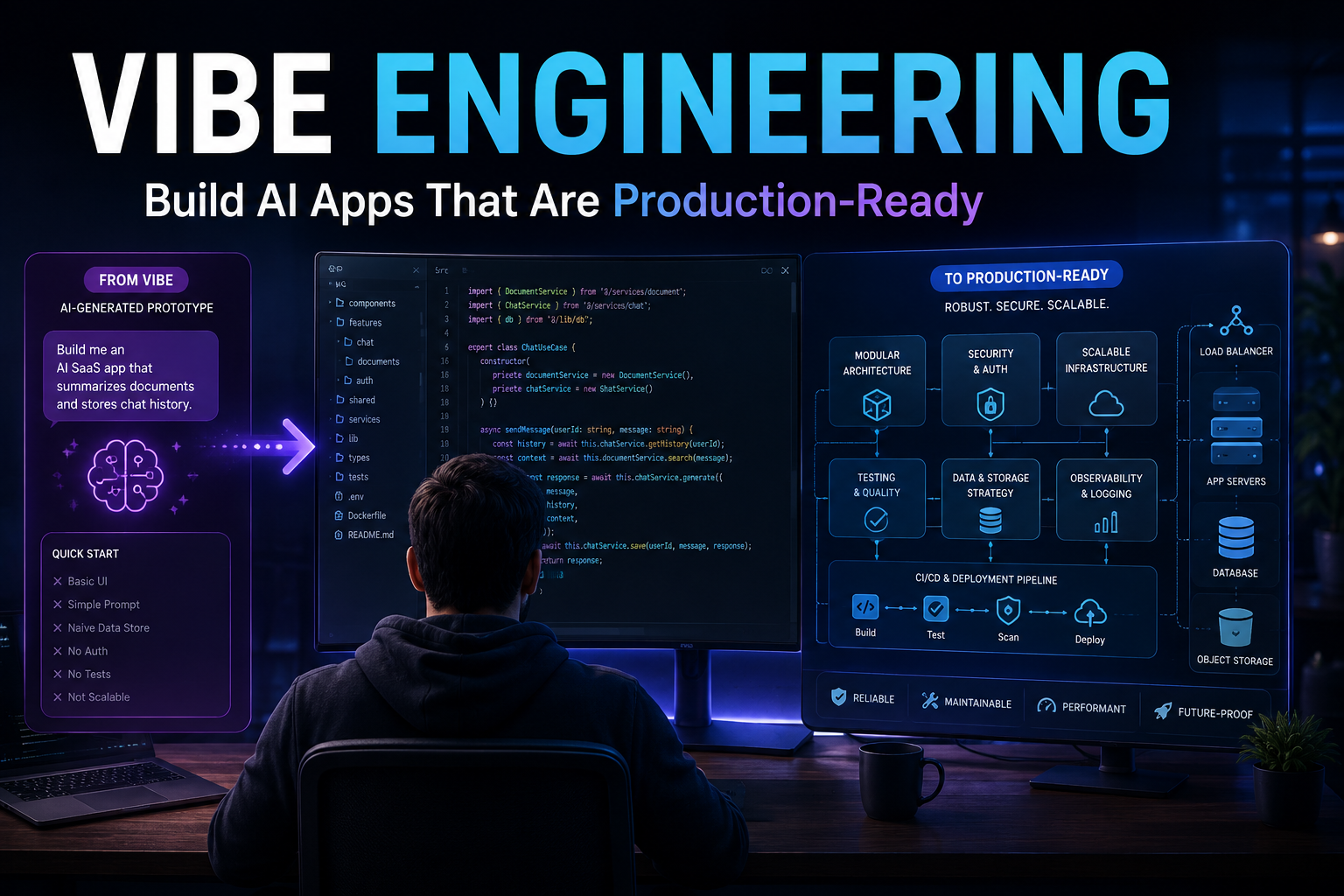
Vibe engineering is an AI-assisted software development approach that combines the speed of AI coding with real software engineering practices.
Instead of simply asking an AI coding assistant to generate an application and publishing whatever it produces, vibe engineering focuses on architecture, security, modularity, testing, scalability, deployment and long-term maintainability.
The idea is simple.
Let AI handle much of the implementation while you remain responsible for the engineering decisions that determine whether the application can survive in the real world.
With vibe engineering, you might describe an application in natural language, ask AI to propose the architecture, review that architecture and divide the application into independent modules.
Then the AI implements those modules one at a time.
This is where vibe engineering differs from simple vibe coding.
Vibe coding can be excellent for rapidly turning an idea into a working prototype.
Vibe engineering takes that speed and combines it with the practices required to turn the prototype into dependable software.
The Four Barriers Every Vibe Engineering Project Eventually Faces
Most prototype-to-production problems belong to a few major categories.
Understanding these categories makes it easier to give AI better instructions.
Security
Public applications receive bots, suspicious inputs, login attempts and automated vulnerability scans. Security should be part of your architecture from the beginning.
Scalability
A feature that works instantly for one user may become slow when hundreds of people use it simultaneously. Databases, APIs and servers all have limits.
Production
Your development computer and your production environment are different. Domains, HTTPS, databases, secrets, workers and environment variables must be configured correctly.
Observability
When something fails, your system should provide enough information to understand the problem. Without useful logging, production debugging becomes guesswork.
Security Begins When Your Application Becomes Public
Your website does not need thousands of visitors before automated bots begin discovering it.
Internet scanners constantly search public servers for weak passwords, exposed files, outdated software, insecure APIs and other vulnerabilities.
$ vibe-engineering-security-check

✓ HTTPS enabled
✓ Debug mode disabled
✓ Environment secrets protected
✓ Login endpoint rate limited
✓ Authorization rules verified
✓ Uploaded files validated
✓ Dependencies reviewed
✓ Database backups configured
A vibe engineering workflow should explicitly tell AI which protections are expected.
Example: Allowing Users to Submit URLs
Suppose your application allows a customer to submit a URL.
Your server visits that URL and generates a preview.
This appears simple, but allowing your server to make requests to arbitrary addresses can create security problems if internal destinations are not blocked.
You do not necessarily need to manually write every protection.
You need to understand the security concept well enough to tell AI that the protection must exist.
How Vibe Engineering Changes AI Software Development
Vibe engineering becomes much more reliable when you stop treating AI as an all-knowing software architect.
Instead, treat it like an incredibly fast implementation partner.
You decide the standards.
AI helps execute those standards.
| Basic Vibe Coding | Vibe Engineering |
|---|---|
| Start generating immediately | Define architecture and product flow first |
| Accept the first solution | Review the proposed technical approach |
| Generate large features together | Build independent modules |
| Test only successful scenarios | Test failures and edge cases |
| Hardcode configuration | Use environment configuration and secrets |
| Debug through guesswork | Use structured logging and error monitoring |
| Make large changes without backups | Save known-good versions with Git |
Vibe engineering does not require becoming faster than AI at writing syntax.
It requires understanding software concepts well enough to recognize which solutions your application needs.
Why Modularity Is Essential for Vibe Engineering
One of the easiest ways to make an AI-generated application difficult to maintain is allowing everything to grow inside a few enormous files.
Imagine one backend file containing authentication, payments, subscriptions, email delivery, AI generation, analytics and administrator tools.
Every small change forces AI to reason about thousands of lines of unrelated code.
Poor Structure
Authentication
Payments
AI Requests
Emails
Reports
Admin Tools
API Endpoints
Vibe Engineering Structure
Modularity is especially valuable when AI is writing or modifying code.
Smaller modules reduce context size and help prevent unrelated functionality from being accidentally changed.
Four Vibe Engineering Habits That Improve AI Development
Understand the Product Flow First
Before asking AI to generate code, understand how information should move through the application.
What does the customer do first? What data gets stored? Which service processes that data? What happens when the request succeeds? What happens if it fails?
Ask AI for a Plan Before Code
Ask the AI to propose the architecture and implementation sequence first.
Review that plan before allowing it to generate thousands of lines of code.
Build One Block at a Time
Complete one core workflow before adding dozens of secondary features.
Small verified changes are easier to troubleshoot than massive AI-generated updates.
Save Every Working Version
Use version control such as Git.
Whenever a major feature works, save that known-good state before requesting another substantial AI modification.
The Vibe Engineering Development Loop
Then repeat the cycle.
The Vibe Engineering Building Blocks You Should Know
You do not need to memorize how to manually implement every production pattern.
You should understand what these patterns do and when your application needs them.
Database Connection Pooling
Databases cannot necessarily accept unlimited simultaneous connections.
When traffic increases, poor connection management can cause applications to become slow or unavailable.
Connection pooling maintains a controlled collection of reusable database connections.
Environment Variables and Secret Management
Production API keys, passwords and payment credentials should not be hardcoded inside your source code.
Vibe engineering projects should separate secrets from application code using secure environment configuration.
Structured Logging
A production application should be able to explain what happened when something fails.
Structured logs can include timestamps, request identifiers, operation names and safe contextual information.
Idempotency
Sometimes the same operation reaches your application more than once.
A customer may double-click a button. A payment service may retry a webhook. A network timeout may cause software to repeat a request.
Idempotency prevents the repeated request from creating repeated side effects.
Rate Limiting
Resource-intensive endpoints should not be available without limits.
This becomes especially important for AI applications where every generation request may cost money.
Background Jobs
Some operations should not happen while a customer waits for a web request to finish.
Large file processing, long AI tasks, video conversion and bulk email delivery may be better handled through a background job queue.
Create a Permanent Vibe Engineering Rules File
Once you know the standards you want every AI-generated feature to follow, you should not need to type those standards repeatedly.
Many AI coding environments allow you to provide persistent project instructions.
Use those instructions as your vibe engineering playbook.
Example Vibe Engineering Rules
- Use modular architecture with one clear responsibility per module.
- Never hardcode passwords, tokens or production secrets.
- Validate all untrusted user input.
- Verify authorization on the server.
- Use structured logging for important events.
- Handle external API failures and timeouts.
- Review database queries and indexes.
- Make payment operations and webhooks idempotent.
- Add rate limiting to abuse-prone endpoints.
- Add automated tests for important business logic.
- Never expose sensitive information through error messages.
- Use established packages for common infrastructure whenever possible.
A Practical Vibe Engineering Roadmap
You do not need to understand every software concept before using AI.
Instead, gradually improve your engineering knowledge while continuing to build.
Build Something With AI
Start by creating a prototype. Experience how quickly an idea can become working software.
Learn Software Vocabulary
Understand concepts such as frontend, backend, database, API, endpoint, server, cache, DNS, deployment and authentication.
Learn Modular Architecture
Separate user accounts, payments, AI features, notifications, analytics and other major concerns.
Use Proven Components
Learn when frameworks, libraries and external services are better than rebuilding common infrastructure yourself.
Plan Before Generating
Ask AI to explain architecture, identify risks and propose an implementation sequence before creating major features.
Learn Production Patterns
Understand rate limiting, connection pooling, caching, queues, logging, idempotency and secret management.
Harden the Application
Review security, authentication, authorization, backups, monitoring, testing and production configuration.
Ship and Improve
Use real production data, logs and error reports to continuously improve the application.
Vibe Engineering Works Better With Proven Frameworks
A mature development framework can dramatically reduce the number of decisions you and your AI assistant need to make.
Frameworks often provide established solutions for common application requirements.
User Accounts
Use established authentication tools instead of inventing password security from scratch.
ORM and Migrations
Database abstraction and migrations help manage schema changes safely.
Built-In Protection
Mature frameworks frequently provide defenses against common web security mistakes.
Established Conventions
Consistent project structures make applications easier for developers and AI assistants to understand.
Popular options may include Django, Laravel, Rails, Next.js and other established ecosystems.
Vibe Engineering With Boilerplates
Starting every new software project with an empty folder can create hundreds of unnecessary decisions.
How will authentication work?
Which database should you use?
How will email verification work?
How will customers pay?
How should the folder structure be organized?
A quality boilerplate solves many of these problems before development begins.
SaaS Starter
Accounts, subscriptions, database structure, email verification and deployment configuration.
AI App Starter
AI provider integrations, usage tracking, credits, queues and generation history.
API Starter
API keys, authentication, request limits, usage tracking and structured error handling.
Mobile Starter
Authentication, backend integration, subscriptions and push notifications.
Vibe engineering is not about rebuilding common infrastructure repeatedly.
It is about using reliable foundations so you can concentrate on the unique value of your application.
Use Vibe Engineering to Build Better AI Apps
Save this guide and use the prompts as a checklist whenever you turn an AI-generated prototype into a real product.
View the Vibe Engineering RoadmapHow to Start Using Vibe Engineering Today
1. Document Your Architecture
Ask your AI assistant to explain the current architecture, major components, data flow and dependencies of your application.
2. Identify Weak Areas
Review the application separately for security, scalability, reliability, deployment and maintainability.
3. Create Your Vibe Engineering Rules
Turn your preferred engineering standards into permanent AI project instructions.
4. Improve One Production Block at a Time
Add logging, configuration validation, rate limiting, backups, monitoring and other production systems gradually.
5. Continue Shipping
Vibe engineering should not remove the speed advantage of AI.
It should allow you to keep that speed while reducing mistakes.
Vibe Engineering Makes Engineering Judgment More Valuable
AI is making software implementation dramatically faster.
As writing code becomes easier, deciding what code should exist becomes more important.
Which architecture should you use?
What belongs in the database?
Which operations require background workers?
Where should you use caching?
Which information belongs in your logs?
What happens if the same request is submitted twice?
What happens when an API provider fails?
What happens when thousands of customers arrive simultaneously?
These are vibe engineering questions.
AI can help solve them, but you must understand enough to ask the right questions.
Use AI to move incredibly fast. Then combine that speed with sound engineering decisions when your application becomes something real people depend on.
Frequently Asked Questions About Vibe Engineering
What is vibe engineering?
Vibe engineering is an AI-assisted software development approach that combines AI-generated code with architecture, security, testing, modularity, deployment and production engineering practices.
What is the difference between vibe engineering and vibe coding?
Vibe coding focuses primarily on using natural-language instructions to quickly generate software. Vibe engineering adds the technical discipline required to make that software secure, maintainable and production-ready.
Can beginners learn vibe engineering?
Yes. Beginners can start by using AI to build prototypes while gradually learning important software concepts such as databases, APIs, authentication, modularity, deployment and security.
Do I need to know programming before learning vibe engineering?
You do not necessarily need deep programming knowledge before starting. However, understanding basic software architecture and engineering concepts becomes increasingly valuable as your applications become more complex.
Can vibe engineering be used for SaaS applications?
Yes. SaaS products are a strong use case because AI can help generate dashboards, user accounts, subscriptions, APIs and other features while established engineering patterns can provide security and reliability.
Is AI-generated code safe for production?
AI-generated code should be reviewed and tested before being trusted in production. Security, authorization, data protection, error handling and infrastructure configuration should receive deliberate attention.
Why is modularity important in vibe engineering?
Modular architecture gives AI smaller areas of code to reason about, helping reduce accidental modifications to unrelated features and making applications easier to test and maintain.
Should I use Git with vibe engineering?
Yes. Version control is extremely useful when AI is making frequent changes because it allows you to restore a previous working version if a new modification creates problems.
What should I learn first for vibe engineering?
Start with software vocabulary such as frontend, backend, database, API, authentication, server, deployment, caching, queues and logging. Then gradually learn production patterns such as rate limiting, idempotency and connection pooling.
Will vibe engineering replace software engineers?
Vibe engineering is better understood as a change in how software development is performed. AI can reduce manual coding work, but architecture, product judgment, testing, security and reliability remain important.
Build With AI. Engineer for the Real World.
Use vibe engineering to combine the speed of artificial intelligence with the architecture and reliability required for production software.
Learn Vibe Engineering ↑