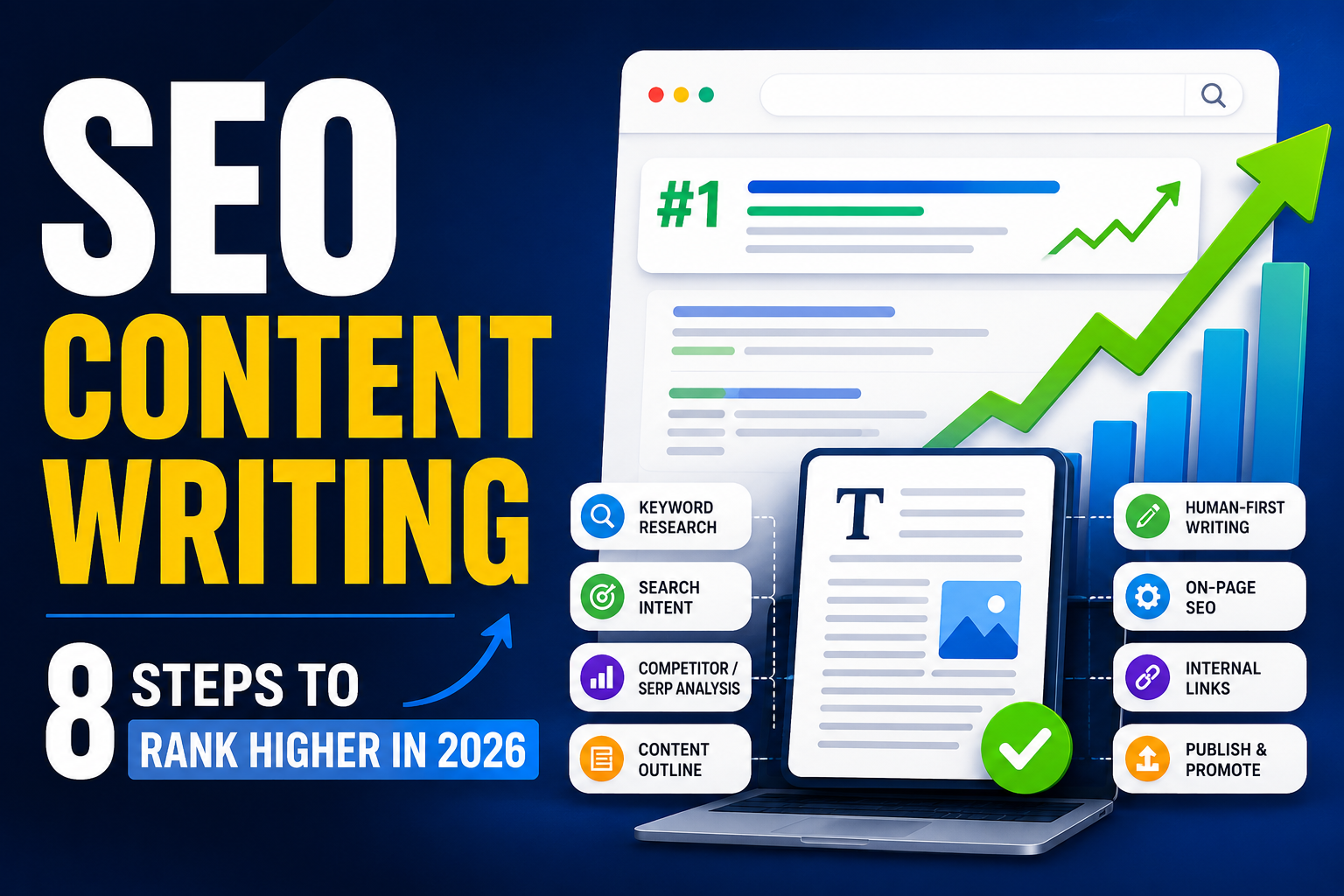
SEO Content Writing: 8 Practical Steps to Create Content That Ranks in 2026
Learn a repeatable SEO content writing process for choosing realistic keywords, matching search intent, building stronger outlines, writing useful content, and optimizing every page before you publish.
SEO content writing is not simply putting a keyword into an article several times. The pages that earn consistent search traffic usually do three things well: they answer the right question, they make the answer easy to consume, and they give search engines enough context to understand exactly what the page is about.
That means your job starts long before you write the introduction. A strong SEO article begins with research, moves through search intent and content planning, and ends with a deliberate optimization pass.
Choose a Keyword You Can Realistically Compete For
Every SEO article needs a clear primary topic. In most cases, that topic is represented by a primary keyword or search query. The mistake beginners make is choosing a phrase only because it has a large search volume.
A keyword can look attractive and still be a poor target. If the first page is dominated by major publishers, government websites, huge ecommerce brands, or sites with much stronger backlink profiles than yours, ranking may take far more authority than you currently have.
Start with relevance before volume
Ask one question first: Would the person searching this phrase realistically benefit from my website? If the answer is no, the keyword does not matter even if it receives thousands of searches.
Use keyword research tools as estimates, not absolute truth
SEO platforms can help you compare search volume, competition, related queries, and ranking pages. Popular choices include Semrush, Ahrefs, and Ubersuggest. Google Search Console is also extremely useful once your site already receives impressions.
Do not treat a keyword difficulty score as a guarantee. Each SEO platform calculates difficulty differently. Instead, use the number as one clue and then inspect the actual search results yourself.
A simple keyword qualification checklist
- The keyword clearly matches your website and audience.
- The current ranking pages are the same type of content you can create.
- At least a few first-page results appear beatable in quality or depth.
- The query has enough commercial or strategic value to justify the work.
- You can add something useful that the existing results do not already explain well.
Mine competitors for realistic topics
Instead of beginning with a giant list of random keywords, identify several websites that are close to your own size and cover a similar niche. Look at the pages that bring them organic traffic. Those topics are often more realistic than the biggest keywords in the industry.
For a newer website, a specific long-tail phrase can be more valuable than a broad term. “SEO” is extremely broad. “SEO content writing checklist for small business blogs” is much narrower, but it also reveals exactly what the searcher wants.
Identify the Real Search Intent Behind the Keyword
Search intent is the purpose behind a query. Two keywords can contain similar words while requiring completely different pages.
| Intent | What the searcher wants | Typical content |
|---|---|---|
| Informational | Learn or solve a problem | Guide, tutorial, explanation |
| Commercial | Compare options before buying | Reviews, “best” lists, comparisons |
| Transactional | Take action now | Product, service, signup or checkout page |
| Navigational | Reach a particular website or brand | Homepage, login, brand page |
The easiest way to understand intent is to search the keyword and inspect the first page. Google has already gathered a huge amount of behavioral data. The type of pages it currently ranks is therefore a useful clue about what users tend to prefer for that query.
Look beyond the basic intent category
Calling a keyword “informational” is only the beginning. You should also determine the preferred format, level of expertise, and expected outcome.
For example, someone searching “SEO content writing” may want a beginner-friendly process, examples, optimization advice, and tool recommendations. A page that only defines SEO writing in 300 words may technically be relevant, but it probably does not satisfy the full job the searcher is trying to accomplish.
Study the Pages Already Winning the Search Results
Competitive research is not about copying headings from the top ten results. It is about understanding the minimum standard Google is currently rewarding and then finding opportunities to produce a better resource.
What to record during a SERP review
- Common subtopics that appear in multiple ranking pages.
- Questions that are answered poorly or not answered at all.
- The dominant page format: tutorial, list, review, comparison, glossary, or landing page.
- Whether the results are written for beginners, professionals, or buyers.
- Use of examples, original data, visuals, templates, calculators, or demonstrations.
- How recently the top pages were updated.
You can also study “People also ask,” related searches, forums, customer reviews, and community discussions. These sources reveal language and frustrations that keyword tools sometimes miss.
Do not imitate the page structure too closely
If every competitor uses the same five sections, those sections may be important because they reflect search intent. But your article should not simply reproduce the same sequence with different wording.
Find a way to improve the experience. You might add a checklist, decision table, expert quote, workflow graphic, downloadable template, clearer examples, or a section addressing an overlooked problem.
Create a Stronger Angle Before You Start Writing
Your angle is the perspective that makes your article useful compared with all the other pages discussing the same subject.
The keyword may tell you the topic, but it rarely tells you the complete angle. “Email marketing tips” could become a beginner guide, a list for ecommerce brands, a case study, a data-backed report, or a “mistakes to avoid” article.
The best angle often combines the dominant search format with something distinctive. If the SERP clearly favors step-by-step guides, you may still use a guide format while differentiating your article through examples, templates, data, or a specialized audience.
Write a Headline That Works for Search and Humans
An SEO headline has two jobs. It must clearly communicate topical relevance to the search engine, and it must make a human want to click.
That does not require clickbait. A strong headline usually combines clarity, the primary keyword or a close variation, and a specific benefit.
Better: SEO Content Writing: 8 Steps to Create Content That Ranks
Why it is better: it names the topic, promises a process, and explains the outcome.
Useful headline formulas
- How to + desired result: How to Write SEO Content That Attracts Organic Traffic
- Number + outcome: 11 SEO Writing Tips for Better Rankings and Readability
- Beginner qualifier: SEO Content Writing for Beginners: A Practical Guide
- Problem/solution: Why Your SEO Content Is Not Ranking — and How to Fix It
Keep the important words close to the beginning. If a title becomes very long, search engines may display a shortened version. More importantly, readers should understand the promise instantly.
Build the Outline Before You Draft
An outline prevents a common SEO writing problem: producing a long article that still feels incomplete. It gives every section a purpose before you invest time in the prose.
Start with the questions the article must answer
Imagine you are having a conversation with the searcher. What would they ask first? What confusion would appear next? What would stop them from taking action?
For an article on SEO content writing, a logical sequence might be:
- How do I pick a keyword?
- How do I know what Google wants?
- What should I learn from competitors?
- How can I make my content different?
- How do I structure the article?
- How do I write it well?
- What should I optimize before publishing?
Add proof and examples to the outline
Do not outline only headings. Under every heading, add the facts, examples, screenshots, expert sources, data points, internal links, and calls to action you may want to include. This makes the writing stage faster and reduces unsupported claims.
Outline template
H1: Primary topic + benefit
Introduction: problem, promise, reason to continue
H2 #1: foundational concept
H2 #2: first major action step
H2 #3: next logical action step
H2 #4: examples / mistakes / decision support
FAQ: unresolved search questions
Conclusion: summarize the process and give a clear next action
Do not chase word count for its own sake
Longer content is not automatically better. Use competing pages to understand the expected depth, then write enough to solve the query completely without stretching simple points into unnecessary paragraphs.
If the topic can be answered exceptionally well in 1,500 words, adding another 2,000 words of filler does not make the page stronger.
Write for Humans First
The drafting stage is where many writers overthink SEO. They try to force the target phrase into every paragraph, which produces stiff and repetitive content.
Instead, write the best explanation you can. If you genuinely stay on topic, natural variations and related concepts will appear without deliberate keyword stuffing.
Keep paragraphs easy to scan
Online readers frequently skim before they commit to reading. Short paragraphs, descriptive subheadings, lists, tables, callout boxes, and graphics make the page easier to understand.
A paragraph should contain one main idea. When the idea changes, start a new paragraph.
Use concrete examples
Abstract advice is easy to forget. Examples help a reader see exactly how to apply the concept.
Concrete version: If the query is “best email marketing software,” and nearly every first-page result is a comparison list, publishing a dictionary-style definition of email marketing software is unlikely to satisfy the query.
Demonstrate first-hand value when possible
Use original observations, screenshots, experiments, product experience, examples from your own work, or clearly attributed expert sources. Content becomes more useful when the reader can see where the conclusions came from.
Write introductions that move quickly
Your introduction does not need a long story unless the story is relevant. A strong introduction usually does three things: identifies the reader’s problem, explains what the article will help them accomplish, and creates a reason to continue.
Optimize the Finished Article Before Publishing
Once the draft is complete, switch from writer mode to editor mode. This is where you refine on-page signals without damaging readability.
Place the primary keyword naturally
There is no universal keyword-density percentage that guarantees rankings. A better approach is to make sure the primary topic is clear in the locations readers and search engines naturally use to understand a page.
- Include the primary keyword or a very close variation in the H1.
- Use it naturally near the beginning of the introduction.
- Use a related variation in at least one meaningful H2 or H3 when appropriate.
- Write a clean, descriptive URL slug.
- Use the topic naturally in the conclusion if it fits.
Write an SEO title and meta description
The SEO title is one of the most important elements for relevance and click-through rate. Keep it descriptive and useful instead of stuffing several keyword variations into one line.
Suggested SEO title:
SEO Content Writing: 8 Steps to Rank Higher in 2026
Suggested meta description:
Learn SEO content writing in 8 practical steps, from keyword research and search intent to outlines, on-page optimization, links, and publishing.
Suggested URL slug:
/seo-content-writing/
Optimize images without breaking the page
Large images can make an otherwise good article feel slow. Resize oversized files before uploading them and use modern formats such as WebP or AVIF when your WordPress setup supports them.
Write alt text for accessibility first. Describe what the image shows. Use a keyword only when it naturally belongs in the description.
Add structured data where appropriate
Article and FAQ structured data can help search engines interpret page content, although markup alone does not guarantee enhanced search results. The HTML in this template includes Article and FAQ JSON-LD that you can keep or remove depending on your SEO plugin and schema setup.
Build Internal Links and Helpful External References
Links are part of the reading experience, not decoration. Good internal links help visitors continue learning and help search engines understand the relationship between pages on your site.
Internal links
Use descriptive anchor text that explains the destination. For example, instead of “click here,” write “learn how to start a blog” or “see our keyword research guide.”
Below are placeholder internal links you can replace with the correct URLs on your own website:
External authority links
Link to high-quality sources when they help verify or expand a claim. For SEO education, useful references can include Google Search Central and reputable SEO tool providers.
Affiliate and referral links
If you have an affiliate relationship with a tool you recommend, use your actual tracking URL and make the relationship clear to the reader. Affiliate links should normally include rel="sponsored nofollow".
SEO Writing Toolbox
These are useful research tools you can reference or replace with your own affiliate URLs.
Explore Semrush Explore Ahrefs Explore UbersuggestA Pre-Publish SEO Content Checklist
- The article answers one clear primary search intent.
- The H1 clearly describes the topic and benefit.
- The target keyword appears naturally, not mechanically.
- Every major section adds new information.
- The page includes examples, evidence, or practical demonstrations.
- Paragraphs and headings are easy to scan on mobile.
- Images are compressed and have useful alt text.
- Internal links point readers to relevant supporting content.
- External links are added where they improve trust or usefulness.
- The SEO title and meta description are compelling and accurate.
- The URL is short and descriptive.
- You checked the page on mobile before publishing.
SEO Content Writing FAQ
What is SEO content writing?
SEO content writing is the process of creating useful content around a clearly defined search topic while making the page easy for both readers and search engines to understand. It combines research, search intent, structure, writing quality, internal linking, and on-page optimization.
How many times should I use my target keyword?
There is no universal keyword-density number that guarantees rankings. Use the keyword where it helps clarify the subject, including the title and introduction, and use natural related language throughout the article. Avoid repetitive keyword stuffing.
How long should an SEO article be?
It should be long enough to satisfy the query completely. Competitive research can help you understand expected depth, but usefulness matters more than hitting an arbitrary word count.
Do backlinks still matter for SEO content?
Links can still influence authority and discovery, but strong content should not rely on backlinks alone. Search intent, content quality, internal linking, site reputation, technical accessibility, and overall usefulness all contribute to organic performance.
Can AI write SEO content?
AI can help with brainstorming, outlines, summarization, and editing, but the finished page should be accurate, useful, original, and reviewed by a person. Add first-hand examples, evidence, experience, and editorial judgment rather than publishing generic generated text unchanged.
Turn SEO Content Writing Into a Repeatable System
Ranking content is rarely the result of one trick. It is the result of a process you can repeat: choose a realistic keyword, understand the searcher, study the SERP, find an angle, outline the page, write the best answer you can, and then optimize the finished article.
When you follow that sequence, SEO becomes much less mysterious. You are no longer guessing what to write. You are making deliberate decisions at every stage of the page.
Most importantly, do not build content only for an algorithm. Build the page a real person would be happy to find after searching the keyword. That is the standard worth aiming for.
Disclosure: If you add affiliate links to this article, clearly disclose the relationship to readers and use the appropriate sponsored link attributes.