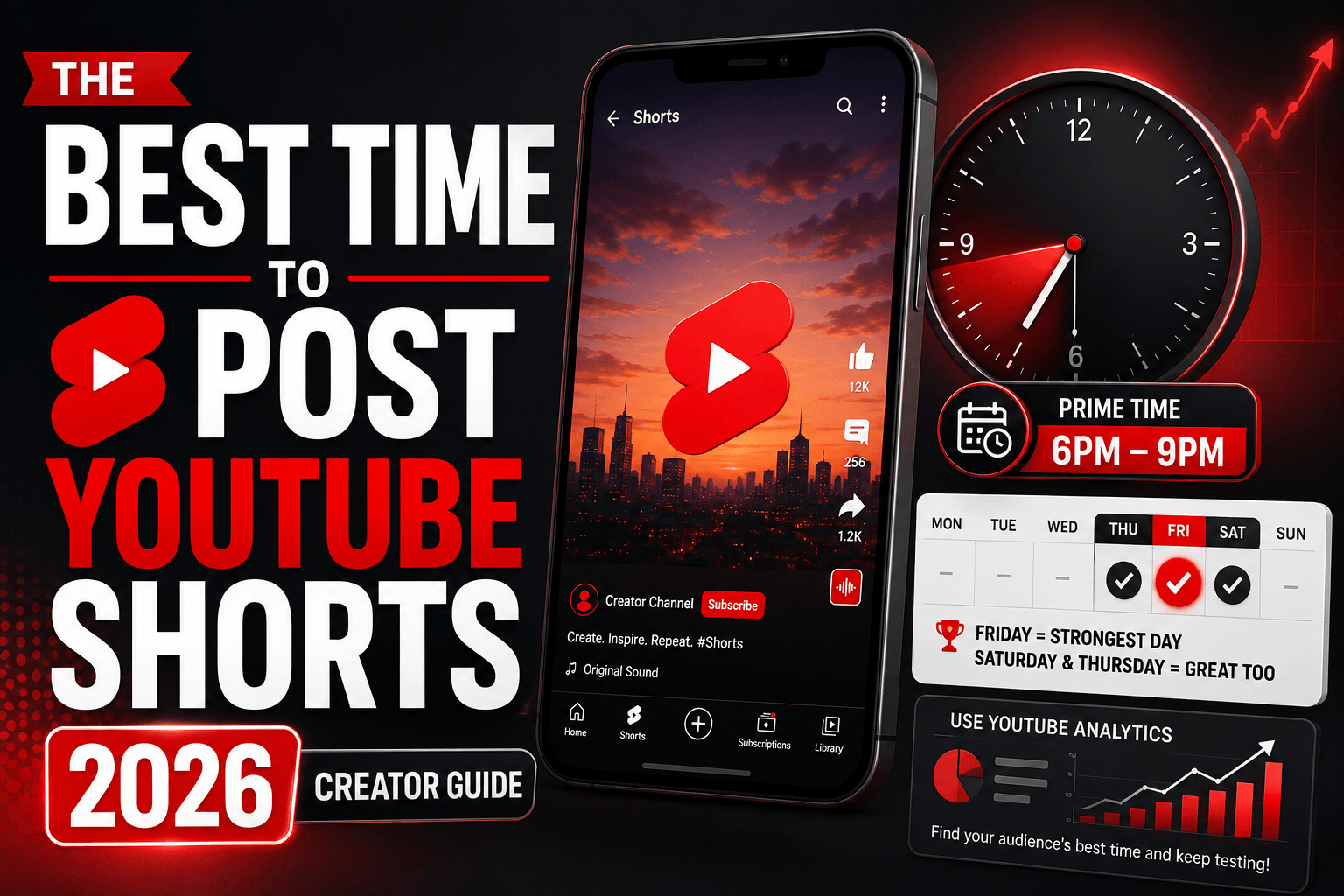
The Best Time to Post YouTube Shorts (2026 Creator Guide)
Making a great YouTube Short is only half of the equation.
You can have a strong hook, fast editing, an interesting topic, and a great call to action — but you still need viewers to discover the video.
That’s why creators frequently ask one important question: What is the best time to post YouTube Shorts?
The simple answer is that there isn’t one publishing time that works for every YouTube channel.
Your audience’s location, age, daily routine, niche, viewing habits, and even the type of content you’re publishing can all change the ideal posting window.
However, there are useful patterns you can use as a starting point.
In this guide, I’ll break down the best starting times, explain which factors matter most, and show you a simple testing system you can use to find the posting schedule that works for your own channel.
Table of Contents
What Is the Best Time to Post YouTube Shorts?
For many creators, a good starting window is between the late afternoon and evening.
This makes practical sense. Students may be finishing school, employees may be leaving work, and more viewers may have free time to scroll through short-form videos.
Recent 2026 research from Buffer analyzing a large number of YouTube videos also found a noticeable difference between long-form YouTube viewing behavior and Shorts.
Long-form videos tended to perform strongly earlier in the day, while Shorts showed stronger performance during evening hours.
A Strong Starting Point
If your channel doesn’t have enough historical data yet, begin testing around:
6:00 PM – 9:00 PM in your target audience’s local time.
Don’t treat this as a guaranteed viral window. Treat it as the first hypothesis you are going to test.
For example, imagine you run a channel about personal finance.
Your viewers may watch longer educational videos in the morning or during lunch breaks, but they may consume quick money tips, financial facts, or motivational Shorts while relaxing at night.
A gaming channel, beauty channel, education channel, comedy channel, or business channel can have completely different audience patterns.
That’s why generic timing recommendations should always be considered a starting point rather than a permanent rule.
What Are the Best Days to Post YouTube Shorts?
Current industry data suggests the end of the workweek and weekend can be particularly interesting for Shorts creators.
A reasonable testing schedule looks something like this:
| Day | Suggested Test Window | Testing Priority |
|---|---|---|
| Monday | 6 PM – 9 PM | Normal |
| Tuesday | 6 PM – 9 PM | Normal |
| Wednesday | 6 PM – 9 PM | Normal |
| Thursday | 6 PM – 9 PM | High |
| Friday | 4 PM – 9 PM | Very High |
| Saturday | 6 PM – 9 PM | High |
| Sunday | Afternoon – Evening | Worth Testing |
Again, don’t schedule every Short according to this table forever.
As soon as you have enough audience data, your own analytics should take priority over generic benchmarks.
Timing Factors That Can Affect Your YouTube Shorts Performance
The clock isn’t the only thing controlling your results.
Here are five factors worth considering before deciding when to press Publish.
Day of the Week
Your viewers probably don’t behave exactly the same way seven days a week.
Weekdays are structured around work, school, commuting, lunch breaks, and evening downtime. Weekends may offer longer periods of casual browsing.
That means the best day for your channel depends heavily on who watches your content.
Time of Day
The same Short can encounter a very different initial audience depending on whether you post at 7 AM, 2 PM, or 8 PM.
When possible, publish while a meaningful portion of your target audience is already active on YouTube.
That gives your new content an opportunity to collect early views, engagement, and viewer-behavior signals.
Your Audience’s Lifestyle
Think about the person on the other side of the screen.
Are your viewers students? Business owners? Parents? Gamers? Night-shift workers? Retirees? People in another country?
A channel aimed at teenagers can have completely different peak periods from one aimed at executives.
The closer your publishing schedule matches your audience’s lifestyle, the more useful your timing strategy becomes.
Trending Topics
Timing becomes even more important when your Short covers something that is happening right now.
If a news story, meme, product launch, challenge, sporting event, or online conversation suddenly takes off, publishing quickly may matter more than waiting for your normal posting hour.
A trend may have a limited attention window.
When relevance is disappearing by the hour, speed can beat an otherwise perfect content calendar.
Your Competitors
Studying successful channels in your niche can reveal useful patterns.
Look at when they tend to publish Shorts and which videos receive unusually strong engagement.
You aren’t trying to copy their schedule.
Instead, you’re looking for patterns and opportunities.
You may even discover that your competitors are ignoring a time slot where your audience is still active.
Use YouTube Analytics Before Trusting Any Generic Posting Schedule
Once your channel has enough viewer data, one feature becomes much more useful than almost any generic internet recommendation:
YouTube Studio’s Audience analytics.
Inside the Audience area, YouTube can provide a report showing when people who watch your channel are active across YouTube.
You should also pay attention to where your viewers live.
If you live in New York but most of your audience is in California, posting according to your own local evening may not make sense.
Likewise, a channel with audiences spread throughout the United States, Europe, Asia, and the Caribbean may need to experiment with several publishing windows.
How to Find the Right Time to Post Your YouTube Shorts
You don’t need to guess forever.
Use a structured experiment.
Step 1: Choose Several Testing Windows
Start with three different time periods.
For example:
- 12 PM – 2 PM
- 4 PM – 6 PM
- 7 PM – 9 PM
Rotate your Shorts between these windows instead of randomly choosing a different hour every day.
Step 2: Review Your YouTube Analytics
Open YouTube Studio and study how viewers respond to each group of Shorts.
Don’t judge your results using views alone.
Look at several metrics together:
- Views
- Average percentage viewed
- Watch time
- Likes
- Comments
- Subscribers gained
- Shares
- Viewed versus swiped away
A time slot that generates slightly fewer views but substantially better retention could still be valuable.
Step 3: Build a Consistent Schedule
After you identify promising windows, establish a schedule you can realistically maintain.
If publishing every day causes your video quality to collapse, publishing slightly less often with better hooks and stronger editing may be the smarter choice.
Your schedule should support the quality of your content — not destroy it.
Step 4: Keep Refining the Schedule
Your ideal posting time can change.
A growing channel may attract viewers from new countries. Your audience may get older. Seasonal behavior can change. Your content niche can shift.
Review your numbers periodically instead of assuming the schedule that worked six months ago will always be best.
Posting Time Won’t Save a Weak YouTube Short
Timing gets a lot of attention because it’s easy to change.
But publishing at exactly the right minute won’t automatically turn weak content into a successful Short.
Your video’s ability to capture and maintain attention is still extremely important.
Before obsessing over your upload schedule, make sure your Short has:
- A strong opening hook
- A clear topic viewers understand immediately
- Fast pacing without unnecessary filler
- Readable on-screen text when appropriate
- A reason to keep watching
- A payoff that matches the opening promise
- Clear audio
- A natural loop or satisfying ending
Should You Post According to Your Time Zone or Your Audience’s?
Generally, focus on the time zone of the people you are trying to reach.
For example, suppose you’re located in Europe but most of your viewers live in the United States.
Scheduling according to European prime time may cause your Short to appear while a large percentage of your American viewers are asleep or busy.
Your YouTube Studio geography reports can help you understand where your audience is located.
For channels with a global audience, consider rotating posting times and comparing results.
What If You Post Multiple YouTube Shorts Per Day?
If you’re publishing more than one Short per day, avoid putting every video online at exactly the same moment.
Spacing them out gives each Short its own testing window and makes your analytics easier to interpret.
For example, a creator publishing three Shorts could experiment with:
Then compare performance over several weeks.
Don’t draw a conclusion from two or three videos. One unusually strong topic can easily distort a small sample.
Common YouTube Shorts Posting Mistakes
1. Changing Your Posting Time Every Day
Random publishing makes your data difficult to interpret.
Test structured time slots so you can compare them.
2. Looking Only at First-Hour Views
A Short doesn’t necessarily finish getting distributed immediately after publication.
Some videos can receive additional exposure after their initial release, so evaluate performance over a larger window before declaring a post a failure.
3. Ignoring Audience Location
Your own clock matters less than your viewer’s clock.
Always consider the countries and time zones contributing the most watch time.
4. Assuming Every Channel Has the Same Peak Time
The best time for a fitness audience may not match the best time for gaming, education, beauty, comedy, music, or business content.
5. Sacrificing Quality Just to Hit a Posting Time
Publishing an unfinished video at 7 PM simply because your calendar says 7 PM is usually a poor trade.
A compelling Short published slightly later may outperform a weak Short posted at the supposed perfect time.
A Simple 4-Week YouTube Shorts Testing Schedule
Here’s a practical experiment you can use on a new or growing channel.
| Week | Primary Time | What to Measure |
|---|---|---|
| Week 1 | 12 PM – 2 PM | Views + retention |
| Week 2 | 4 PM – 6 PM | Views + retention |
| Week 3 | 7 PM – 9 PM | Views + retention |
| Week 4 | Best-performing window | Confirm previous result |
Keep the number and general quality of videos reasonably consistent throughout the test.
If you publish one exceptional viral topic during one week and weak content during another, you aren’t really comparing posting times anymore.
Want to Grow Your YouTube Channel Faster?
The right publishing schedule is only one part of a successful YouTube strategy. Strong topics, hooks, titles, editing, analytics, and consistent content production matter too.
Check Out My Recommended YouTube Tool →Frequently Asked Questions
What is the best time to post YouTube Shorts?
For a channel without enough analytics data, late afternoon and evening is a reasonable place to start testing. Recent 2026 data suggests Shorts often perform strongly during evening hours. However, your channel’s own Audience analytics should ultimately determine your schedule.
What is the best day to upload YouTube Shorts?
Friday is one of the strongest days worth testing, with Saturday and Thursday also useful candidates. Results can differ substantially depending on your audience and niche.
Is it good to post YouTube Shorts at night?
It can be. Evening viewing is particularly relevant for short-form content because viewers may have more free time after work, school, dinner, or other daily commitments.
Does posting time really matter for YouTube Shorts?
Timing can influence the audience available around publication, but it isn’t the only factor affecting performance. Topic selection, viewer satisfaction, retention, engagement, and the quality of the video itself remain important.
Should I delete and repost a Short if it gets few views?
Don’t automatically delete a Short simply because its first few hours are slow. Give the video time to collect data and evaluate why viewers may or may not be responding before deciding what to change.
How many YouTube Shorts should I post per day?
There isn’t one universal number that every creator must follow. Choose a frequency you can maintain without sacrificing video quality, then evaluate your analytics to determine whether increasing or decreasing your publishing frequency improves results.
Should I post at exactly the same time every day?
You don’t necessarily need to publish at the exact same minute each day. Consistency is useful, but testing several reliable publishing windows can help you discover when different parts of your audience are most active.
Final Thoughts
So, when should you publish your next YouTube Short?
If you’re starting without much channel data, the 6 PM to 9 PM range is a useful testing window, particularly toward the end of the week.
But don’t turn a general benchmark into an inflexible rule.
The creator who understands their own audience will almost always have an advantage over someone blindly following a generic posting-time chart.
Use YouTube Analytics. Test different periods. Track your results. Look at retention and engagement in addition to views.
Then repeat what works.
Ultimately, the goal isn’t to discover the best time to post on YouTube.
It’s to discover the best time to post for your audience.
Continue Reading
If you’re working on growing a YouTube channel, these guides can help you plan your next videos and improve your content strategy.
YouTube Audience Analytics: https://support.google.com/youtube/answer/9314416
Buffer 2026 YouTube Posting-Time Research: https://buffer.com/resources/best-time-to-post-on-youtube/