The Best Time to Post YouTube Shorts (2026 Data + Creator Strategy)
Timing will not rescue a weak Short. However, publishing when your audience is ready to watch can give strong content a better first push. In this guide, you will get a practical schedule to test, plus a repeatable way to find the best posting time for your own channel.
When should you publish a Short?
Recent large-scale data points to evenings as the strongest overall window for Shorts, with Friday standing out. Even so, your own YouTube Analytics should be the final decision-maker.
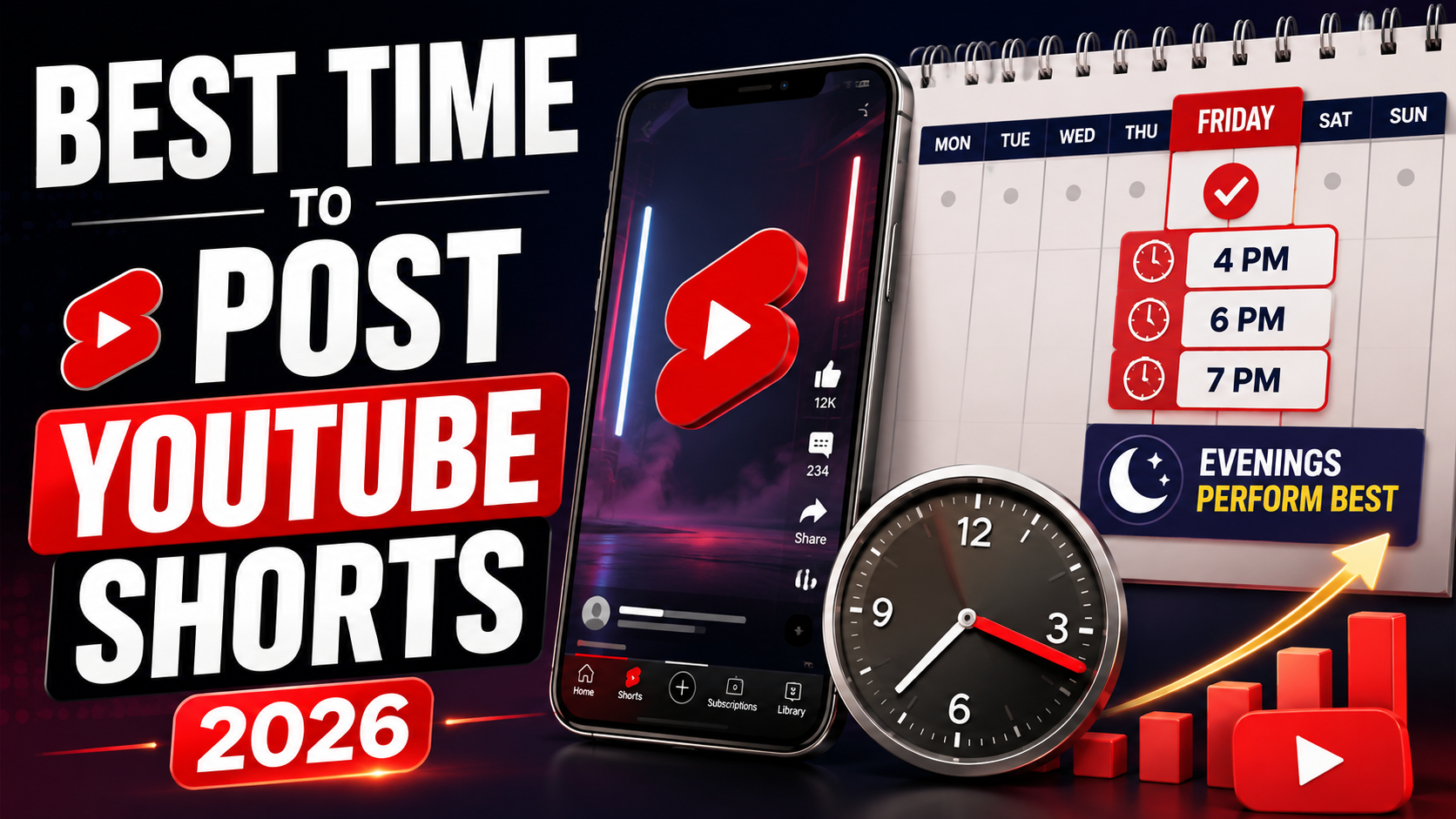
For a strong starting point, test Friday at 4 PM, 6 PM, or 7 PM.
Buffer’s July 2026 analysis of 1.8 million YouTube videos found that the top three Shorts posting slots were Friday at 4 PM, 6 PM, and 7 PM. Across the week, Shorts tended to perform best in the evening, roughly 6 PM–11 PM. Treat these as benchmark times in your audience’s local time, then refine them using your channel analytics.
What Is the Best Time to Post YouTube Shorts?
There is no universal hour that works for every channel. For example, a gaming channel with a teenage U.S. audience may peak late at night, while a business channel aimed at professionals can behave very differently. In addition, geography, age, school and work schedules, niche, posting frequency, and even the type of Short all influence when people are available to watch.
Still, broad datasets are useful because they give you a smarter place to start. In Buffer’s 2026 analysis, Shorts showed a much more evening-heavy pattern than long-form YouTube videos. Friday was particularly strong, and the top individual posting times were 4 PM, 6 PM, and 7 PM on Friday.
YouTube can also resurface Shorts after the initial upload window. In other words, a Short may begin slowly and then receive another wave of distribution hours or days later. Therefore, creators should avoid deleting a video just because the first hour looks disappointing.
Typical 2026 Shorts opportunity map
Illustrative visualization based on the evening-heavy pattern in Buffer’s dataBest Time to Post YouTube Shorts by Day
If your channel does not yet have enough audience data to reveal a clear pattern, the schedule below is a useful testing baseline. Specifically, these times reflect the strongest daily slots reported in Buffer’s 2026 Shorts analysis.
| Day | Best times to test | Practical use |
|---|---|---|
| Monday | 8 PM, 5 PM, 6 PM | Good for after-work or after-school viewing. |
| Tuesday | 8 PM, 9 PM, 7 PM | Lean later in the evening. |
| Wednesday | 7 PM, 8 PM, 9 PM | Strong, compact evening test window. |
| Thursday | 7 PM, 8 PM, 9 PM | Strong day Good lead-in to the weekend. |
| Friday | 4 PM, 6 PM, 7 PM | Best overall Make this a priority test day. |
| Saturday | 7 PM, 11 AM, 6 PM | Useful for both an evening test and a weekend morning test. |
| Sunday | 7 PM, 8 PM, 5 PM | Good for end-of-weekend scrolling. |
How to use these daily posting times
However, do not treat the table as a rigid publishing law. Instead, use it as a set of hypotheses. Then, choose two or three windows, post comparable content into each, and compare the results over several weeks.
When to replace the benchmark schedule
Once your channel has enough viewer data, let your own analytics take priority. In particular, compare the benchmark times with the darkest blocks in the Audience tab. If your viewers consistently peak at a different hour, follow that pattern and keep testing.
Timing Factors That Affect Shorts Performance
The same schedule can produce dramatically different results across two channels. Therefore, before deciding that a particular time is “bad,” consider the variables below.
Day of the week
Weekday routines and weekend routines are different. For instance, school, commuting, work, sports, events, and family time all change when viewers have a few minutes to scroll.
Time of day
Short-form video often fits naturally into breaks and evening downtime. However, your own audience may also have a morning or lunch-hour pocket that broad studies miss.
Viewer location
If most viewers are in New York, a 7 PM Eastern upload is very different from 7 PM Pacific. Consequently, international channels should optimize for the region responsible for the largest share of watch time.
Audience lifestyle
Students, parents, professionals, gamers, and retirees do not use YouTube on identical schedules. Therefore, match your posting rhythm to the real life of the person you are trying to reach.
Topic and trend speed
For breaking news or fast trends, publishing quickly can matter more than waiting for a “perfect” hour. In that case, if attention is peaking now, speed often beats schedule precision.
Competition and content supply
Look at when similar creators publish, but do not automatically copy them. Instead, test whether a less crowded period gives you cleaner access to your audience.
What about the YouTube Shorts algorithm?
Shorts distribution is not identical to a normal subscriber feed. For example, YouTube can test a Short with small groups, pause distribution, and later surface it to more viewers if the response is promising. As a result, the first 30–60 minutes matter, but they are not the entire life of the video.
Instead of judging a post only by first-hour views, track the full performance curve. For example, a healthy Short may show multiple bursts of distribution. In addition, pay attention to how many viewers choose to watch, average percentage viewed, rewatches, likes, comments, shares, and subscribers gained from the Short.
How to Find Your Best Posting Time in YouTube Analytics
The most useful timing data is already inside YouTube Studio. More importantly, YouTube’s Audience report includes a “When your viewers are on YouTube” chart based on viewer activity across YouTube during the previous 28 days.
Open YouTube Studio
First, sign in to your channel, open YouTube Studio, and select Analytics from the left-hand menu.
Go to the Audience tab
Next, choose Audience. Then, look for the purple activity chart showing when your viewers are online across YouTube.
Identify the darkest blocks
Darker periods indicate more of your viewers are online. Therefore, those are prime windows to test. For Shorts, start by posting around the beginning of a strong block rather than after it has nearly ended.
Compare against actual Short results
Finally, do not stop at the heatmap. Compare views, retention, engagement, subscriber conversion, and traffic patterns for Shorts published in different windows.
A 4-Step System to Find Your Personal Sweet Spot
Step 1: Pick three test windows
First, start with three clearly different publishing windows. For example, test Friday at 4 PM, Friday at 7 PM, and Wednesday at 8 PM. Most importantly, keep the experiment simple enough that you can tell what changed.
Step 2: Keep content quality reasonably comparable
Next, remember that a timing test becomes meaningless if one Short is an exceptional trend-driven video and the next is an average filler post. Therefore, group similar formats together: tutorials versus tutorials, reactions versus reactions, and tips versus tips.
Step 3: Track more than views
Views are important, but they do not explain everything. In addition, add columns for average percentage viewed, likes per 1,000 views, comments, shares, subscribers gained, and whether the Short received a second distribution wave.
Step 4: Run the test for several weeks
One viral post can distort the result. Therefore, a better decision comes from repeated observations. After 12–20 comparable Shorts, patterns usually become easier to see. At that point, keep the winners, remove consistently weak slots, and test a new time against your current best.
Simple posting-time test sheet
Copy this structure into Google Sheets or Notion| Date | Time | Topic | 24h views | Avg. % viewed | Subs |
|---|---|---|---|---|---|
| Week 1 | Fri 4 PM | Tip / How-to | _____ | _____ | _____ |
| Week 1 | Wed 8 PM | Tip / How-to | _____ | _____ | _____ |
| Week 2 | Fri 7 PM | Tip / How-to | _____ | _____ | _____ |
Sample YouTube Shorts Posting Schedules
Consistency is easier when you decide your rhythm before you start filming. For that reason, here are three practical schedules you can adapt.
For 3 Shorts per week
- Wednesday: 8 PM
- Friday: 6 PM
- Sunday: 7 PM
For 5 Shorts per week
- Monday: 8 PM
- Wednesday: 7 PM
- Thursday: 8 PM
- Friday: 4 PM or 7 PM
- Saturday: 7 PM
For daily Shorts
Publish during each day’s strongest evening window from the table above. Then, let your analytics replace the generic schedule over time. However, daily posting should not force you into weaker content. If quality drops, fewer high-retention Shorts can be more useful than filling every day.
Build a repeatable Shorts workflow
For a smoother workflow, create in batches, schedule ahead, and review your results once a week instead of guessing every day. If you also work with downloaded clips for content you own or have permission to reuse, you can organize your workflow with your existing creator tools.
Explore the YouTube Shorts DownloaderCommon YouTube Shorts Timing Mistakes
1. Obsessing over the minute
There is usually no meaningful difference between 7:00 PM and 7:07 PM. Therefore, think in windows, not magic minutes. In practice, a consistent evening block is more actionable than chasing false precision.
2. Ignoring time zones
Use the time zone of the audience you want to reach, not necessarily the one where you live. For example, if your top audience is in another country, schedule around them.
3. Changing too many variables at once
If you change topic, hook style, editing pace, video length, title, and posting time on every upload, you will not know what created the result. Instead, run cleaner tests.
4. Deleting Shorts too quickly
A slow start does not always mean the post is dead. In fact, Shorts can be resurfaced later. Therefore, unless there is a real error in the content, give the system time to gather signals.
5. Posting at a “best time” your audience never uses YouTube
Generic studies are a starting point. However, your own Audience tab is more relevant. If your chart clearly peaks at noon, follow your audience rather than an internet average.
6. Sacrificing the hook for scheduling
A Short with an irresistible opening published at a merely decent time can outperform a weak Short uploaded at the “perfect” time. Therefore, strong content remains the priority.
Does Posting Time Really Matter for YouTube Shorts?
Yes, but in context. Publishing when more of your likely viewers are online can improve the chance of early engagement. As a result, YouTube gets more information about how people respond to the video. In addition, subscribers and returning viewers may encounter the Short while they are actively watching.
However, timing is not a substitute for viewer satisfaction. YouTube’s recommendation systems are designed to connect viewers with videos they are likely to enjoy. Therefore, if people swipe away immediately, a perfect schedule will not fix the underlying content problem.
The practical approach is to optimize timing after you have a repeatable content format. In other words, think of timing as the final 10% improvement on top of topic selection, scripting, hooks, editing, and retention.
How Time Zones Change the Best Posting Time
For a local channel, use the local time of your core audience. By contrast, an international channel should use YouTube Studio to identify top geographies. If your audience is split between North America and Europe, you may need to alternate upload windows or choose a compromise period that catches one region in the evening and another earlier in the day.
In addition, you can segment your tests by content type. For example, post U.S.-focused Shorts in a U.S. evening window and globally relevant Shorts at a time that overlaps multiple regions.
Frequently Asked Questions
What is the best time to post YouTube Shorts in 2026?
A strong benchmark is Friday at 4 PM, 6 PM, or 7 PM. More broadly, recent Buffer data suggests Shorts often perform well in evening hours, especially toward the end of the week. However, your own YouTube Analytics should determine the final schedule.
What is the best day to post YouTube Shorts?
Friday ranked as the strongest day in Buffer’s 2026 Shorts analysis, followed by Saturday and Thursday. Therefore, the latter half of the week is a useful place to concentrate testing.
Is it better to post YouTube Shorts in the morning or at night?
For Shorts, evenings generally look stronger in current broad data. By contrast, long-form YouTube videos can have stronger morning windows. Even so, always verify with your channel’s audience activity.
Should I post a Short before my viewers peak?
It is worth testing publication near the beginning of a strong audience-activity window. However, Shorts can continue receiving recommendation traffic long after publication. Therefore, there is no universal lead time that every creator must follow.
How many YouTube Shorts should I post per day?
There is no mandatory number. Instead, choose a frequency you can sustain without reducing quality. For example, one strong Short per day—or several strong Shorts per week—can be more useful than a high-volume schedule filled with weaker videos.
Why did my Short get views hours after I posted?
YouTube may test and resurface Shorts in waves. As a result, a video can receive a small initial audience and later be shown more broadly if viewer response suggests it deserves additional distribution.
Where do I see when my viewers are online?
First, open YouTube Studio → Analytics → Audience and look for the “When your viewers are on YouTube” report. According to YouTube, this report reflects when your viewers were online across YouTube during the previous 28 days.
Final Takeaway
If you need one simple starting point, make Friday evening your anchor test window. For example, try 4 PM, 6 PM, and 7 PM. Then, compare those results with one or two other evening slots during the week.
After that, stop relying on averages. Instead, open YouTube Studio, learn when your own viewers are online, track your results, and refine the schedule. Ultimately, the creator who tests consistently will usually learn more than the creator who keeps searching for a universal “perfect” posting time.
• Buffer: Best Time to Post on YouTube — 1.8M Shorts and long-form videos analyzed (2026)
• YouTube Help: Understand your YouTube audience
• YouTube Help: Learn what viewers are watching
Editorial note: This article is original educational content and uses third-party research as a reference point. External links may change over time. If affiliate links are added later, disclose them clearly near the top of the article and use appropriate rel attributes where required.