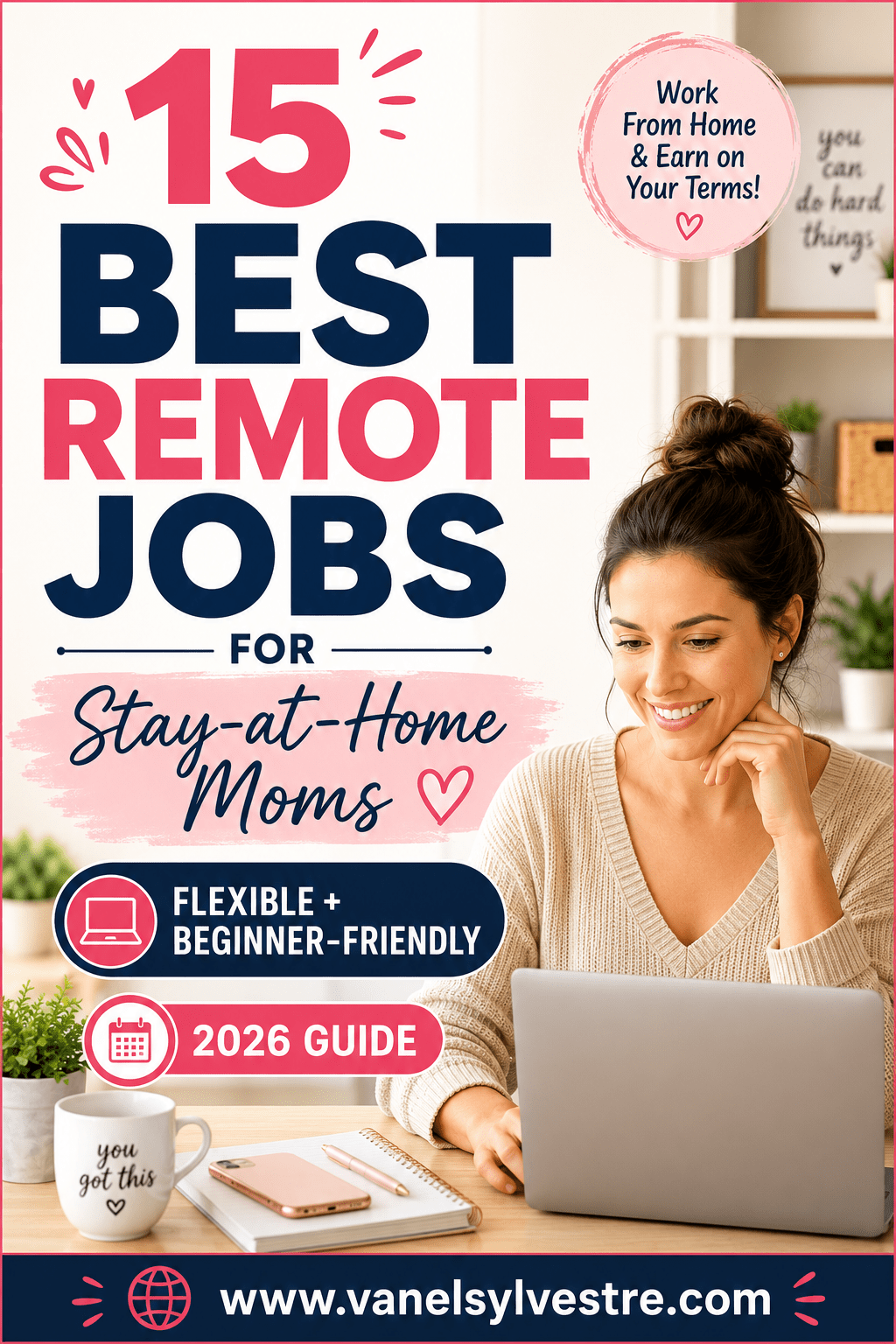
15 Best Remote Jobs for Stay-at-Home Moms
A practical guide to flexible, beginner-friendly, and higher-paying work-from-home careers that can fit around school schedules, childcare, and family responsibilities.
Working from home can be especially valuable for parents who need more control over when and where they work. The best role is not necessarily the one with the highest advertised salary. For many stay-at-home moms, the more important questions are whether the work can be performed remotely, whether the schedule is predictable, how much uninterrupted time is required, and whether the role can grow into better-paying work later.
This guide groups 15 realistic career paths into three categories: flexible professional roles, options that may be easier to enter with limited direct experience, and higher-paying jobs for people who already have specialized skills or management experience.
Most Flexible Work-From-Home Jobs for Stay-at-Home Moms
Flexibility depends on the employer, but roles built around projects, appointments, analysis, writing, documentation, or asynchronous collaboration often provide more control than phone-heavy jobs with constant live coverage. The following careers are strong starting points for parents who want professional work without returning to a traditional office every day.
1. Market Research Analyst
Market research analysts help businesses understand customers, competitors, pricing, and market demand. Typical assignments can include reviewing survey results, studying customer behavior, comparing competitors, preparing dashboards, and turning raw information into recommendations a company can act on.
This type of work can fit remote life well because much of the analysis is computer-based. Project deadlines matter, but many tasks do not require you to be on calls all day. Parents with strong spreadsheet skills, curiosity, and an ability to explain data clearly can build a valuable career in this field.
- Excel or Google Sheets
- Survey and customer research
- Data interpretation
- Clear business writing
- Analytics and visualization tools
2. Human Resources Specialist
HR specialists support recruiting, onboarding, employee records, benefits, policies, and internal communication. Distributed companies increasingly handle these processes online, so many HR responsibilities can be performed with email, video calls, HR software, and shared documents.
This role can be a good match if you are organized, patient, discreet, and comfortable communicating with different personalities. Some positions have fixed meeting windows, while others are more task-oriented and offer greater scheduling freedom.
- Recruiting and screening
- Scheduling and organization
- Conflict resolution
- Employee onboarding
- HRIS and applicant-tracking systems
3. Public Relations Specialist
Public relations specialists help organizations shape their public image. They may write press releases, create media pitches, prepare executive talking points, coordinate interviews, manage press lists, and monitor how a brand is being discussed.
PR is attractive for remote work because a large share of the job is writing, researching, planning, and relationship management. Freelance and agency work may also allow you to take on a smaller client load when family demands are heavier.
- Persuasive writing
- Editing
- Media outreach
- Brand messaging
- Deadline management

GTPLAYER Computer / Office Chair
If you plan to work from home for several hours at a time, a dedicated chair can make your workspace more practical than working from a couch or bed. This Amazon listing is the GTPLAYER chair associated with ASIN B0BBPRZHRX.
View GTPLAYER Chair on Amazon4. Training and Development Specialist
Training specialists create learning materials and help employees improve their skills. Remote projects may include producing onboarding guides, recording training videos, building slide decks, hosting virtual workshops, or designing lessons inside a learning-management system.
People with a teaching, HR, operations, customer-success, or instructional-design background can transition well into this type of role. Much of the preparation can be completed independently, although live training sessions may require set hours.
- Instructional design
- Presentation and facilitation
- Course-building software
- Project management
- Feedback and assessment
5. Career Counselor or Career Coach
Career counselors help clients clarify career goals, improve resumes, prepare for interviews, plan job searches, or navigate a career transition. Sessions are often delivered by video or phone, which makes the work highly compatible with a home office.
If you work independently, appointments can often be scheduled around school hours or evenings. Credentials may be required for certain counseling positions, while coaching or resume-consulting businesses may have more flexible entry requirements.
- Listening
- Coaching and goal setting
- Resume and interview knowledge
- Research
- Client communication
6. Legal Assistant
Remote legal assistants support attorneys with document preparation, case organization, research, scheduling, filing, and client communication. The job rewards accuracy and reliability, and it can provide steady professional work for someone who prefers structured tasks.
Some employers expect legal-office experience or paralegal training, but entry requirements vary. Parents returning to the workforce may be able to start with administrative legal support and build specialized knowledge over time.
- Document formatting
- Legal research
- Confidentiality
- Calendar management
- Attention to detail
Work-From-Home Jobs for Moms With Limited Direct Experience
No legitimate job is truly “zero skill,” but some careers let you prove ability through a portfolio, certification, subject knowledge, volunteer experience, or short freelance projects instead of requiring years in the exact same job title.
7. Fundraiser
Fundraisers help nonprofits and community organizations attract donors, run campaigns, write outreach messages, organize virtual events, and sometimes assist with grants. Communication ability can matter as much as a traditional corporate background.
A practical way to enter the field is to volunteer with a local organization, help with one campaign, and document measurable results. That experience can become proof that you understand donor communication and campaign organization.
- Persuasive writing
- Relationship building
- Event coordination
- CRM organization
- Basic grant research
8. Graphic Designer
Graphic designers create social media graphics, presentations, ad creative, logos, thumbnails, web assets, printable materials, and brand content. It is one of the most portfolio-driven remote careers: clients often care more about the quality of your work than where you learned the skill.
Canva can be enough for simpler client work, while Adobe Illustrator, Photoshop, and Figma can open the door to more advanced projects. Freelance design is especially useful for parents who want to control project volume from month to month.
- Canva, Photoshop, Illustrator, or Figma
- Typography and layout
- Brand consistency
- Client revisions
- Portfolio presentation
9. Online Fitness Instructor
Fitness instructors can now coach clients through livestreams, recorded programs, private video sessions, or membership communities. A parent with the appropriate fitness knowledge and certification can build a schedule around a small number of classes instead of committing to a full day at a gym.
This is also a role where a personal brand can create additional income streams through digital programs, memberships, or group coaching. Always follow the certification and insurance requirements that apply where you live and to the type of instruction you provide.
- Fitness instruction
- Motivation and communication
- Video setup
- Client safety
- Scheduling and community management
10. Online Tutor
Online tutors teach academic subjects, languages, test preparation, software, or specialized skills through video calls and online classroom tools. Tutoring can be one of the easiest professional services to schedule around children because sessions are usually booked in advance.
You can work through tutoring platforms or find private clients. A teacher credential can help, but strong knowledge of a subject and an ability to explain it clearly may be enough for many independent tutoring niches.
- Subject expertise
- Patience
- Clear explanations
- Zoom or Google Meet
- Digital whiteboards

HOMREST Executive Office Chair With Foot Rest
This is a second workstation option for readers who want a high-back chair with an extendable footrest. The image and product reference correspond to Amazon ASIN B0B58CR4TF.
View HOMREST Chair on AmazonHighest-Paying Work-At-Home Jobs for Moms
The roles below can offer significantly higher earning potential, but they generally require more experience, specialized knowledge, professional credentials, or leadership responsibility. For someone returning to work after a career break, these can also be long-term targets: begin with an individual-contributor role, rebuild current experience, and then move into management.
11. Financial Manager
Financial managers oversee budgets, forecasts, reports, cash flow, financial controls, and business planning. Remote finance teams are common in distributed companies, though this work usually requires substantial experience and reliable availability during business hours.
For someone with prior accounting or finance experience, remote financial management can combine strong income potential with the ability to eliminate commuting time.
- Financial planning and analysis
- Budgeting
- Forecasting
- Excel and accounting systems
- Business strategy
12. Marketing Manager
Marketing managers coordinate campaigns, content, paid media, email marketing, SEO, social media, analytics, and brand strategy. Because digital marketing is already performed online, the role is naturally compatible with remote teams.
The strongest candidates typically combine creative judgment with measurable results. If you have experience growing traffic, leads, email subscribers, or sales, document those outcomes in a portfolio or case study.
- Campaign strategy
- Analytics
- Content marketing
- SEO and paid media
- Team leadership
13. Human Resources Manager
HR managers lead recruiting, employee relations, performance systems, compensation processes, policies, and workforce planning. Companies with distributed employees frequently need HR leaders who understand how to manage people across locations and time zones.
This is not usually an entry-level position, but it can be a strong remote career destination for someone who previously worked in recruiting, HR operations, benefits, or employee relations.
- People leadership
- Employment policies
- Recruiting strategy
- HRIS platforms
- Conflict resolution
14. Public Relations Manager
PR managers direct media strategy, corporate messaging, press relationships, executive communications, reputation management, and crisis response. The work can be remote, but senior positions may involve frequent calls and occasional travel.
For experienced writers and communicators, PR management can provide a high-value path that builds on earlier work in journalism, marketing, communications, or agency roles.
- Strategic messaging
- Media relations
- Crisis communication
- Executive writing
- Campaign leadership
15. Accountant
Accountants prepare and review financial records, reconcile accounts, assist with taxes, create reports, and help businesses understand their financial position. Many bookkeeping and accounting workflows are now cloud-based, making remote delivery practical.
Parents with accounting experience can look for employee roles, contract bookkeeping work, seasonal tax work, or a small client practice. Credentials and licensing requirements vary by service and location.
- Bookkeeping and accounting principles
- QuickBooks, Xero, or similar software
- Excel
- Financial reporting
- Accuracy and confidentiality
Stay-at-Home Mom Jobs and “Opportunities” to Avoid
Be cautious when the money flows in the wrong direction. A legitimate employer pays you for your work. Be skeptical of listings that require expensive starter kits, mandatory inventory purchases, application fees, cryptocurrency transfers, gift-card payments, or “training” payments before you can begin.
Also watch for unrealistic claims such as guaranteed high income for almost no work, pressure to recruit friends and family, interviews conducted only through anonymous messaging apps, or companies that refuse to provide a verifiable business identity.
How to Tell if a Remote Job Is Legitimate
Verify the employer. Search the company independently instead of relying only on the link inside the job ad. Look for an established company website, consistent contact information, real employees, and a careers page.
Read the job description carefully. Real roles normally explain responsibilities, required skills, reporting relationships, hours or expectations, and a hiring process. Vague promises are a warning sign.
Protect personal information. Basic contact information is normal during an application. Banking credentials, passwords, gift cards, crypto transfers, or highly sensitive identity information should not be required before a legitimate hiring and payroll process.
Compare compensation with the market. An unusually high salary for simple tasks can be bait. Research similar roles so you know what is plausible.
How to Choose the Right Remote Job for Your Family
Start with your real schedule, not an idealized one. Write down the hours when you can reliably focus, how often you are interrupted, whether you can take calls, and whether you need work that can be paused. A job with a slightly lower hourly rate may be more sustainable if it gives you significantly more control.
Next, inventory the experience you already have. Parenting itself may not replace professional credentials, but many parents have previous work experience, volunteer work, community leadership, budgeting, event organization, teaching, writing, sales, or technical skills that can be repositioned for remote work.
Finally, build proof. A small portfolio, sample project, certification, volunteer project, or freelance assignment can reduce the risk an employer feels when hiring someone who has been out of the workforce for a while.
Frequently Asked Questions
What is the best remote job for a stay-at-home mom?
There is no single best option. Online tutoring and freelance design can offer strong schedule control, while HR, marketing, finance, and research roles may provide more predictable long-term career growth.
What remote jobs can I start with little experience?
Entry-level tutoring, fundraising support, junior design work, administrative support, and some customer or recruiting roles can be accessible if you can demonstrate the underlying skills.
Can stay-at-home moms make a full-time income remotely?
Yes, but income depends on the field, skill level, hours available, location, and whether you work as an employee, contractor, or business owner. Higher-paying professional roles generally require specialized experience.
How can I avoid work-from-home scams?
Verify the employer independently, avoid upfront payments, be skeptical of guaranteed income claims, protect sensitive information, and research the company before accepting an offer.
Should I work as an employee or freelancer?
Employment may provide greater stability and benefits, while freelancing can offer more control over clients and hours. Parents who need maximum scheduling flexibility sometimes prefer freelance work, but it also requires finding clients and managing income fluctuations.
What Most “Remote Jobs for Moms” Guides Leave Out
Many articles about the best remote jobs for stay-at-home moms are useful for discovering job titles, but discovery is only the first step. A parent does not simply need to know that a job can theoretically be performed from home. She needs to know whether the job can survive real family life: school pickup, a toddler at home, appointments, sick days, limited quiet time, and a schedule that may change from one week to the next. That difference is important. A job can be remote without being flexible, and a flexible job can still require several uninterrupted hours every day.
That is why this guide goes beyond a list of occupations. For every career path, think about five practical questions: How many live meetings are likely? Can the work be completed asynchronously? Is part-time work common? Can you enter the field without returning to school for several years? And can the role grow into a meaningful income instead of remaining a temporary side hustle? These questions make the article more useful for readers searching phrases such as remote jobs for stay-at-home moms, work-from-home jobs for moms, flexible jobs for moms, and remote jobs for moms with no experience.
Remote Does Not Always Mean Flexible
Another weakness in many job roundups is that they blur national occupational statistics with actual remote-work conditions. A median wage for an occupation does not mean a beginner working remotely will earn that amount, and an occupation being computer-based does not guarantee that every employer offers remote positions. For example, the U.S. Bureau of Labor Statistics notes that most market research analysts work full time during regular business hours. That makes market research remote-friendly in many organizations, but not automatically child-care-friendly. The distinction matters when choosing a sustainable career.
The Schedule-Match Test: Choose a Remote Job That Fits Your Real Day
Before applying for jobs, create a simple weekly availability map. Mark the hours when you can work without interruption, the hours when you can work but may be interrupted, and the hours when work is unrealistic. This exercise can prevent you from applying to jobs that look attractive on paper but conflict with your responsibilities. If you have three reliable hours during school time and another two hours after bedtime, project-based work may fit better than a customer-service position requiring a continuous eight-hour shift.
Asynchronous work is usually the easiest category to combine with an unpredictable household. Examples include research, writing, bookkeeping, design, editing, data analysis, and some marketing tasks. You receive an assignment and a deadline, then complete much of the work independently. Meetings may still exist, but they are not the entire job.
Appointment-based work can also be family-friendly when you control the calendar. Tutoring, coaching, consulting, and some fitness instruction fall into this category. The advantage is predictability: you can open only the time slots you can reliably honor. The disadvantage is that once a client books a session, you need quiet, dependable coverage for that period.
When a Remote Job Still Requires Fixed Coverage
Coverage-based work requires more caution. Customer service, live chat, dispatching, reception, and some administrative roles may be fully remote but still require continuous availability. These jobs can be excellent for a parent who has dependable childcare or older children, but they may be stressful if interruptions are frequent. Remote does not mean “work whenever you want.”
Deadline-based professional work often sits in the middle. HR, public relations, marketing, accounting, and legal support may offer autonomy for parts of the day while still requiring scheduled meetings and fast responses. When interviewing, ask what percentage of the week is spent in meetings, whether core collaboration hours exist, and how performance is measured.
15 Remote Jobs for Stay-at-Home Moms Compared
| Job | Beginner Friendly | Schedule Control | Live Interaction | Best Entry Strategy |
|---|---|---|---|---|
| Market research analyst | Medium | Medium | Medium | Analytics portfolio |
| HR specialist | Medium | Medium | High | Recruiting coordinator experience |
| PR specialist | Medium | Medium | Medium | Writing portfolio |
| Training specialist | Medium | Medium | Medium | Sample course or lesson |
| Career coach | Medium | High | High | Niche + client testimonials |
| Legal assistant | Medium | Medium | Medium | Administrative/legal training |
| Fundraiser | Medium | Medium | Medium | Volunteer campaign results |
| Graphic designer | High | High | Low | Portfolio |
| Online fitness instructor | Medium | High | High | Relevant certification |
| Online tutor | High | High | High | Subject expertise |
| Financial manager | Low | Medium | Medium | Finance experience |
| Marketing manager | Low | Medium | Medium | Results-based case studies |
| HR manager | Low | Medium | High | Progressive HR experience |
| PR manager | Low | Medium | High | Campaign results |
| Accountant | Medium | Medium | Low-Medium | Accounting/bookkeeping skills |
Best Work-From-Home Jobs for Moms Without a Degree
A college degree can be useful, but it should not be treated as the only path into remote work. For parents without a four-year degree, the most practical strategy is to target jobs where employers can evaluate concrete ability. Graphic design is a clear example: a strong portfolio can demonstrate layout, branding, social graphics, presentation design, and advertising skills. Online tutoring can work similarly when you have deep knowledge in a subject. Bookkeeping, virtual administrative support, customer support, content production, and certain sales roles can also reward demonstrable competence.
The key is to replace a missing credential with evidence. Instead of simply writing “good at social media” on a resume, build a sample 30-day content calendar and show several graphics. To demonstrate spreadsheet ability, create a clean dashboard using sample data. For tutoring, prepare a short sample lesson that explains a difficult concept clearly. Proof reduces uncertainty for employers and clients.
Certificates can help when they are directly connected to the job, but avoid collecting certificates without building practical work. A short credential plus a portfolio is usually more persuasive than a long list of courses with no examples. The goal is employability, not simply completing training.
Best Part-Time Remote Jobs for Stay-at-Home Moms
Part-time remote work is attractive because it can create income without requiring a parent to immediately reorganize the entire household around a 40-hour week. Online tutoring, freelance graphic design, bookkeeping, career coaching, virtual fitness instruction, fundraising support, and contract marketing are especially adaptable because the workload can often be defined by clients, projects, or appointments.
When evaluating part-time jobs, calculate the hidden time as well as the paid time. A one-hour tutoring session may require lesson preparation and follow-up. A design project may include revisions. Freelancing requires invoicing and client acquisition. A role advertised as 20 hours per week can therefore consume more than 20 hours unless the scope is clear.
Ask prospective employers whether the part-time schedule is fixed or flexible. “Twenty hours per week” might mean four fixed five-hour shifts, or it might mean completing a set of responsibilities before weekly deadlines. Those arrangements are very different for a stay-at-home parent.
Remote Jobs Moms Can Do at Night or on Weekends
Parents who provide childcare during the day often search specifically for work they can perform after bedtime or on weekends. The strongest choices are usually asynchronous jobs: freelance writing, editing, design, bookkeeping, research, certain marketing tasks, website content updates, transcription, and project-based administrative work. These jobs can sometimes be completed without needing another person online at the same time.
Tutoring can also work at night because students may be available after school. Depending on time zones, teaching international students may create additional scheduling options. Customer support can offer evening shifts too, although that is less flexible because you normally must remain available continuously during the assigned shift.
Protect against burnout. Working all day as a caregiver and then working deep into the night is not automatically sustainable. A better goal is a schedule you can repeat for months. Two or three focused evenings may produce better results than trying to work every night.
How to Return to Remote Work After a Career Break
A resume gap does not erase the experience you had before becoming a stay-at-home parent. Start by identifying which parts of your previous career are still current and which need refreshing. Software may have changed, industry terminology may have evolved, and hiring practices may be different. A targeted refresher course can solve a specific gap faster than starting an entirely new degree.
On your resume, emphasize results from previous employment instead of apologizing for time away. If you managed a budget, increased sales, trained employees, reduced errors, coordinated events, supported executives, created marketing materials, or managed client relationships, quantify those outcomes whenever possible. Hiring managers need to understand the value you can bring now.
If you completed meaningful volunteer, freelance, community, or business work during the career break, consider including it when relevant. Organizing a nonprofit fundraiser, managing a community website, doing bookkeeping for a family business, or creating marketing materials can demonstrate current skills. Do not inflate ordinary household responsibilities into corporate experience; instead, use genuine projects that produced observable work.
LinkedIn and a small portfolio site can also help establish a current professional identity. Use a headline that describes the role you are targeting rather than focusing on the career break. Add samples, certifications, recommendations, and a concise summary of your expertise.
Build a Simple Portfolio Website to Win Remote Clients
For portfolio-driven remote careers such as graphic design, marketing, career coaching, tutoring, consulting, writing, and freelance services, a small professional website can give employers and potential clients one place to review your work, learn what you offer, and contact you. You do not need a complicated website. A strong starter portfolio can include a home page, work samples or case studies, an about page, and a contact page.
If you are starting from scratch and want a beginner-friendly way to create a portfolio, Hostinger is one option to consider. Its website-building tools are designed to help users launch portfolio sites without needing to code. Your portfolio should focus on proof: show several of your strongest projects, explain the problem behind each project, describe what you contributed, and make it easy for a recruiter or client to contact you.
Build Your Portfolio Website With Hostinger
When WordPress Makes More Sense
If you want your portfolio to grow into a blog, freelance-business website, lead-generation site, or content brand, WordPress can provide more room to expand. For readers who specifically want managed WordPress hosting, SiteGround offers WordPress setup, migration, backups, caching, security features, and staging tools on eligible plans.
See SiteGround WordPress Hosting
Hosting for a Growing Freelance or Client Website
If your remote work eventually develops into a larger WordPress business, agency, or multiple-client website operation, you may want hosting with more scaling and server-management options. Cloudways is a managed cloud-hosting option built around platforms such as WordPress and includes features such as staging, backups, cloning, caching, and resource scaling. It is a more natural recommendation for a reader whose simple portfolio has grown into a serious web business than for someone who only needs a one-page resume site.
Explore Cloudways Managed Hosting
Managed WordPress for Established Professional Sites
For an established WordPress site where managed infrastructure, developer workflows, staging environments, caching, and security are priorities, WP Engine is another option. This is better positioned as an advanced choice for a growing professional website rather than something every new remote-job applicant needs on day one.
Which option should you choose? If your immediate goal is simply getting a portfolio online, start simple. Hostinger is the most natural placement in this guide for a beginner portfolio. SiteGround fits readers who specifically want a WordPress portfolio or blog. Cloudways and WP Engine make more sense later if a freelance site becomes a larger business or a more demanding WordPress project. You do not need to buy hosting to apply for a remote job; these options are for readers who want to build their own professional web presence.
Resume Keywords for Remote Jobs
Remote employers often look for evidence that a candidate can operate independently. Where truthful, your resume can highlight remote collaboration, written communication, time management, documentation, project ownership, asynchronous communication, deadline management, virtual meetings, cloud-based tools, and cross-functional collaboration. The exact keywords should come from the job description rather than from a generic list.
For an HR role, relevant terms may include recruiting, onboarding, applicant tracking systems, employee relations, HRIS, benefits administration, scheduling, and compliance. Marketing applications may use terms such as SEO, content strategy, analytics, email marketing, paid media, conversion optimization, campaign management, and CRM. Accounting listings often mention reconciliations, accounts payable, accounts receivable, month-end close, financial reporting, QuickBooks, Xero, and Excel.
Do not stuff keywords into a resume. Applicant-tracking systems and human reviewers both need context. A bullet such as “Managed email marketing” is weaker than “Planned and executed weekly email campaigns, tracked opens and conversions, and used results to improve future campaigns.” Use only claims you can support in an interview.
Questions Stay-at-Home Moms Should Ask Before Accepting a Remote Job
A job interview is also your opportunity to determine whether the role fits your life. You do not need to disclose unnecessary personal details to evaluate the schedule. Ask operational questions that any remote candidate could reasonably ask.
- What are the expected working hours and time zone?
- Are there core hours when everyone must be online?
- How many hours per week does the team typically spend in meetings?
- Is performance measured by hours online, completed work, or business outcomes?
- How quickly are employees expected to respond to Slack, Teams, or email?
- Is the role fully remote, or are occasional office visits required?
- Does the company provide equipment or a home-office allowance?
- How often does the role require phone or video calls?
- What does a typical day look like for someone in this position?
- Are schedules fixed, flexible, or arranged with the manager?
The answers can reveal whether “remote” really means location-independent work or simply an office job performed from your house. A position with six hours of meetings every day has a very different flexibility profile from a role with one weekly team meeting and project deadlines.
What You Need to Work From Home
You do not need an expensive home office to begin, but reliable basics matter. Most remote workers need a dependable computer appropriate for the job, stable internet, a headset or microphone for calls, and a place where confidential conversations can happen when necessary. Some employers provide equipment, so do not buy expensive hardware before learning what the company supplies or requires.
For video-heavy work, prioritize clear audio before decorative upgrades. A simple headset in a quiet room can improve a call more than an elaborate background. For design, analytics, finance, or other screen-intensive work, a larger monitor can improve productivity. For tutoring or training, good lighting and a camera positioned near eye level help create a more professional experience.
Ergonomics matter when work becomes regular. A supportive chair, suitable desk height, and screen placement can make a long work session more comfortable. The Amazon product recommendations in this article are optional examples rather than requirements for getting a remote job.
A 30-Day Plan to Find a Legit Remote Job
Days 1–3: choose one or two target roles. Avoid applying randomly to every remote job. Select roles that match your existing skills and schedule. Read at least 15 current job descriptions and record the skills, software, experience, and schedule requirements that appear repeatedly.
Days 4–7: update your resume and professional profiles. Rewrite your summary around the target role. Add measurable accomplishments. Remove irrelevant information that distracts from the position you want. Make sure your LinkedIn profile and resume tell the same professional story.
Days 8–12: close one important skill gap. If most listings request a tool you have never used, learn the fundamentals and create a small practice project. Do not try to learn ten platforms simultaneously. Focus on the gap most likely to prevent an interview.
Days 13–17: create proof of work. Designers need samples. Marketers can create a campaign case study. Analysts can build a dashboard. Tutors can prepare sample lessons. Administrative candidates can demonstrate polished spreadsheets, schedules, or process documentation without exposing anyone’s confidential information.
Days 18–30: apply selectively and track results. Keep a spreadsheet with the company, job title, date, source, resume version, contact, interview status, and follow-up date. Quality usually matters more than sending hundreds of generic applications. Tailor the top portion of your resume and the most relevant bullets to each strong opportunity.
At the end of 30 days, diagnose the funnel. If you receive almost no interviews, improve targeting, resume positioning, or proof of skills. Interviews without offers usually signal that your responses, examples, or positioning need improvement. Offers that repeatedly conflict with your schedule are a sign to target a different type of role.
Remote Job Scam Warning for 2026
Remote-job scams deserve more than a short generic warning. The Federal Trade Commission has warned about fake recruiters contacting people with vague remote offers and eventually asking victims to send money. In 2026, the FTC specifically highlighted unsolicited job messages that may ask a person to reply “YES” or “INTERESTED,” fake-check schemes, and task scams that eventually require the worker to deposit personal money.
Never pay to receive wages. Be suspicious if a supposed employer sends a check and instructs you to buy equipment from a particular vendor or send part of the money elsewhere. A bank may initially show funds from a fake check as available, but that does not mean the check is legitimate. Also be cautious with jobs centered on receiving and reshipping packages from your home.
Verify recruiters through an independently located company website. Do not rely solely on the phone number, email, or website supplied by the person contacting you. If a recruiter claims to represent a known company, visit that company’s official careers page yourself and see whether the opening exists.
Related Questions About Remote Jobs for Moms
What are the best remote jobs for stay-at-home moms with no experience?
Good starting points can include online tutoring when you have subject knowledge, junior graphic design when you can build a portfolio, fundraising support, administrative work, customer support, and entry-level recruiting coordination. “No experience” does not mean no skills; employers still need evidence that you can perform the work.
What are the best work-from-home jobs for moms with babies?
Jobs with asynchronous, deadline-based work can be easier to combine with unpredictable interruptions than roles requiring constant phone coverage. Freelance design, writing, editing, bookkeeping, research, and some marketing work can offer more control, although every employer and client has different expectations.
More Questions About Flexible Work for Moms
What remote jobs can moms do during school hours?
Tutoring, bookkeeping, design, career coaching, virtual assistance, recruiting coordination, marketing, and project-based administrative work can fit school-hour schedules when the employer or client allows part-time or flexible hours.
What work-from-home jobs can moms do at night?
Project-based writing, editing, graphic design, bookkeeping, research, content production, and some tutoring can be performed during evenings. Look for jobs described as asynchronous, freelance, contract, project-based, or flexible rather than assuming every remote job permits nighttime work.
Are there legitimate remote jobs for moms without a degree?
Yes. Degree requirements vary by occupation and employer. Portfolio-driven and skill-based work such as design, bookkeeping, support, tutoring, sales, and certain administrative or marketing roles may be accessible without a four-year degree. Always read the actual job requirements.
How can a stay-at-home mom make money without paying for childcare?
The most realistic approach is work that fits existing childcare coverage, school hours, partner availability, naps, or evenings. However, jobs requiring uninterrupted calls or fixed shifts may still require dependable childcare. Avoid assuming that full-time childcare and full-time paid work can always happen simultaneously.
Which remote careers have room for advancement?
Marketing, accounting, HR, market research, training and development, public relations, and finance all have established career ladders. A parent can start in an individual-contributor position and later pursue senior specialist, manager, director, consulting, or independent-business opportunities.
How do I explain being a stay-at-home mom on a resume?
Keep the explanation concise and focus the resume on relevant qualifications and accomplishments. If you completed genuine freelance, volunteer, educational, or business projects during the gap, include them when they support the role you are pursuing.
Which Remote Job Should You Choose?
If maximum schedule control is your priority, begin by investigating online tutoring, freelance graphic design, career coaching, project-based marketing, bookkeeping, or other deliverable-based work. Parents who value stability and benefits more should focus on established remote employee roles and confirm the working hours before accepting an offer. For long-term income growth, consider career ladders in marketing, finance, accounting, HR, market research, public relations, and training.
The best remote job for a stay-at-home mom is not defined by a job title alone. It is the intersection of skills, income requirements, available work hours, family support, and the amount of real-time interaction the job demands. Use those criteria to narrow the field, then build proof that you can solve the employer’s problem. That approach is more useful than chasing a long list of “easy work-from-home jobs” that may not match your life.
How Each Remote Career Fits a Stay-at-Home Mom’s Schedule
A salary table alone cannot tell you whether a career is practical for your household. The same occupation can feel flexible at one company and rigid at another. Use the following job-by-job notes to understand the hidden scheduling demands before investing time in applications or training.
Market Research Analyst: Best for Focused School-Hour Work
Market research can be a strong choice when you already enjoy numbers, consumer behavior, surveys, spreadsheets, and business strategy. A typical project might involve cleaning survey data, comparing competitors, researching a target market, identifying customer segments, or preparing a presentation for decision-makers. These assignments often reward concentrated blocks of work. That makes school hours useful, because two or three uninterrupted hours can be more productive than an entire day of constant interruptions.
The limitation is that many analyst jobs are standard full-time positions. If you need unusual hours, search for contract research, freelance insights work, marketing analytics support, or project-based competitive research. A beginner can create portfolio projects using public data: choose an industry, identify competitors, compare pricing and positioning, and summarize what a hypothetical company should do next. The finished report demonstrates both analysis and communication.
Human Resources: Best for Parents With Predictable Daytime Availability
HR can be remote, but it is often people-intensive. Recruiter screens, manager meetings, onboarding calls, employee questions, and interviews happen during business hours. A parent who has dependable school-time coverage may find HR very practical; a parent caring for a baby or toddler without backup may find the live-call requirement difficult.
If you want to enter HR, recruiting coordination can be an accessible bridge. Coordinators schedule interviews, update candidate records, communicate with applicants, and support recruiters. From there, experience can lead toward recruiting, HR operations, benefits, employee relations, or HR management. Learn the terminology used in applicant-tracking and HR information systems, but remember that organization and professional communication are central skills.
Public Relations: Best for Strong Writers Who Can Handle Deadlines
PR combines asynchronous writing with time-sensitive communication. Drafting a press release or researching journalists can happen independently, but a media request may require a fast response. Parents considering PR should ask how often urgent requests occur and whether the team expects continuous daytime monitoring.
A portfolio can include a sample press release, media pitch, company boilerplate, executive biography, crisis-response statement, and simple media plan. These pieces show that you understand the purpose of PR rather than simply being a good general writer. Freelance PR can provide greater control, but clients still expect reliability when a campaign is active.
Training and Development: Best for Teachers Moving Into Corporate Work
Former teachers often have transferable skills that map naturally to training and development: lesson planning, presentation, assessment, curriculum design, facilitation, and explaining complex ideas to different audiences. Corporate terminology may be different, but the underlying skill of helping people learn is highly relevant.
To demonstrate ability, create a short sample training module. Pick a business topic you understand, define learning objectives, prepare a lesson, build a short assessment, and explain how you would measure whether the training worked. This is more persuasive than simply saying you are interested in instructional design. Recorded or self-paced training development can be especially compatible with a flexible home schedule.
Career Coaching: Best for Appointment-Based Flexibility
Independent career coaching can give you direct control over your calendar. You might reserve appointments only during school hours, two evenings per week, or Saturday mornings. The tradeoff is that self-employment requires marketing, scheduling, billing, and client acquisition in addition to the coaching itself.
Specialization can make the service easier to explain. Instead of offering generic career advice to everyone, a coach might focus on interview preparation, resume strategy, career changes, returning to work after a break, or a specific industry. Clear positioning helps prospective clients understand why they should choose you.
Legal Assistant: Best for Detail-Oriented Parents
Legal support involves deadlines and confidential information, so reliability matters. Remote legal assistants may organize documents, prepare correspondence, manage calendars, assist with filings, maintain case records, or communicate with clients. Some assignments can be completed independently, while court deadlines and attorney schedules create fixed priorities.
If you are new to the field, learn document formatting, professional correspondence, file organization, confidentiality practices, and the terminology used in the legal specialty you are targeting. Never claim legal expertise you do not have. The objective is to become dependable support for licensed professionals.
Fundraising: Best for Mission-Driven Communicators
Fundraising is broader than asking people for money. Organizations need donor research, email campaigns, event coordination, sponsorship outreach, grant support, database updates, impact stories, and donor stewardship. That creates multiple entry points for someone with writing, administration, sales, nonprofit, or community experience.
A volunteer project can become a credible portfolio example if you document the goal, your responsibilities, what you created, and the result. For instance, organizing a small online campaign can demonstrate copywriting, project management, outreach, and reporting. Respect donor privacy and never publish confidential information in a portfolio.
Graphic Design: Best for Project-Based Flexibility
Graphic design is one of the strongest options when you need work that can be paused and resumed. Many projects are defined by a deliverable and deadline rather than constant live availability. A parent can create social graphics, presentations, thumbnails, lead magnets, advertising creative, or simple brand assets during focused blocks of time.
The challenge is competition. A generic portfolio filled with unrelated practice pieces makes it hard for clients to understand your specialty. Build several samples around a clear market, such as ecommerce graphics, YouTube thumbnails, real-estate marketing, restaurant social media, or business presentations. Show before-and-after thinking and explain the objective of each piece.
Online Fitness Instruction: Best for Moms Who Want a Set Appointment Calendar
Virtual fitness work can be structured around a small number of sessions. You can offer individual appointments, group classes, or prerecorded programs, depending on your qualifications and business model. Live instruction requires a quiet and safe environment plus enough space to demonstrate movements.
Because fitness affects health and physical safety, appropriate education, certification, screening, and insurance are important. Do not treat a social-media following as a substitute for professional competence. Parents who already have legitimate fitness credentials may find that virtual delivery expands the number of clients they can serve without commuting.
Online Tutoring: Best for School-Hour or Evening Sessions
Tutoring is attractive because the unit of work is easy to understand: a scheduled lesson with a student. You can teach mathematics, science, languages, reading, test preparation, music theory, software, or another subject you genuinely know. Some platforms determine rates and schedules, while private tutoring provides more control but requires finding clients.
Prepare systems before taking many students. Use a calendar with buffer time, a repeatable lesson template, a way to share resources, and a simple process for communicating progress. If your own children are home during sessions, make sure you can provide the student with the focused attention they are paying for.
Financial Manager: Best for Experienced Finance Professionals Returning Home
Financial management is a high-responsibility career rather than a casual side job. Forecasts, budgets, reporting deadlines, leadership meetings, and business decisions can create demanding periods. Its advantage for an experienced professional is that much of the underlying work is digital, and removing a commute can materially improve the day.
If you previously worked in finance and took a career break, refresh current software and reporting practices, reconnect with professional contacts, and consider whether a senior analyst or fractional finance role could be a bridge back. Do not focus only on the manager title if a slightly different position offers a better re-entry path.
Marketing Manager: Best for Results-Oriented Digital Professionals
Remote marketing is common because websites, email, analytics, search, advertising, content, and social platforms are digital. Yet management roles involve meetings, approvals, reporting, and coordination. Parents who need greater flexibility may prefer an individual-contributor specialty such as SEO, email marketing, content strategy, paid media, or analytics before moving into management.
Marketing portfolios should emphasize outcomes. Traffic growth, qualified leads, conversion improvements, lower acquisition costs, revenue contribution, email performance, or successful launches are stronger evidence than a list of tools. Protect confidential employer data and use percentages or anonymized examples when necessary.
HR Manager and PR Manager: Best for Experienced Professionals With Daytime Coverage
Both HR management and PR management can be performed remotely, but neither should automatically be described as highly flexible. Managers are responsible for people, decisions, escalations, and urgent issues. These positions can be excellent for experienced mothers who have reliable daytime availability and want to eliminate commuting, but they may not suit someone seeking work that can be completed entirely after children go to bed.
This distinction is one of the most important lessons in a remote job search: location flexibility and time flexibility are separate benefits. Always evaluate them separately.
Accountant: Best for Structured, Detail-Focused Work
Cloud accounting systems allow many bookkeeping and accounting tasks to be performed from home. Reconciliations, transaction review, reporting, accounts payable, accounts receivable, and some tax-related work can be highly structured. Deadlines around month-end, quarter-end, and tax periods may create busy stretches.
Independent bookkeeping can offer schedule control, but client records still need to be handled securely and accurately. If you are rebuilding skills, practice with sample companies rather than real confidential data. Learn the software commonly requested by the employers or clients you want to serve.
Why This Guide Is More Useful Than a Simple List of Job Titles
A strong answer to the search “best remote jobs for stay-at-home moms” should help a reader make a decision, not merely provide inspiration. That means discussing schedule fit, entry requirements, career-break strategy, part-time possibilities, evening work, degree alternatives, portfolio creation, interview questions, equipment, scam prevention, and a concrete application plan. These are the questions that appear after a reader discovers a job title and begins asking whether it will actually work for her.
This guide also avoids promising that every occupation is flexible simply because some jobs in that occupation are remote. Current labor data can describe wages, education, and projected employment, but individual employers decide whether a particular opening is remote, hybrid, part-time, fixed schedule, or flexible. Readers should therefore verify the conditions of each vacancy rather than relying on a general career label.
Editorial note: This article is an original 2026 guide inspired by the broad information architecture commonly used in remote-career roundups. Career demand, salaries, education requirements, and remote availability change over time, so readers should verify current information with employers and authoritative labor-market sources before making a career decision.
Amazon note: Product availability, images, pricing, and listing details can change. Amazon affiliate links on this page use the Associates tag vanelsylves09-20.


Pingback: 6 Best Part Time Jobs for Stay at Home Moms in 2026 - Vanel Sylvestre