The Seiko King Turtle: Is This Affordable Dive Watch Still Worth Buying?
The Seiko King Turtle takes one of the Japanese brand’s most recognizable dive-watch designs and upgrades it with sapphire crystal, a ceramic bezel, excellent lume, serious water resistance, and the dependable 4R36 automatic movement.

Few affordable dive watches are as immediately recognizable as the Seiko Turtle. Its broad cushion-shaped case, oversized luminous markers, and unusual crown position give it a visual identity that stands apart from the countless Submariner-inspired watches competing in the same part of the market. The King Turtle takes that familiar formula and gives it a noticeably more premium specification.
Among the best-known versions are the Seiko Prospex SRPE03, with its black textured dial and stainless-steel bracelet, and the SRPE05, which pairs a green patterned dial with a rugged silicone strap. Both retain the unapologetically large personality that made the modern Turtle famous, but add some important upgrades that make the word “King” more than simple marketing.

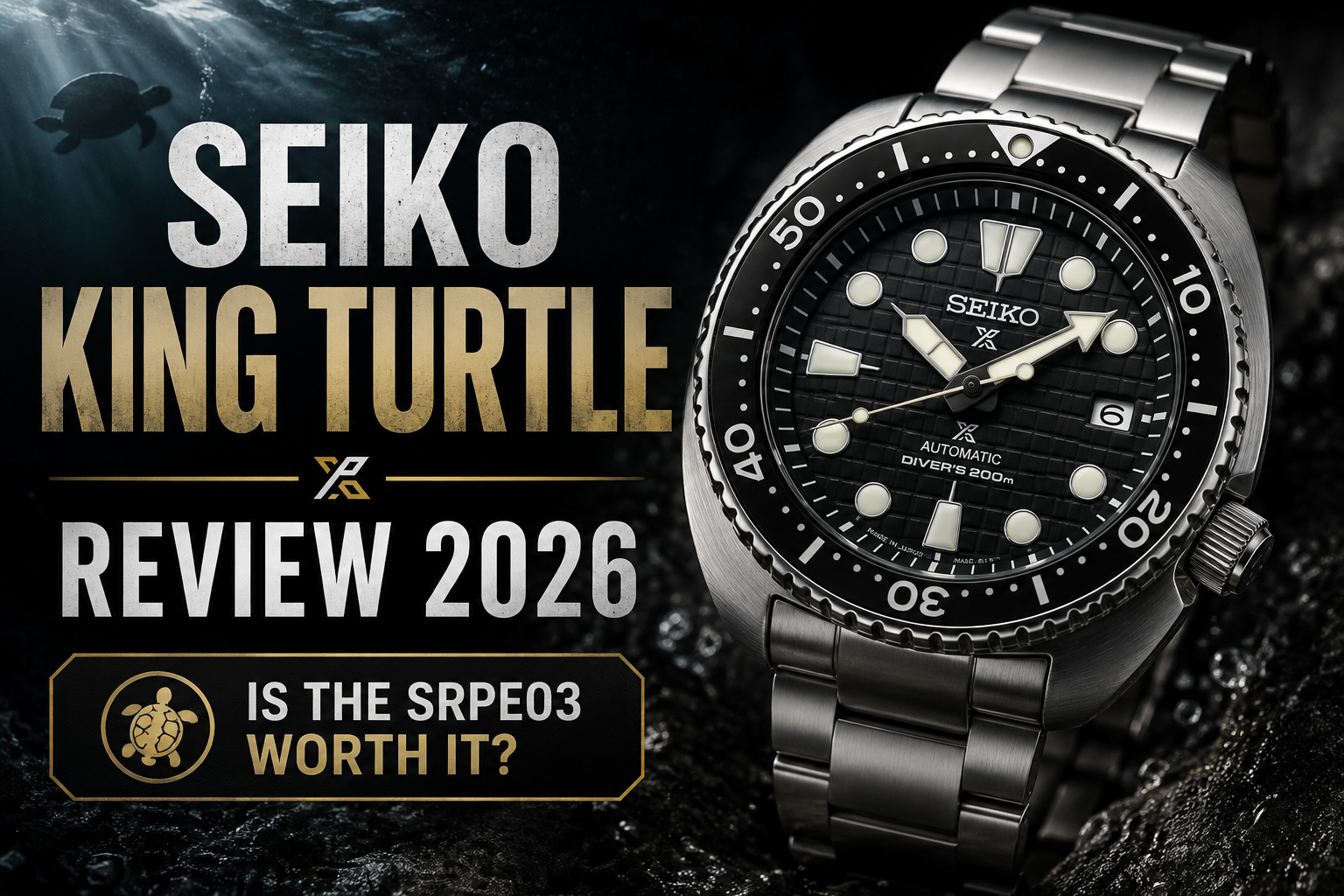
Seiko Prospex King Turtle SRPE03
Black waffle-pattern dial, stainless-steel bracelet, automatic 4R36 movement, sapphire crystal, ceramic dive bezel, and 200-meter water resistance.
Seiko King Turtle: Quick Verdict
The King Turtle is best suited to someone who wants a large, distinctive mechanical diver with legitimate tool-watch credentials rather than a slim, dressy sports watch. Its sapphire crystal and ceramic bezel are major improvements over many entry-level Seiko divers.
- Sapphire crystal
- Ceramic bezel insert
- Excellent LumiBrite lume
- 200-meter water resistance
- Distinctive Turtle case
- Hand-winding and hacking movement
- Strong everyday durability
- 45 mm diameter is large
- Heavy on the steel bracelet
- 41-hour reserve is modest today
- Cyclops magnifier divides opinion
- Bracelet finishing is functional rather than luxurious
Where the Seiko Turtle Came From
Seiko’s reputation in dive watches stretches back decades. Rather than simply copying Swiss diver design, Seiko developed watches with their own practical solutions, case shapes, and mechanical architecture.
This willingness to be different eventually produced some of the most recognizable Japanese dive watches ever made. The Turtle is among the strongest examples of Seiko creating a watch that enthusiasts can identify immediately.
The Turtle name itself is an enthusiast nickname rather than the original formal model name. When viewed from above, the rounded cushion case and relatively short projecting lugs resemble the shell and limbs of a turtle.
The nickname proved so appropriate that it became inseparable from the watches. Vintage Turtle references helped establish the shape during the 1970s and 1980s. When Seiko revived the concept in its modern Prospex collection, collectors again responded to the combination of character, toughness, and attainable pricing.

King Turtle Case and Design
Numbers first: the SRPE03 case measures approximately 45 mm in diameter, 13.2 mm thick, and 47.7 mm lug-to-lug. Lug width is 22 mm.
Those dimensions tell an interesting story because the diameter sounds enormous while the lug-to-lug measurement is comparatively restrained.
That is one of the secrets behind the Turtle’s wearability. It spreads horizontally across the wrist instead of extending far beyond it. People who normally dismiss a 45 mm watch may therefore find the King Turtle surprisingly manageable.
The stainless-steel case has broad flowing surfaces that protect the bezel and movement while also giving the watch its unmistakable profile. There is no attempt to make this diver delicate.
Everything from the crown guards to the bezel edge has been shaped around usability. One of the defining details remains the crown positioned at roughly four o’clock.
This position helps prevent the crown from digging into the back of the wearer’s hand and contributes to the asymmetrical personality of the watch.
Dial, Sapphire Crystal and Lume
The SRPE03’s dial is one of the strongest reasons to choose the King Turtle over a more basic diver.
Instead of a completely flat black surface, Seiko uses a three-dimensional geometric texture frequently described by enthusiasts as a waffle dial.
The texture gives the face considerably more depth without hurting readability. Large circular hour plots surround the dial while oversized hands allow the time to be recognized immediately.
This is exactly what a serious dive watch should prioritize.
At three o’clock there is a day-and-date display topped by a magnifier. The magnifier is likely to be one of the more divisive features.
Some buyers appreciate the added practicality, while others prefer an uninterrupted crystal. Either way, it contributes to the King Turtle’s distinctive face.
The crystal itself is one of the biggest upgrades. Seiko uses sapphire crystal with anti-reflective treatment on the inner surface.
Sapphire offers far better resistance to everyday scratches than the mineral glass commonly fitted to less expensive sports watches.
LumiBrite Performance
Lume has traditionally been one of Seiko’s strengths, and the King Turtle continues that reputation.
Seiko applies LumiBrite to the hands and hour markers, giving the watch a bright initial glow and strong nighttime readability.
It is not merely decorative. A dive watch needs the minute hand, bezel orientation, and hour markers to remain recognizable in poor lighting.
Those oversized luminous surfaces serve that purpose extremely well.
The Ceramic Dive Bezel
Another important “King” upgrade is the ceramic bezel insert.
Compared with conventional painted aluminum, ceramic offers greater resistance to scratches and tends to preserve its glossy appearance for much longer.
The bezel rotates in one direction, as expected on a dive watch. Its deeply cut outer edge provides plenty of grip, even when your hands are wet.
The broad numerals and luminous orientation marker retain the functional look of older Seiko divers while giving this version a more premium surface.
Seiko’s decision to combine a ceramic bezel with sapphire crystal is important because those are two of the areas most likely to receive visible wear.
Together, these upgrades help the King Turtle maintain its appearance better than many cheaper alternatives.
Seiko King Turtle SRPE03 Specifications
Inside the King Turtle: Seiko Caliber 4R36
Beneath the solid caseback is Seiko’s familiar Caliber 4R36.
It is not a high-end movement, but it is exactly the kind of mechanism that makes sense in a rugged watch at this price level: proven, straightforward, and designed for everyday use.
The 24-jewel automatic movement can also be wound manually, something older entry-level Seiko automatic movements did not always offer.
Pulling the crown into the time-setting position stops the seconds hand, allowing the watch to be synchronized more precisely.
Power reserve is approximately 41 hours.
In today’s market that number is no longer exceptional. Some competing movements provide substantially longer reserves.
However, for a watch normally worn regularly, the reserve remains perfectly practical.
The most important distinction is that the 4R36 has earned a reputation as a practical, durable workhorse. That fits the philosophy of the Turtle perfectly.
Bracelet, Clasp and Strap Options
The black SRPE03 is commonly paired with a stainless-steel bracelet.
It includes a folding clasp, security lock, push-button release, and extension system. The hardware reinforces the watch’s serious dive-tool character.
Finishing on the bracelet is competent rather than luxurious, which is one of the areas where the King Turtle’s price level remains apparent.
Owners looking for additional comfort frequently experiment with rubber, silicone, and NATO-style straps.
Fortunately, the 22 mm lug width makes aftermarket strap shopping easy. The Turtle case is visually flexible enough to work with numerous different styles.

Seiko King Turtle SRPE05 Green
The SRPE05 keeps the same bold Turtle case, sapphire crystal, ceramic bezel, and 4R36 movement but adds a khaki-green textured dial and matching silicone strap.
How Does the Seiko King Turtle Wear?
The King Turtle is substantial. There is no way around that.
The 45 mm case occupies considerable visual space, particularly when paired with the stainless-steel bracelet. Buyers who want an understated watch should probably look elsewhere.
Yet the relatively short 47.7 mm case length prevents it from wearing like a conventional long-lugged 45 mm watch.
The curved cushion-shaped case hugs the wrist, and the four-o’clock crown avoids the uncomfortable pressure point produced by some large watches.
On a medium-to-large wrist, the proportions can feel surprisingly natural.
On a smaller wrist, changing from the steel bracelet to a lighter rubber or silicone strap can make a significant difference.
The watch is also thick enough to feel substantial but not so thick that it becomes impractical for everyday wear.
Seiko King Turtle SRPE03 vs SRPE05
| Feature | SRPE03 | SRPE05 |
|---|---|---|
| Dial | Black textured dial | Khaki-green textured dial |
| Case | 45 mm stainless steel | 45 mm stainless steel |
| Movement | 4R36 automatic | 4R36 automatic |
| Crystal | Sapphire | Sapphire |
| Bezel | Black ceramic | Black ceramic |
| Water Resistance | 200 meters | 200 meters |
| Standard Strap | Stainless-steel bracelet | Green silicone strap |
| Best For | Versatile everyday use | Sportier outdoor appearance |
Mechanically, neither version has a meaningful advantage.
Choosing between them is primarily about appearance and strap preference. The SRPE03 looks slightly more traditional and versatile, particularly on its steel bracelet.
The SRPE05 has a more adventurous personality and feels lighter thanks to the silicone strap.
What Makes the King Turtle Different From a Regular Turtle?
The biggest improvements are easy to appreciate in everyday ownership.
A sapphire crystal makes scratches much less likely, while the ceramic bezel gives the watch a more premium appearance and improved long-term durability.
The patterned dial also adds visual depth missing from many more basic models.
These upgrades may sound small when written on a specification sheet, but together they substantially change the overall impression of the watch.
This is why the King Turtle occupies an interesting position.
It remains accessible compared with luxury Swiss dive watches but includes several materials traditionally associated with more expensive timepieces.
Can You Actually Dive With the Seiko King Turtle?
The King Turtle isn’t merely styled to resemble a diving instrument.
Seiko rates the watch to 200 meters / 660 feet, and it uses a screw-down crown, screw caseback, and unidirectional timing bezel.
Those specifications make it more than capable for recreational swimming, snorkeling, and diving when the watch is properly maintained.
As with any mechanical dive watch, seals should be checked periodically if the watch is regularly exposed to water.
In normal ownership, the 200-meter rating provides a generous margin of confidence.
Is the 45 mm Seiko King Turtle Too Big?
This is probably the most important question prospective buyers should answer.
If you simply compare diameters, 45 mm sounds huge. But diameter alone does not explain how a watch actually fits.
The King Turtle’s comparatively short lug-to-lug measurement and rounded case shape help keep the watch centered on the wrist.
It can therefore fit wrists that might normally struggle with a conventional 45 mm watch.
That does not make it small. The King Turtle still looks bold.
Anyone wanting a discreet 38-to-40 mm diver may prefer another model. But buyers attracted to the Turtle’s distinctive proportions may see the generous size as part of the appeal.
How Good Is the Seiko King Turtle Value?
Value is one of the strongest arguments for the King Turtle.
You get an in-house automatic movement, sapphire crystal, ceramic bezel, impressive lume, day/date complication, and legitimate dive-watch construction without approaching traditional luxury-watch pricing.
There are competitors with longer power reserves or slimmer cases, and some microbrands offer extremely aggressive specification sheets.
Yet relatively few combine those specifications with Seiko’s long history, instantly recognizable styling, service network, and enormous aftermarket support.
The Turtle also possesses something that cannot be measured on a comparison chart: personality.
Many affordable divers are technically excellent but visually generic. The King Turtle rarely suffers from that problem.
Is the Seiko King Turtle Worth Buying in 2026?
For the right buyer, yes.
The King Turtle remains compelling because it combines an iconic Seiko case with practical upgrades that owners can appreciate every time they wear the watch.
The sapphire crystal and ceramic bezel are particularly important. They improve scratch resistance and help the watch maintain its appearance, while the 4R36 movement provides the convenience of hacking, hand-winding, and an integrated day/date display.
There are compromises.
The movement’s approximately 41-hour reserve is ordinary by modern standards, the bracelet is not luxury-grade, and 45 mm will simply be too large for some wrists.
But none of those points erase the core appeal.
If you want a watch that looks unmistakably Seiko, has genuine dive-watch capability, and feels more premium than an entry-level automatic diver, the King Turtle remains a strong option.
Check the Seiko King Turtle SRPE03
Compare the latest Amazon price, current sellers, and availability for the black-dial Seiko Prospex King Turtle.
View Seiko King Turtle on AmazonSeiko King Turtle FAQ
What movement is inside the Seiko King Turtle?
The SRPE03 and SRPE05 use Seiko’s Caliber 4R36 automatic movement. It features manual winding, hacking, a day/date display, and approximately 41 hours of power reserve.
Does the Seiko King Turtle have sapphire crystal?
Yes. The King Turtle uses sapphire crystal, providing better scratch resistance than the mineral crystal used on many less expensive watches.
How water resistant is the Seiko King Turtle?
The Seiko King Turtle is rated to 200 meters or 660 feet and features a screw-down crown and screw caseback.
How big is the Seiko King Turtle?
The SRPE03 measures approximately 45 mm in diameter, 13.2 mm thick, and 47.7 mm from lug to lug.
What is the difference between the SRPE03 and SRPE05?
The SRPE03 uses a black textured dial and stainless-steel bracelet, while the SRPE05 uses a green textured dial and matching silicone strap.
Does the King Turtle have a ceramic bezel?
Yes. A ceramic bezel insert is one of the principal upgrades that distinguishes the King Turtle from more basic Turtle models.
Is the Seiko King Turtle good for everyday wear?
Yes, especially for buyers who enjoy larger sports watches. Its sapphire crystal, ceramic bezel, automatic movement, and 200-meter water resistance make it suitable for active everyday use.
Final Thoughts
The King Turtle represents one of Seiko’s most interesting combinations of recognizable heritage and practical modern upgrades.
It keeps the unusual cushion-shaped personality that made the Turtle famous while addressing two features enthusiasts frequently request from affordable divers: sapphire crystal and a ceramic bezel.
It is not attempting to compete with a thin luxury diver.
Instead, it succeeds as a tough, highly legible mechanical watch with enough character that it never feels anonymous.
If the 45 mm case fits your wrist and the bold Turtle styling appeals to you, the Seiko King Turtle SRPE03 deserves serious consideration.
Buyers who want something more colorful should also take a look at the green SRPE05.
Amazon and the Amazon logo are trademarks of Amazon.com, Inc. or its affiliates. Product prices and availability may change after publication.