Watch Review · Seiko Prospex
Seiko Alpinist GMT Review: SPB377 vs SPB379
A detailed look at the Seiko Prospex Alpinist GMT SPB377 and SPB379, including the 6R54 movement, dimensions, features, price, pros and cons.

Seiko Alpinist GMT Review: Quick Verdict
The Seiko Alpinist GMT SPB377 and SPB379 take one of Seiko’s most recognizable adventure-watch designs and add a useful mechanical GMT complication.
Both models feature a compact 39.5mm stainless-steel case, sapphire crystal, 200-meter water resistance, an internal rotating compass scale and Seiko’s automatic Caliber 6R54 GMT movement.
The SPB377 offers the more colorful appearance with its blue sunray dial and matching blue leather strap. The SPB379 uses a black dial and black leather strap for a more understated tool-watch appearance.
For buyers who already appreciate the distinctive Alpinist design, these GMT models provide a compelling combination of heritage, everyday wearability and travel functionality.
Seiko Alpinist GMT SPB377
A 39.5mm automatic GMT featuring a blue sunray dial, sapphire crystal, approximately 72 hours of power reserve and 200-meter water resistance.
Check SPB377 on Amazon
Seiko Alpinist GMT SPB379
The darker Alpinist GMT offers the same core specifications as the SPB377 with a versatile black dial and black leather strap.
Check SPB379 on AmazonThe Seiko Alpinist occupies a particularly interesting position in Seiko’s extensive watch catalog. It isn’t a conventional dress watch, but it also doesn’t look like the typical modern dive watch or military field watch.
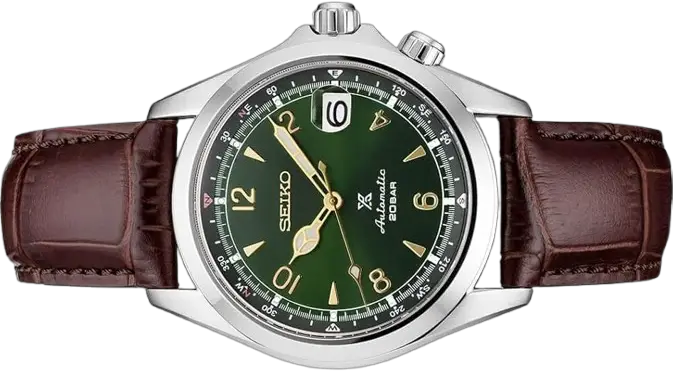
Its polished details, prominent Arabic numerals, distinctive hands and internal compass scale give the Alpinist a personality that is immediately recognizable.
Adding GMT functionality therefore makes a surprising amount of sense. The Alpinist has always been associated with exploration, travel and outdoor adventure. A second time-zone complication simply extends that philosophy beyond the mountains.
The History Behind the Seiko Alpinist
The Alpinist story stretches back to 1959, when Seiko introduced the Laurel Alpinist. The watch was developed with outdoor enthusiasts and mountain climbers in mind.
Early versions emphasized reliability and legibility, but the family eventually evolved into something more distinctive.
Modern Alpinist watches combine serious sports-watch specifications with polished styling that makes them considerably more versatile than many purpose-built outdoor watches.
The internal compass bezel became one of the family’s defining characteristics. Combined with the unusual handset and distinctive dial layout, it created an aesthetic that enthusiasts could identify immediately.
Models such as the famous green SARB017 helped transform the Alpinist into an enthusiast favorite. Later generations brought the collection into Seiko’s Prospex family while introducing updated movements, sapphire crystals and improved specifications.
Why a GMT Complication Makes Sense
A GMT watch allows the wearer to monitor another time zone in addition to regular local time.
On the Alpinist GMT, Seiko adds a prominent red-tipped GMT hand that completes one rotation every 24 hours.
The additional hand works with the engraved 24-hour scale surrounding the dial.
Travelers can use the normal hour and minute hands for local time while keeping the GMT hand synchronized with their home time.
People working with customers or offices internationally can also use the additional hand to monitor another region without constantly calculating the time difference.
Seiko Alpinist GMT Case and Dimensions
One of the strongest features of both watches is the relatively compact case.
The stainless-steel case measures approximately 39.5mm in diameter and 46.4mm from lug to lug.
Thickness is approximately 13.6mm. That is noticeable, but reasonable for an automatic GMT offering 200 meters of water resistance.
Sapphire Crystal
Both Alpinist GMT models use a curved sapphire crystal. Sapphire provides significantly better scratch resistance than the mineral crystals commonly used on less expensive watches.
An anti-reflective coating is applied to the inner surface to improve visibility.
200-Meter Water Resistance
The 200-meter rating is another important advantage. It provides considerably more protection than most traditional dress watches and supports the Alpinist’s adventure-watch positioning.
Seiko Alpinist GMT Dial and Compass Bezel
The SPB377 and SPB379 share the same basic dial architecture, but their different colors give them noticeably different personalities.
The SPB377 features a blue sunray dial that can appear dark navy in some lighting conditions and considerably brighter blue under direct light.
Interested in the Blue SPB377?
Check current Amazon listings for the Seiko Alpinist GMT SPB377.
The SPB379 uses a black dial and takes the watch in a more traditional tool-watch direction.
The black background also creates excellent contrast with the red-tipped GMT hand.
The Red GMT Hand
The red-tipped GMT hand provides an effective visual contrast without overpowering the regular hour and minute hands.
Its arrow-shaped tip points toward the engraved 24-hour scale, allowing the second time zone to be read quickly.
Internal Compass Scale
The rotating internal compass scale remains an important part of the Alpinist identity.
A secondary crown controls the compass ring while the main crown handles the movement and time-setting functions.
Seiko 6R54 GMT Movement
Inside both references is Seiko’s automatic Caliber 6R54.
The movement contains 24 jewels, operates at 21,600 vibrations per hour and provides approximately 72 hours of power reserve.
That three-day reserve is particularly useful for an everyday mechanical watch. Depending on how fully wound it is, you can remove the watch for much of a weekend without immediately needing to reset it.
GMT Note: The 6R54 provides an independently adjustable 24-hour GMT hand rather than an independently jumping local-hour hand.
This configuration is commonly referred to by watch enthusiasts as an office or caller GMT.
It works particularly well for people who primarily want to monitor a second location.
A travel or flyer GMT instead allows the regular local hour hand to jump independently. Frequent international travelers sometimes prefer that configuration because local time can be adjusted more quickly after landing.
Leather Strap and Everyday Wear
Both watches arrive on leather straps. The blue SPB377 receives matching blue leather, while the SPB379 uses black.
Leather gives the watches a slightly more refined personality than rubber or fabric.
The 20mm lug width is particularly useful because it is one of the most common replacement strap sizes.
Owners can easily move from leather to sailcloth, NATO-style fabric, rubber or an aftermarket bracelet.
Seiko SPB377 vs SPB379: Which Should You Buy?
Mechanically, the two watches are essentially the same. Your decision therefore comes primarily down to appearance.
Choose the SPB377 If…
Choose the SPB377 if you want a more visually distinctive Alpinist. Its blue sunray dial changes dramatically under different lighting conditions and provides a slightly dressier personality.
Choose the SPB379 If…
Choose the SPB379 if versatility matters more. Black works with almost any strap color and reinforces the rugged side of the Alpinist design.
SPB377 Blue
Blue sunray dial, matching blue leather and a more colorful personality.
Check Price on Amazon
SPB379 Black
Classic black styling with a stronger expedition-watch appearance.
Check Price on AmazonIs the Seiko Alpinist GMT a Good Everyday Watch?
The Alpinist GMT works particularly well as an everyday watch because Seiko has kept its dimensions relatively manageable.
Many automatic GMT watches are large. At 39.5mm, the Alpinist GMT offers enough wrist presence without becoming excessively oversized.
Sapphire crystal, 200-meter water resistance and the protective case coating also make it considerably easier to wear regularly.
At the same time, the polished details and leather strap allow it to work with smarter clothing more successfully than many dedicated sports watches.
Seiko Alpinist GMT Pros and Cons
Pros
- Excellent 39.5mm case size
- Compact 46.4mm lug-to-lug
- Mechanical GMT functionality
- Approximately 72-hour power reserve
- 200-meter water resistance
- Sapphire crystal
- Internal rotating compass scale
- Distinctive Alpinist styling
- Versatile 20mm lug width
- Blue and black dial choices
Cons
- More expensive than entry-level Seiko GMT models
- No steel bracelet included
- 13.6mm thickness may feel substantial on smaller wrists
- Office GMT rather than jumping local-hour GMT
- Dial design may be too busy for minimalists
Seiko Alpinist GMT Price and Value
Both the SPB377 and SPB379 have an official U.S. list price of approximately $1,150.
That positions the watches considerably above Seiko’s entry-level automatic GMT offerings.
However, the package includes a sapphire crystal, 200-meter water resistance, Seiko’s 6R-series movement, an internal compass bezel, strong case finishing and the established Alpinist design.
If your only goal is finding the least expensive automatic GMT, there are cheaper choices.
If you specifically want the Alpinist’s combination of heritage, compact dimensions, outdoor capability and GMT functionality, these models become considerably more compelling.
Check Current Seiko Alpinist GMT Prices
Amazon prices and availability can change. Always confirm the exact reference number before purchasing.
Seiko Alpinist GMT Review: Final Verdict
One of the strongest aspects of the SPB377 and SPB379 is that they still look unmistakably like Seiko Alpinist watches.
The GMT hand and 24-hour scale add functionality without removing the compass bezel, distinctive hands or recognizable dial design.
The result is a mechanical watch capable of handling international travel, outdoor adventures and everyday office wear without looking dramatically out of place in any of those environments.
The SPB377 is the model to consider if you want something with more visual impact. Its blue sunray dial emphasizes the watch’s polished details and can look dramatically different depending on the light.
The SPB379 is arguably the more versatile long-term choice. Its black dial works with almost anything and makes experimenting with different 20mm straps particularly easy.
Neither model is the cheapest way to purchase a mechanical GMT. Instead, their appeal comes from combining genuine GMT functionality with one of Seiko’s most recognizable designs.
Seiko Alpinist GMT FAQ
What movement does the Seiko Alpinist GMT use?
Both the SPB377 and SPB379 use Seiko’s automatic Caliber 6R54 GMT movement with approximately 72 hours of power reserve.
Is the Seiko Alpinist GMT a true GMT?
The watch displays a genuine additional 24-hour time zone. However, the independently adjustable hand is the GMT hand rather than the local hour hand, a configuration commonly called an office GMT.
How big is the Seiko Alpinist GMT?
The watch measures approximately 39.5mm in diameter, 13.6mm thick and 46.4mm from lug to lug.
Is the Seiko Alpinist GMT water resistant?
Yes. Both the SPB377 and SPB379 are rated to 200 meters or 20 bar of water resistance.
Does the Seiko Alpinist GMT use sapphire crystal?
Yes. Both models use curved sapphire crystal with an anti-reflective coating on the inner surface.
What is the difference between SPB377 and SPB379?
The main difference is color. The SPB377 has a blue sunray dial and blue leather strap, while the SPB379 uses a black dial and black leather strap. Their major technical specifications are essentially the same.
What strap size does the Seiko Alpinist GMT use?
Both references use a 20mm lug width, making replacement leather, rubber, fabric and aftermarket bracelet options widely available.
How long is the Seiko Alpinist GMT power reserve?
The Caliber 6R54 provides approximately 72 hours, or about three days, of power reserve when fully wound.
Is the Seiko Alpinist GMT worth buying?
It is particularly compelling for buyers who want a relatively compact mechanical GMT with 200-meter water resistance, sapphire crystal and the distinctive styling of the Seiko Alpinist family.