Switching to an induction cooktop can make some older pots and pans unusable. The cookware needs a magnetic, induction-compatible exterior. A good stainless steel induction cookware set can provide durability, even heating and years of everyday use without relying on a nonstick cooking surface.
This 2026 guide focuses on genuine stainless steel options for induction cooking, including value-oriented tri-ply sets from Tramontina, Cuisinart and T-fal.
Affiliate disclosure: This article contains Amazon affiliate links. If you make a qualifying purchase through one of these links, we may earn a commission at no additional cost to you. Prices and availability can change, so confirm the current Amazon listing before ordering.
Why Choose Stainless Steel Cookware for Induction?
Stainless steel is a strong choice for cooks who want durable cookware that can move between different types of stovetops. However, stainless steel by itself is not automatically induction compatible. The outside layer or base must contain a magnetic material that works with an induction cooktop.
- Durability: Quality stainless steel resists scratching, chipping and everyday wear.
- Induction compatibility: A magnetic stainless exterior or induction-ready base allows the pan to work with induction.
- No nonstick coating required: Uncoated stainless steel gives you a traditional metal cooking surface.
- Better heat distribution: Tri-ply cookware commonly combines stainless steel with an aluminum core to spread heat more evenly.
- Versatility: Many induction-ready stainless sets also work on gas, electric and ceramic cooktops.
What to Look for in a Stainless Steel Induction Cookware Set
| Feature | Why It Matters | What to Look For |
|---|---|---|
| Induction-ready base | Induction requires magnetic cookware. | Manufacturer explicitly states induction compatibility. |
| Construction | Better construction can reduce hot spots. | Tri-ply, fully clad or a substantial bonded base. |
| Useful pieces | A large piece count is not useful if you never use half the set. | Frying pans, saucepans, sauté pan or Dutch oven, stockpot and lids. |
| Handles | Secure handling matters with heavier stainless cookware. | Comfortable, securely riveted handles. |
| Oven rating | Useful for recipes that start on the stove and finish in the oven. | Check both cookware and lid temperature limits. |
| Warranty | Cookware is a long-term purchase. | Review the current manufacturer’s warranty before buying. |
Best Affordable Stainless Steel Induction Cookware Sets for 2026
1. Tramontina Signature Tri-Ply Clad Stainless Steel 12-Piece Set

Tramontina is a strong choice for shoppers who want to step up from thin budget cookware without moving into the highest premium price tier. Its Signature 12-piece set uses tri-ply clad construction with an aluminum core and a magnetic stainless steel exterior designed for induction cooking.
- 12-piece stainless steel cookware collection.
- Tri-ply clad construction for more even heat distribution.
- Magnetic stainless steel exterior for induction compatibility.
- Includes frying pans, saucepans, a sauté pan, stockpot and matching lids.
- A good fit for buyers prioritizing long-term stainless steel construction.
Best for: Home cooks who want a well-rounded stainless steel induction cookware set with a balance of performance and value.
Check Tramontina on Amazon →2. Cuisinart MultiClad Pro Triple Ply Stainless Steel 12-Piece Set
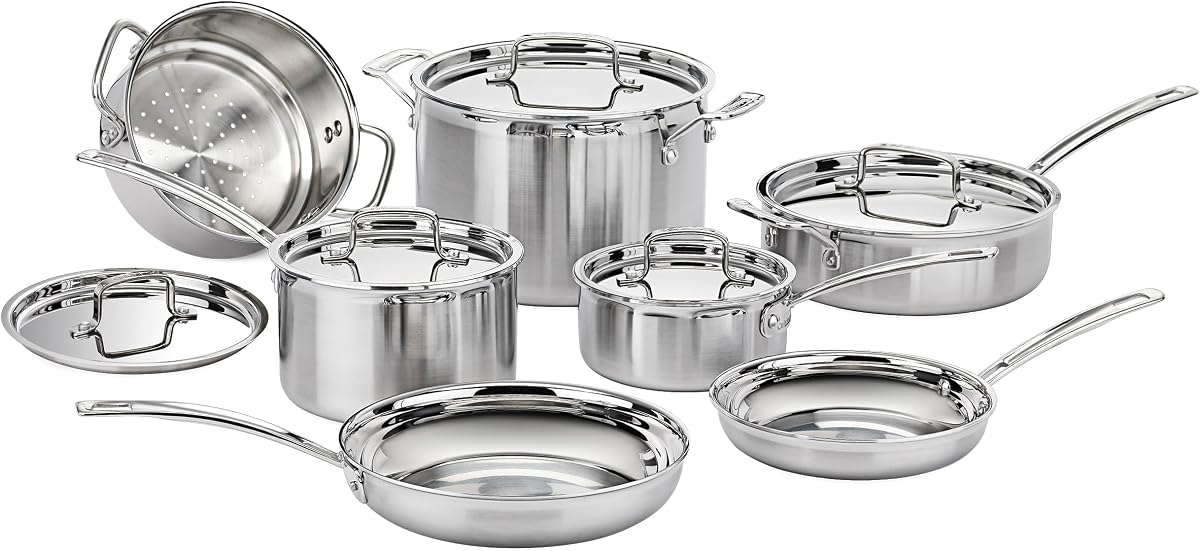
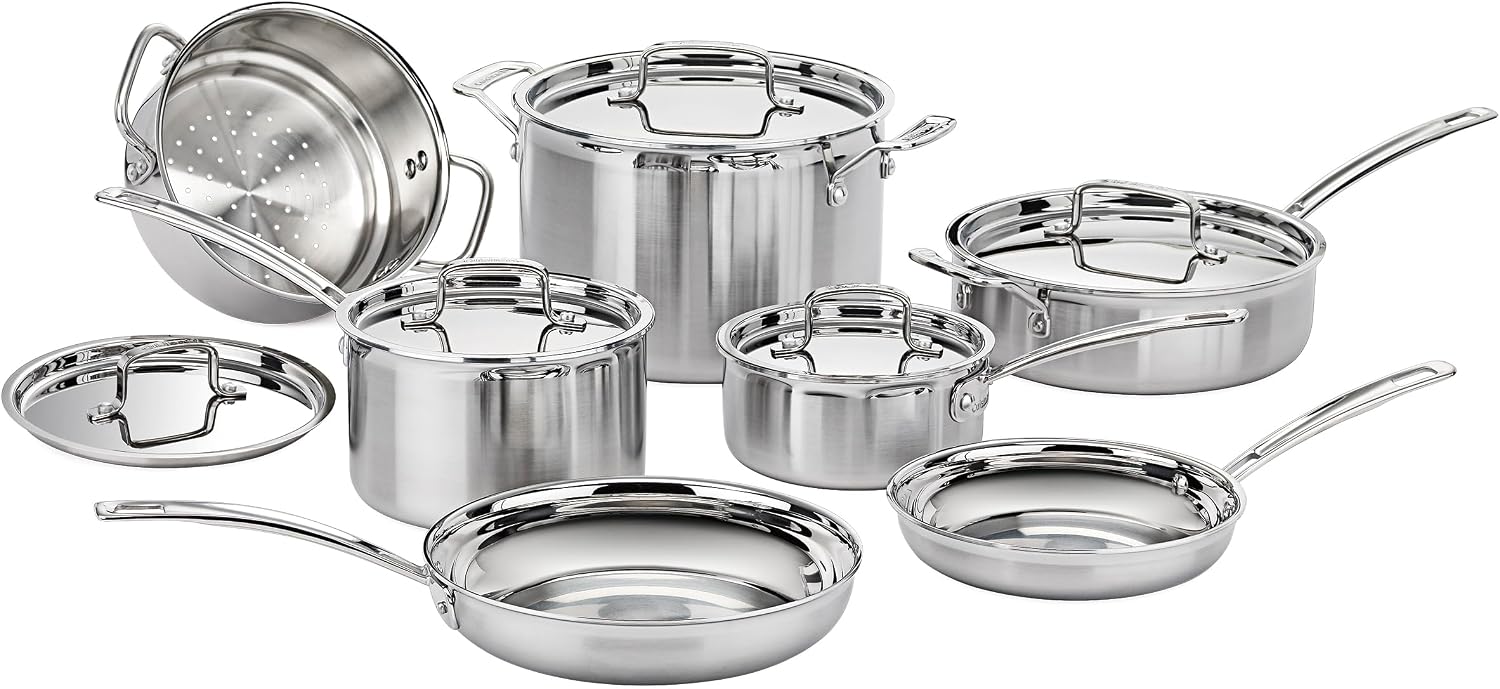
Cuisinart’s MultiClad Pro is another practical option for induction users. The 12-piece MCPS-12N set uses triple-ply construction with an aluminum core, stainless steel cooking surfaces and an induction-compatible exterior.
- 12-piece set with saucepans, sauté pan, stockpot, skillets, lids and steamer insert.
- Triple-ply construction designed to distribute heat through the base and sidewalls.
- Compatible with induction, electric and gas cooktops.
- Stainless steel cooking surface rather than a conventional nonstick coating.
- Oven-safe design; always confirm the current listing and care instructions before use.
Best for: Buyers who want a widely established stainless cookware line with a useful mix of everyday pieces.
Check Cuisinart on Amazon →3. T-fal Ultimate Stainless Steel Copper-Bottom 13-Piece Set

This T-fal set is a useful alternative for shoppers who want stainless steel cookware with a multi-layer base. It combines stainless steel with conductive metals in the base and is sold as compatible with induction cooking.
- 13-piece stainless steel cookware set.
- Multi-layer base designed to spread heat across the cooking surface.
- Includes frying pans, saucepans, a Dutch oven, steamer and lids.
- Compatible with induction and other common stovetop types.
- Useful for buyers who prefer a larger set with a broad mix of pieces.
Best for: Shoppers who want a larger stainless steel induction cookware collection and prefer T-fal.
Check T-fal on Amazon →Quick Comparison
| Set | Construction | Pieces | Best For |
|---|---|---|---|
| Tramontina Signature Tri-Ply | Tri-ply clad stainless + aluminum core | 12 | Best overall balance |
| Cuisinart MultiClad Pro | Triple-ply stainless + aluminum core | 12 | Established all-purpose choice |
| T-fal Ultimate Stainless Steel | Stainless steel with multi-layer base | 13 | Larger all-purpose set |
Stainless Steel vs. Nonstick Induction Cookware
The original version of this guide mixed stainless steel cookware with Kitchen Academy nonstick sets. Those products can be useful induction cookware, but they do not closely match the search intent behind stainless steel induction cookware set. This update focuses the main recommendations on stainless steel cookware instead.
Choose stainless steel if durability, browning, searing and an uncoated cooking surface are priorities. Choose nonstick when easy release for delicate foods is more important. Many kitchens use both rather than expecting one cookware material to handle every job.
How to Cook With Stainless Steel on Induction
Induction responds quickly, so high heat is rarely necessary for routine cooking. Start with low to medium heat and give the pan time to preheat. Add oil after the pan is warm, then add food. For proteins, allow a crust to form before trying to move the food. It will often release more easily once browning has developed.
For cleanup, let the pan cool before washing it. Warm soapy water handles routine residue. For stubborn discoloration or stuck-on food, follow the manufacturer’s cleaning instructions for that specific cookware line.
How Induction Cooking Works With Stainless Steel
An induction cooktop does not heat cookware in the same way as a traditional electric coil. It creates an electromagnetic field that interacts with magnetic cookware. That is why the words stainless steel on a box do not automatically guarantee compatibility. Some stainless alloys are not sufficiently magnetic, while induction-ready cookware uses a magnetic exterior layer or bonded base.
This distinction matters when you shop online. Instead of assuming that every stainless steel pot will work, look for an induction symbol or an explicit statement from the manufacturer. A household magnet is also useful when checking cookware you already own. If it sticks strongly to the bottom, the pan may be compatible, although the manufacturer’s specifications remain the better authority.
Induction also changes the cooking experience. The cooktop can respond quickly when you raise or lower the power. With a well-constructed pan, this gives you useful temperature control for simmering sauces, sautéing vegetables and searing proteins. It also means that you usually do not need to begin every recipe at maximum power.
Tri-Ply vs. 5-Ply Stainless Steel Cookware
One of the most common questions when comparing a stainless steel induction cookware set is whether more layers automatically mean better cookware. The answer is no. Construction quality, thickness, pan geometry and how well the layers are bonded can matter as much as the advertised layer count.
What is tri-ply cookware?
Tri-ply generally refers to three bonded layers. A common design places an aluminum core between stainless steel layers. Stainless steel provides the durable cooking and exterior surfaces, while aluminum conducts heat more efficiently. Fully clad tri-ply construction extends those bonded layers up the sides of the cookware rather than limiting the conductive material to a disc on the bottom.
What is 5-ply cookware?
Five-ply cookware uses five bonded layers, often combining stainless steel with one or more conductive metals. A well-designed 5-ply pan can provide excellent heat distribution and thermal stability, but it can also be heavier and more expensive. The extra layers alone do not guarantee that it will outperform a good tri-ply pan in your kitchen.
For buyers focused on affordability, quality tri-ply cookware is often the practical sweet spot. It can deliver even heating and a durable stainless surface without pushing the set into premium pricing simply to increase the layer count.
What Does 18/10 Stainless Steel Mean?
You may see cookware marketed as 18/10 stainless steel. The numbers refer to the approximate chromium and nickel content of the stainless alloy. This type of stainless steel is widely used for cookware because it offers corrosion resistance and a smooth, durable finish.
However, the interior cooking surface and the induction-compatible exterior do not necessarily use the same stainless alloy. For example, a clad pan can use a corrosion-resistant stainless cooking surface, an aluminum core for heat conduction and a magnetic stainless exterior for induction compatibility. That layered approach is one reason clad cookware can combine several useful properties in one pan.
Fully Clad vs. Disc-Bottom Cookware
Affordable induction cookware generally uses one of two approaches. Fully clad cookware bonds the conductive layers through the bottom and sidewalls. Disc-bottom cookware attaches a conductive, induction-compatible plate primarily to the base.
A bonded base can be perfectly adequate for boiling pasta, making soup or preparing other everyday meals. Fully clad construction becomes more attractive when you care about heat spreading through the sides of a skillet or sauté pan. It can also make temperature changes feel more consistent across a larger cooking surface.
Do not reject a cookware set simply because it uses a bonded base. Instead, match the construction to the food you cook and the amount you want to spend. A well-made set with the right pan sizes is more useful than an expensive set filled with pieces you rarely touch.
What Pieces Do You Actually Need?
Cookware companies often advertise large piece counts, but lids are normally counted as individual pieces. A 12-piece set does not necessarily contain 12 pots and pans. Before buying, read the complete set composition and decide whether those sizes fit your cooking habits.
- 8- to 10-inch frying pan: useful for eggs, vegetables, smaller portions and reheating.
- 10- to 12-inch frying pan: better for family portions, browning meat and one-pan meals.
- 1.5- to 2-quart saucepan: practical for sauces, grains and smaller servings.
- 3-quart saucepan: gives you more room for pasta, vegetables and larger side dishes.
- Sauté pan: its straight sides make it useful for braising, shallow frying and saucy dishes.
- Stockpot or Dutch oven: handles soup, pasta water, beans, stews and batch cooking.
For a first kitchen, a carefully selected 8- to 12-piece set is often enough. If you already own several good pans, buying individual pieces may make more financial sense than replacing everything at once.
How to Keep Food From Sticking to Stainless Steel
Stainless steel does not behave like a coated nonstick pan. That does not mean every meal has to stick. Technique makes a significant difference.
Begin by preheating the pan gradually over low or medium heat. Once the pan is warm, add an appropriate amount of cooking fat and let it heat briefly before adding food. Very cold or wet ingredients can lower the surface temperature quickly, so patting proteins dry can help when you want browning.
After placing meat in the pan, avoid forcing it loose immediately. As a crust develops, many foods naturally release more easily. If the food is firmly attached, it may simply need more time. This approach can improve browning while leaving flavorful fond in the pan for a sauce.
Eggs and delicate fish require more practice because they are less forgiving. If those foods are a major part of your routine, keeping one small nonstick or well-seasoned pan alongside your stainless cookware can be more practical than expecting one surface to excel at every task.
Common Stainless Steel Cookware Mistakes
- Using maximum induction power for everything: induction can heat quickly. Moderate settings are enough for many recipes.
- Adding food to a cold pan: proper preheating can improve browning and release.
- Overcrowding: too much food traps steam and makes browning more difficult.
- Adding salt to cold water and leaving it undissolved: some manufacturers recommend adding salt after water reaches a boil to reduce the chance of pitting.
- Thermal shock: placing a very hot pan directly into cold water can stress cookware. Let it cool first.
- Assuming every lid has the same oven rating as the pan: glass lids can have a lower temperature limit.
How to Clean Stainless Steel Cookware
For normal cleanup, allow the cookware to cool and wash it with warm water, dish soap and a non-abrasive sponge. Drying it soon after washing can reduce water spots.
For stuck-on food, add warm soapy water and let the pan soak before scrubbing gently. A nylon cleaning pad can help with tougher residue when the manufacturer’s instructions permit it. Stainless steel can also develop rainbow-like heat tint or cloudy mineral marks. These cosmetic changes do not necessarily mean the cookware is damaged.
Always follow the care instructions for the exact model you buy. Dishwasher-safe does not mean handwashing has no benefit; gentler cleaning can help preserve the appearance of polished cookware.
Stainless Steel Cookware Pros and Cons
| Advantages | Trade-Offs |
|---|---|
| Durable cooking surface | Requires more technique than conventional nonstick cookware |
| Excellent for browning and searing | Quality clad sets can cost more upfront |
| No conventional nonstick coating | Food can stick when temperature and oil are poorly managed |
| Many sets are oven and dishwasher compatible | Clad stainless cookware can be relatively heavy |
| Induction-ready models can work across multiple cooktops | Not every stainless steel pan is induction compatible |
Who Should Buy an Induction Stainless Steel Set?
A complete set makes the most sense for someone moving to induction, furnishing a first kitchen or replacing several worn pieces at the same time. It is also appealing if you want matching cookware with similar handles, lids and care requirements.
You may be better off buying individual pans if you already have a good stockpot, rarely use saucepans or prefer mixing specialized cookware. For example, some cooks use stainless steel for sautéing and searing, cast iron for high-heat cooking and a small nonstick skillet for eggs.
How We Evaluated These Cookware Sets
For this update, we prioritized characteristics that directly match the article’s search intent: a stainless steel cooking surface, stated induction compatibility, useful set composition, bonded or clad construction, manufacturer-supported specifications and reasonable positioning for shoppers seeking value.
We also removed the old monthly Amazon sales claims because those figures can change quickly. A product should not remain our recommendation merely because a marketplace displayed a temporary “bought in past month” number. Construction, compatibility and practical usefulness are more durable criteria for comparing cookware.
Frequently Asked Questions
Does all stainless steel cookware work on induction?
No. Induction requires a magnetic base or exterior. Look for an induction-compatible symbol or a clear statement from the manufacturer.
Is tri-ply worth it for induction cooking?
For many buyers, yes. Tri-ply construction typically places an aluminum core between stainless steel layers. That design helps distribute heat while retaining a durable stainless cooking surface.
What is the best affordable stainless steel induction cookware set?
For this 2026 comparison, Tramontina’s Signature Tri-Ply 12-piece set offers the strongest overall balance of useful pieces, induction compatibility and clad construction. Cuisinart MultiClad Pro and T-fal Pro Tri-Ply are also strong alternatives depending on your preferred set composition and current price.
Should I buy the set with the most pieces?
Not necessarily. Count the pots and pans you will actually use. Some large sets increase the advertised piece count with lids, utensils and accessories. A smaller set with the right pan sizes can be a better value.
Can I use stainless steel induction cookware on a gas stove?
Usually yes when the manufacturer lists compatibility with gas as well as induction. The featured cookware is sold as compatible with induction and other common cooktop types, which can be useful if you move or replace your stove later.
Is stainless steel cookware naturally nonstick?
No. Uncoated stainless steel is not a conventional nonstick surface. Proper preheating, temperature control and cooking fat can improve food release, but the cooking experience remains different from PTFE- or ceramic-coated cookware.
Is heavier stainless steel cookware better?
Weight can indicate more substantial construction, but heavier is not automatically better. The pan should feel stable without becoming uncomfortable to lift when it contains food. Construction quality and heat distribution matter more than weight alone.
Can stainless steel cookware go in the dishwasher?
Many modern stainless steel sets are dishwasher-safe, although care instructions vary by manufacturer and model. Still, check the instructions for your exact model, especially for lids and polished finishes.
How long can a stainless steel cookware set last?
There is no universal lifespan, but quality stainless steel cookware can remain useful for many years when it is not badly warped or physically damaged. Unlike a coated pan, there is no conventional nonstick layer that must retain its release properties for the cookware to function.
Final Verdict
If you want an affordable stainless steel induction cookware set in 2026, start by comparing construction and useful pan sizes rather than choosing only by piece count. Tramontina is our best overall value pick, Cuisinart is an established alternative, and T-fal offers a larger multi-layer stainless steel alternative.
Because Amazon pricing changes frequently, use the buttons above to check the current price and availability before purchasing.